Archive for January, 2010
 Posted in
Isn’t it amazing the way even some non-tech products have dropped in price?
 January 28th, 2010 |
  Author:
 We’re all used to the price of computers and electronic items generally dropping in price over the years but it happens to some surprising items outside that arena too.
One major example I spotted lately was the Encyclopedia Britannica. Way back in 1981 that cost £600 for the full set yet now you can pick up the 2007 equivalent for £450. Granted, that’s on an offer at the moment but even without that offer it’s still only £745 (although, oddly, the 2010 edition is only £712!). That gets you a LOT of books: the 32000 pages spread over 32 volumes add up to over four feet of shelf space and weigh in at over 60 kilos.
Yeah, I know, people tend to look towards DVD or online versions of these things these days and, yes, I know that the paper one will date a whole lot but I still quite like having the books sitting there to leaf through. Besides, in reality, knowledge doesn’t really date that quickly. Sure, the likes of the Haiti disaster won’t be in even the 2010 edition but then it’s not so much the immediate information that you want in an encyclopedia but the more historic stuff and that doesn’t change terribly quickly.
Now, if only I could find a corner in the house to fit them in…
Copyright © 2004-2014 by Foreign Perspectives. All rights reserved.Eeek… three assignments in the one week!
One of the problems in doing three separate Open University courses at once is that the timetables they run to are completely independent of one another.
Thus I find myself looking at the prospect of doing the End Course Assessment for the cardiology course, the third TMA for the human biology course and the first TMA of the astronomy course all in the same week. Fortunately, that week is the third week of March so at least I have the chance of spacing the assignments out over the next month and a bit. Not quite so much as I’d like to though as part of the cardiology assignment involves submitting an essay plan to the tutor sometime in February and the astronomy assignment requires some practical work to be in hand by then and with our weather that’s very much hit and miss.
What I’m still amazed at is how quickly I’m managing to get through the courses. All being well, I’m on schedule to finish the course text for the human biology course in the next week or so which should let me get going on the notes for that which’ll definitely be required come exam time in June. I finished all of the reading for the cardiology course before Christmas so it “only” has the end of course assessment to be done which looks fairly doable at the moment though I’ve not actually started on it yet so that opinion could change very easily. I’m getting through the astronomy reading quite well though I suspect that I’ll be needing to go over a few things again for the assignment as it’s proving to be a more difficult course than originally expected.
Interestingly, courtesy of the astronomy course I have been assigned a “pathway tutor” as part of the pilot project. What that means is that I will retain that tutor throughout the course of my physics degree with the OU. Previously, one of the consistent comments that they’d received was that all the courses were entirely independent which, whilst nice in some respects, meant that a lot of people felt a little at sea when they’d finished a course and weren’t always that sure what they should do next or for that matter how they should go about designing the perfect sequence of courses for them. In the past that planning assistance has come from the regional centres officially and a number of course forums inofficially. Neither are ideal. The official source involved people who didn’t always have the knowledge of what was entailed in particular subjects whilst the unofficial route produced advice that might have been intended to be helpful but wasn’t always as it couldn’t take into account the particular backgrounds of those enquiring nor did those replying have anything like the full picture of what was coming up in a particular degree programme anyway.
So far, it’s in typical OU style: it’s there if you want to use it but if you’ve your own ideas you’re free to ignore it.
Copyright © 2004-2014 by Foreign Perspectives. All rights reserved.Progressing too fast with the OU course?
Thanks to the Reader I find that I’m getting much more time to read the text books than I ever had previously. It might be only 10 minutes whilst wandering around a supermarket, 20 minutes waiting for James & John to finish their class, or even just 5 minutes when I’m a little too early for them at school but it’s all been adding up.
Thus I find myself likely to be completing the biology texts by the end of the month which is getting on for four months early and when the course is officially 9 months that’s saying something. Even with the astronomy which I only started on at two weeks ago when I checked the timetable I’m at the point I should be at the end of February!
That’s not to say that I’ll have completed both of those courses because I still have the assignments to do and, of course, the exams to revise for. However, it looks like the summer will be much less busy than I had ever expected it to be this year.
One handy consequence of all this is that I should have quite a lot of time to make decent notes on the topics which I’ve rarely gotten around to in the past. All being well, I’ll be getting going on the biology notes (definitely required!) early in January. I might even consider the astronomy notes after that although so far most of the text has been largely revision from my astronomy readings many years ago.
Copyright © 2004-2014 by Foreign Perspectives. All rights reserved.Andrew Barrington Montgomery
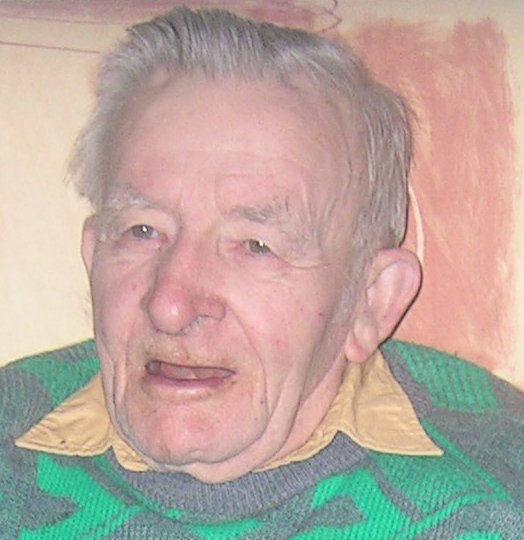 Andrew, the second son of my granny, was born in Killinchy on September 18th 1920. and almost made it to 90, dying just a few days ago on January 16th.
Growing up in the depression obviously limited the options open at the time but even so after starting off in the day school of McQuiston Memorial Presbyterian church in Belfast, he went on to Euston Street school and then to Belfast tech (now the Belfast Metropolitan College). By the time he’d passed through those the war had started and Andy joined the merchant navy rising in due course to the rank of Chief Petty Officer. During his time in the navy he was stationed in Jamaica and New York from whence he sent various momentos back home and picked up a number of medals along the way.
With the end of the war he joined Mackies which was one of the big engineering works of that era in Belfast. He remained there the rest of his working life. Following the death of his father in 1963, Andy cared for his mother through to the end of her life in 1988.
Although born in Killinchy, for the majority of his life Andy lived in the family home at 16 Lecumpher Street. When that was earmarked for redevelopment at the end of the 1990s, he was forced to move on to the Clarawood Estate where he spent a few brief years before moving into the Tudordale Nursing Home where he spent most of his final decade.
Andy was quite keen on cars and motor transport generally. Over the years that I knew him he managed to get around in a variety of them including a “mods” type scooter in the early 1960s and an Austin A40 (one of the tiniest cars you ever did see!) and latterly a Mini Metro. A number of these would never have passed a modern MOT and at one stage he ended up driving the A40 minus the floor of the car! Added to this was a keen interest in photography with quite a steady build-up of photographs over the years although perhaps his best photos were taken the time when he’d managed to forget to put a film in the camera!
Whilst he’d travelled the world with the navy, afterwards Andy limited himself to Northern Ireland and specifically Killinchy where he spent the summer months in a cottage rented by the family for over 30 years. From that base he went on numerous day trips with his favourite destination being the reservoir at Silent Valley and the Mourne area generally. In his latter years though he found that the travelling became too much and gradually the trips became shorter and in his final decade he never travelled more than a few miles from the nursing home.
There’s no mention here of surviving children because Andy never did get around to having a family. That’s perhaps the saddest thing about his death because though he loved children he never had any of his own. It does seem particularly sad to go to the funeral of someone like that: though there are probably more tears from any children when a mother or father dies at least there is a continuation whereas here that’s not the case.
Copyright © 2004-2014 by Foreign Perspectives. All rights reserved.Using the ebook reader: one month on
It’s been almost a month since I started using the ebook reader so I’m really getting settled into using it now.
Although it’s “only” got 1/2 GB of memory that’s proved not to be any kind of restriction at all. Frankly, I doubt that I’ll ever fill it with books that I’m actually going to read. The manual says that it’ll hold 350 books but I suspect that it’ll be more in reality for me (the number depends on the length of the book and if it’s illustrated). Although 1/2GB doesn’t sound like much in computer terms it’s an awful lot of books. To give you some idea of just how many books you’re really talking about, consider that the library in our son’s school has “only” 10,000 (about 14GB) and in terms of footage that 1/2GB is equivalent to roughly 7 shelves of books each 5 foot long.
Actually those stats make for some sad reading in some ways because I suspect that once these readers drop some more in price the day can’t be long off when libraries will cease to exist, at least in their current form. Even now, if you get one of the connected readers you can buy books directly from the reader so in theory you have access to a library of millions of books regardless of how much memory your particular reader has.
What’s it like using it though? Well, one “problem” that I’ve encountered is that I find that I read more with it than when I’m reading the equivalent “real” book. That’s starting to become a slight problem in that I’m moving further ahead of the course schedule for both the human biology and the astronomy courses that I’m doing at the moment than I was planning to. Thus it seems likely that I will complete all of the reading for the biology course around the end of this month rather than the end of the following month as per my schedule. It’s also extremely useful for the astronomy course which has a whole bunch of books amounting to a couple of inches thick in total which I can flick between as necessary, something that I just wouldn’t have done with the paper books.
Although in an ideal world I’d have a screen on the reader about A5 size rather than the A6 size that I currently have, that’s really only because of the diagrams that are in my textbooks. They are readable on the A6 screen but barely. Having said that, with an A5 size reader I wouldn’t be carrying it around all the time so I’d not get as much reading done.
Colour would definitely be nice for the textbooks and that’ll come in a few years time I expect but normal books are in black and white anyway so I suspect that colour isn’t really a big deal for many people using the readers at the moment.
Availability of books hasn’t been an issue for me as yet though there seem to be a lot of ebooks available these days and the number will only increase over time. There are loads of classics available free too although if you’re really keen you can buy these too (they’re the ones sitting at the lower end of the price range usually). In practical terms, you can get a fairly sizeable chunk of ex-copyright (ie older than 75 years) books ranging from Shakespeare to the popular books of the 1930s (and some later ones too) free. That includes such things as the massive Webster dictionary of 1910, the Encyclopedia Britannica of the same vintage (though not called that for copyright reasons) and a whole bunch of stuff that sounds really impressive to have on your reader. Included amongst that is the “5 foot bookshelf” of classics which dates from the early 1900s and from whence I did my shelf calculations above.
If you’re flicking through the demo readers in the shop you might think that the slow screen refresh rate is just way too slow. However, it actually seems to work out at close to the speed at which you’d be able to turn a page in a normal book and it’s best to think of it in those terms. You might flick through computer screens fairly quickly but you don’t do that with books, do you? The only downside of that is that video obviously isn’t possible so science-fiction style animated books aren’t a runner with the current generation of readers but wait a few years and they’ll turn up.
One not so obvious point is that people don’t know what you’re reading. So, the OH has the impression that I’m constantly reading the textbooks which is good in some ways, although not so good in that she thinks I’m totally obsessed with the courses.
Definitely a very worthwhile thing to get.
Copyright © 2004-2014 by Foreign Perspectives. All rights reserved.

