Archive for the ‘France’ Category
 Posted in
Travelling jazz festival
 June 3rd, 2007 |
  Author:
 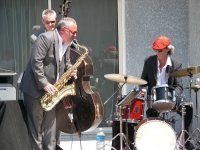 Jazz is particularly popular in the Perpignan area with the three week long Jazzebre starting on September 29th this year but in addition to that there are also numerous smaller scale jazz festivals throughout the year.
Today for instance Mas Camps winery hosted one stop on the route of the travelling jazz festival which is basically an upmarket pub crawl taking in a number of the local wineries during the day. The busload of participants are currently sampling the produce whilst the group heads on to set up again at the next winery on the route.
Fete de la Musique on June 21st is the next major music festival and is celebrated all over France.
Copyright © 2004-2014 by Foreign Perspectives. All rights reserved.Bastille Day in Paris
In France, it’s called “le quatorze juillet” but everywhere else it’s definitely Bastille Day on July the 14th.
This is the biggest celebration in France and, whilst it’s marked by processions everywhere in France, Paris is definitely the best place to see it.
The centre of Paris becomes a huge pedestrian zone over the course of the morning up until the parade is finished. The metro system usually isn’t fully operational either and the stations close to the route are closed in the run-up to the start of the parade around 10am. After the various roadblocks are removed, the traffic is much worse than normal (hard as that may be to believe if you’ve experienced the normal Paris traffic!). Therefore, to see the parade you’ll need to be staying somewhere within walking distance of the centre; it’s not too late to book a hotel and there’s also the option of one of the network of apartments, many of which are quite central (we stayed in the Citadine at Les Halles).
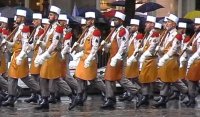 Unless you’re up very early, you’ll probably get a better view of the parade in one of the side streets rather than attempting to force your way through the massive crowds along the main parade going down the Champs-Elysee. You’ll miss seeing the president if you do this but realistically you’ve little chance to do that anyway as the best spots are taken up very early in the day. If you’re really set on seeing the president, the thing to do is to walk to the Elysee Palace just after the parade where you’ll see a continual stream of dignatories heading in for lunch.
 The evening sees the fireworks show based around the Eiffel Tower. The crowds here are massive but that doesn’t matter as by far the best way to get to the perfect spot is on one of the evening dinner cruises down the Seine. If you choose the second sitting, the boat arrives at the perfect spot just as the fireworks are starting. Although the prices obviously aren’t cheap, they are far from the astronomical level that you might expect on such a day and sailing down the Seine on the evening of Bastille Day is by far the most civilised way to end the day.
What about the Bastille itself? Well, the prison was demolished in 1789 by the revolutionary government and today Place de la Bastille is a massive roundabout.
Copyright © 2004-2014 by Foreign Perspectives. All rights reserved.Buying a house in France: Part 22: French administration
The French excel at administration. If there’s something that can be documented, it is required to be documented. Or, to put it another way, this section of the guide will be long.
We’ll be covering the more essential areas of French administration and will cover the areas of health, education, social security and tax of course but will also be touching on other areas such as employment in France, retirement and the like plus other aspects of French life such as the electricity company, mobile phones, TV, the electrical system and so on. We’ll also touch on a number of aspects of what to do about your life back home’ as these also impact on the administration that you will come across in France.
The number of abbreviations and terms in French administration is astronomical but don’t worry as we’ll define the terms required as we go along.
Finally, in this section of the guide, we’ll be moving further into the topic of how to settle in France although we will also cover the issues involved from the point of view of those who are buying a holiday home in France. For example, with a holiday home you deal with the health system in a totally different way from that if you are living in France.
To begin with, we’ll be starting with the most common sets of documents that you’ll be asked for: the ID card, Livre de Famille and proof of address.
Copyright © 2004-2014 by Foreign Perspectives. All rights reserved.What is it with the weather these days?
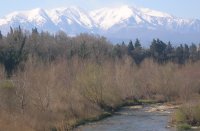 This is how the Canigou mountain is supposed to look from around late October through to around April ie lots of snow all over it.
I’d planned to take a photo of it with the flowering fruit trees in the foreground and snow covered mountain in the background for over a year now. Quite hard to do actually as there are usually only a few weeks in which you can take it each year and, of course, you can’t really depend on the weather being perfect for your photos.
In fact, it wasn’t possible to take this year simply because it hasn’t been snow covered since March last year. Ever since then, it’s been pretty much constantly t-shirt weather where we are and the montain has only been mainly snow covered for stretches of a few days at a time over the whole of that period.
Funnily enough, whilst it’s been t-shirt weather all that time, now that we’re heading into Summer, we’re getting the winds that we normally associate with February (when we didn’t get them) along with the rain and generally dull conditions that are more a Winter-time thing here.
Is the freakish weather an aspect of global warming? It’s much too early to say that of course but one thing that people forget is that a “global warming” doesn’t necessarily mean that everywhere gets warmer and in fact many places would experience unusual weather conditions due to the changing weather patterns that a global warming would bring.
Copyright © 2004-2014 by Foreign Perspectives. All rights reserved.Rennes le Chateau and the Da Vinci Code
 The Da Vinci Code books and films has placed a number of sights in the Pyrenees firmly on the tourist circuit.
Of these, by far the easiest to get to is the village of Rennes le Chateau which is about 15 minutes drive from Quillan on the Carcassonne road.
Not so long ago, there was one relatively small car park which would have held at most 20 cars yet when we went recently we found a stream of car park signs starting about a mile before the village. However, the main rush of tourists following the release of the film has now died down so even on a public holiday there weren’t the crowds that these car parks anticipate.
The principal Da Vinci sights are the church and the museum, both open every day but note that the church is only open three hours in the afternoons (free admission). In the church, the statue of the devil is just inside the door on your left. Although the “no flash photography” signs are largely ignored, you’ll find that your photographs turn out much better without it, just be sure to remember to bring along a small tripod to steady your camera. Around the church is the graveyard but the grave of the priest Sauniere isn’t among those and you’ll find his grave within the grounds of the museum.
 The museum (admission charge around EUR 5) is right beside the church and is housed in Sauniere’s former house and its grounds. Due to the terrain, these are often buffeted by winds so it’s best to visit on a calm day if you can arrange to do that.
Inside the house the rooms are arranged as a series of themes broadly based on those made famous by the Da Vinci Code book. Two of the rooms are setup as they were in his day and the small chapel is still there, of course. The view from the small castle ramparts is quite spectactular but easily missed as you enter via a conservatory which seems like the end of the tour. Amongst the exhibits are Sauniere’s original headstone (now replaced by a much more modern one) and the pillar in which he found the scrolls.
Stained glass was obviously pretty popular in the village and you’ll find examples of it in the house itself and several others around the town.
There’s a small but well stocked gift shop on the way to the church but don’t miss the larger shop just a few hundred yards further along on the road heading out of the village. The museum has a smaller selection than either of these.
This is part of our Pyrenees Guide.
Copyright © 2004-2014 by Foreign Perspectives. All rights reserved.

