Archive for the ‘France’ Category
 Posted in
What happens to the childrens’ English when you move to France?
 December 8th, 2006 |
  Author:
 The vast majority of people don’t seem to consider what will happen to their childrens’ English when they move to France. They seem to just assume that they’ll grow up bilingual without any effort. After all, they’ll learn English at home and French at school.
That’s not what actually happens though.
In practice, children end up speaking the English of about an 8 or 9 year old if they’ve moved here prior to that age. For those older (and this includes adults!), their English basically stops at the level it was when they moved to France.
Surely I can’t include adults in that statement? Well, yes. Think about it. If you’d moved here even 10 years ago, chances are you’d not know the English words for Internet, e-mail, Child Tax Credit, etc. So, yes, your English stops developing too.
Don’t forget the education that children here won’t get. If they move over between 11 and 18 then they won’t learn the English versions of all those words that they’d have picked up during their GCSE and A-levels. In fact, if they went to age 16 here and tried to move back to do A-levels, they would have a very restricted range of subjects that they’d be able to do. History? No chance: they’d be taught that Nelson was the enemy for instance. Geography: would they know that the Etats-Unis was America? English: no chance, naturally, as they’d have been taught English as a foreign language. In fact, apart from French, it’s doubtful if they would be able to do A-levels.
The effect is much more noticeable in younger children. Try talking to someone who was born here to English parents. Unless their parents have done something about it, chances are that you’d find it very difficult to speak to them. Such children are rarely fluent in English.
What can you do about it though?
Up to age 11 it’s fairly easy. Just get the likes of the Ladybird books and read to them and let them watch UK TV. That should keep them fairly much up with the English that they’d have spoken if they’d have remained in the UK.
Beyond that, it’s much harder. I suspect you’d need to send them to a bilingual school (note: international schools are quite different).
Anyway, something to think about. Most people don’t get as far as thinking about it so you’re way ahead already.
Copyright © 2004-2014 by Foreign Perspectives. All rights reserved.Fenouilledes Car Rally 2006 around Auberge Mas Camps
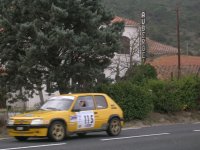
Rallying is pretty tiring, at least for us! Just one of the guests turned up in the afternoon and the rest arrived after midnight. Usually a late arrival means a late departure but as the next stage was due to start around 8.45am, the rally officials who checked-in around 1.30am had to leave around 7am.
The Fenouilledes car rally is a little odd in that the main roads aren’t closed so we often saw slow moving vans being followed by a posse of rally cars. The net effect of that was that as the normal road traffic reduces drastically after about 7pm, the night speeds of the cars were considerably higher.
Whereas they arrive at Mas Camps via a relatively small backroad on Saturday, the Sunday route takes them down the long straight directly in front of us as you can see so it’s not quite so easy to take a decent photo.
With the late night last night we’re glad that there’s nobody staying this evening so we can take it a little easier to recover.
Copyright © 2004-2014 by Foreign Perspectives. All rights reserved.Fenouilledes Car Rally 2006 from Auberge Mas Camps
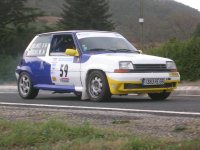 We’re actually fully booked by the organisers of the rally Association Sportive Automobile-Club du Roussillon (l’ASA-Roussillon) but so far only one couple has arrived as, I think, most of those who are staying with us are the support personnel for the rally so are presently at various points along the route.
The route today takes the cars along the back road past our main entrance where there’s a sharp bend just in front of the winery and one guy managed to wrap his car around the tree right at the end of the 1km or so straight a few years ago. Nothing so spectacular, so far, this year but it’s not a bad spot to take photos from all the same.
No results in as yet as we can still hear the cars roaring past our driveway.
Copyright © 2004-2014 by Foreign Perspectives. All rights reserved.Fenouilledes Car Rally 2006, Perpignan area
 This rally, organised by the Association Sportive Automobile-Club du Roussillon (l’ASA-Roussillon), takes place annually in the Fenouilledes to the west of Perpignan in the Pyrenees-Orientale and this year is over the weekend of November 25th 2006.
As usual with French events, all the publicity is in French and there’s little distribution of it outside the local area so it’s a great opportunity to see a good rally without the usual crowds.
This year the route of the Fenouilledes Car Rally starts on Saturday in Ille-sur-Tete, heads up into the mountains through Belesta and Pezilla where they loop round through Rasigueres, Panezes and Latour de France finally turning at Estagel and heading back over the hill to Millas and then towards Ille-sur-Tete. The Sunday route is similar but goes through Ansignan after Pezilla, descending into Maury before once again crossing the hill at Estagel towards Millas and finishing at Ille-sur-Tete. There’s a map of the route Fenouilledes Car Rally Map 2006 and some photos of the key points on the route at Key Points on Fenouilledes Car Rally 2006 with complete details of the stages at Stage Details for Fenouilledes Car Rally 2006 and the participants at Participants in Fenouilledes Car Rally 2006.
By co-incidence, Auberge Mas Camps is in one of the better places to watch the race and have been fully booked by the rally organisers, ASA-Roussillon.
All being well, I’ll get some decent photos for a later posting.
Copyright © 2004-2014 by Foreign Perspectives. All rights reserved.Americans on holiday abroad: the “Disney World effect”
One thing to bear in mind about American visitors is that, for the most part, they don’t go on holiday terribly often and, aside from the students and retired, the bulk of Americans only get two weeks holiday per year.This has a number of knock-on effects relating to their expectations of what foreign countries are like and, in the main, they expect them to be just like the Disney World version of the various countries.
The “Disney World effect” isn’t necessarily down to Disney World but rather a consequence of how the Americans see “abroad” through the eyes of the Disney parks, films, and occasional travel programmes (not forgetting that with only two weeks vacation time, the number of travel shows on American TV is correspondingly less than it is in Europe). Think of how a European would see America if their only experience was through films: everyone must eat McDonalds, you’re bound to get mugged and/or killed,…. Of course, we know that America isn’t really like that because we’ve been there or we know people who have been there and mainly they’ll have been there for a month long holiday, or indeed several of them.
So, just as in the Disney World version of France, everyone speaks english and accepts dollars. Except, of course, they don’t. Granted, I’m sure that there are very few Americans who arrive in France and expect everyone to accept dollars, but we’ve come across a number who were taken in by the American Express Travellers Check Card and had considerably difficulty in getting money whilst here. In America, just about everyone accepts Amex, which definitely isn’t the case around Europe. In fact, we’ve come across a number of Americans who were quite surprised to find that their credit and debit cards would work abroad and thought that they’d to get a special international use one.
Naturally, the two-week holiday time has a really major affect on how they go on vacation. For a start, all their holidays are effectively what would be called short-breaks in Europe and there’s a much greater concentration on packaged holidays which are in turn mainly a series of city-breaks. It’s therefore quite rare to see any Americans outside the cities and equally rare to see any travelling around outside an organised tour (DIY tours naturally take a little longer). This is another aspect of the Disney World effect where it’s possible to visit Europe in a day: it ain’t realistically possible to visit Europe in less than a month but you can visit individual countries inside the two-week period.
Then there are a whole bunch of assumptions that aren’t so obviously wrong if you’ve not travelled abroad before (and, for the most part, Americans don’t get further than Canada or Mexico). We beefed up our France FAQ in an attempt to address this but I’m sure that many things still need to be added. For instance, in the UK (which isn’t just England) and Ireland, they drive on the left, European electricity is 220V (not 110V) and uses a variety of plugs, American standard phone plugs don’t fit any European phone sockets,… One that we’d not thought about before yesterday was that air conditioning isn’t standard in hotels even in the south of France and even in those hotels that do have it, it’s usually not switched on outside the Summer period.
Apologies to those Americans who are well-travelled but the majority aren’t.
Copyright © 2004-2014 by Foreign Perspectives. All rights reserved.


