Archive for the ‘Places’ Category
 Posted in
Buying a house in France: Part 22: French administration
 June 1st, 2007 |
  Author:
 The French excel at administration. If there’s something that can be documented, it is required to be documented. Or, to put it another way, this section of the guide will be long.
We’ll be covering the more essential areas of French administration and will cover the areas of health, education, social security and tax of course but will also be touching on other areas such as employment in France, retirement and the like plus other aspects of French life such as the electricity company, mobile phones, TV, the electrical system and so on. We’ll also touch on a number of aspects of what to do about your life back home’ as these also impact on the administration that you will come across in France.
The number of abbreviations and terms in French administration is astronomical but don’t worry as we’ll define the terms required as we go along.
Finally, in this section of the guide, we’ll be moving further into the topic of how to settle in France although we will also cover the issues involved from the point of view of those who are buying a holiday home in France. For example, with a holiday home you deal with the health system in a totally different way from that if you are living in France.
To begin with, we’ll be starting with the most common sets of documents that you’ll be asked for: the ID card, Livre de Famille and proof of address.
Copyright © 2004-2014 by Foreign Perspectives. All rights reserved.What is it with the weather these days?
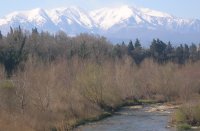 This is how the Canigou mountain is supposed to look from around late October through to around April ie lots of snow all over it.
I’d planned to take a photo of it with the flowering fruit trees in the foreground and snow covered mountain in the background for over a year now. Quite hard to do actually as there are usually only a few weeks in which you can take it each year and, of course, you can’t really depend on the weather being perfect for your photos.
In fact, it wasn’t possible to take this year simply because it hasn’t been snow covered since March last year. Ever since then, it’s been pretty much constantly t-shirt weather where we are and the montain has only been mainly snow covered for stretches of a few days at a time over the whole of that period.
Funnily enough, whilst it’s been t-shirt weather all that time, now that we’re heading into Summer, we’re getting the winds that we normally associate with February (when we didn’t get them) along with the rain and generally dull conditions that are more a Winter-time thing here.
Is the freakish weather an aspect of global warming? It’s much too early to say that of course but one thing that people forget is that a “global warming” doesn’t necessarily mean that everywhere gets warmer and in fact many places would experience unusual weather conditions due to the changing weather patterns that a global warming would bring.
Copyright © 2004-2014 by Foreign Perspectives. All rights reserved.Rennes le Chateau and the Da Vinci Code
 The Da Vinci Code books and films has placed a number of sights in the Pyrenees firmly on the tourist circuit.
Of these, by far the easiest to get to is the village of Rennes le Chateau which is about 15 minutes drive from Quillan on the Carcassonne road.
Not so long ago, there was one relatively small car park which would have held at most 20 cars yet when we went recently we found a stream of car park signs starting about a mile before the village. However, the main rush of tourists following the release of the film has now died down so even on a public holiday there weren’t the crowds that these car parks anticipate.
The principal Da Vinci sights are the church and the museum, both open every day but note that the church is only open three hours in the afternoons (free admission). In the church, the statue of the devil is just inside the door on your left. Although the “no flash photography” signs are largely ignored, you’ll find that your photographs turn out much better without it, just be sure to remember to bring along a small tripod to steady your camera. Around the church is the graveyard but the grave of the priest Sauniere isn’t among those and you’ll find his grave within the grounds of the museum.
 The museum (admission charge around EUR 5) is right beside the church and is housed in Sauniere’s former house and its grounds. Due to the terrain, these are often buffeted by winds so it’s best to visit on a calm day if you can arrange to do that.
Inside the house the rooms are arranged as a series of themes broadly based on those made famous by the Da Vinci Code book. Two of the rooms are setup as they were in his day and the small chapel is still there, of course. The view from the small castle ramparts is quite spectactular but easily missed as you enter via a conservatory which seems like the end of the tour. Amongst the exhibits are Sauniere’s original headstone (now replaced by a much more modern one) and the pillar in which he found the scrolls.
Stained glass was obviously pretty popular in the village and you’ll find examples of it in the house itself and several others around the town.
There’s a small but well stocked gift shop on the way to the church but don’t miss the larger shop just a few hundred yards further along on the road heading out of the village. The museum has a smaller selection than either of these.
This is part of our Pyrenees Guide.
Copyright © 2004-2014 by Foreign Perspectives. All rights reserved.The Hermitage of San Antoine and Gorges of Galamus
 When we first bought our place here, one of the things that we immediately recognised was that it was an area that wasn’t terribly well known outside France. Not because there wasn’t loads of stuff to see and things to do here but that it was an area of the south of France that was relatively difficult to get to. When we arrived, Ryanair had only been flying into Perpignan for a few years and the bridge on the A75 at Millau hadn’t been completed so it was more than a day of driving to reach here from Paris.
Anyway, we figured that it would be a good idea to build up a tourist guide to the region and that’s what became Pyrenees Themes which we created over the course of around two years travelling around the region.
Roll forward a bit and ’tis now high time that we started updating it which we’re making a start on by revisiting some old places and adding some new ones plus there’ll eventually be a whole lot more information about the various sites and sights that we get around during the update.
 As before, we’re starting with the closest places and working out, so we were off to the Hermitage of San Antoine over the weekend. This is an extremely popular location with a number of different activities. The hermitage itself is built right into the rockface as you can see with a small church built into a large cave along with several grottoes with some quite impressive carvings. There’s no entry charge.
You can reach the hermitage from the main car park (the first one you reach from St Paul) or continue on round the corner to the smaller car park which is much closer to the hermitage and leads you down a set of normal steps, through a short tunnel and into the hermitage. From the main car park, it’s a much longer walk along a poorly maintained path; the rocks are VERY slippery so watch your step on this route.
There’s even a gite d’etape as part of the complex (dorm style accommodation).
The Gorges de Galamus surround the hermitage and offer the chance to explore underground caves, walking trails and the like. One thing to avoid is the exit from the main carpark in the direction away from St Paul during busy days as it’s strictly one way for quite a distance and can be completely blocked with cars.
There’s a small gift shop in the main carpark which has quite a range of items but seems to keep fairly short hours. The much smaller gift shop cum café within the hermitage complex confines itself mainly to religous items.
A number of people have pointed this site out as the highlight of the places they’ve seen in the locality.
This is part of our guide to the Pyrenees.
Copyright © 2004-2014 by Foreign Perspectives. All rights reserved.We totalled the car!
 It was bound to happen sooner or later of course. French drivers driving tractors on a road where 100km/hour is sometimes far too slow for the people behind.
Anyway, we were tootling along this morning at quite a low speed as we’d just left the village, slowed down even more as there was oncoming traffic, moved out to overtake the tractor in front and, of course, he decided that was the time to turn (naturally without indicating that he was planning on doing it).
So we are sans voiture at the moment and likely to be so for a while I suspect if insurance claims move along at the usual pace of French administration.
Fortunately the insurance covers us for a replacement car so we’re picking up a rental car tomorrow afternoon.
Given the level of damage (both sides nicely smashed in, roof caved in, windscreen and side window broken, some wheels punctured and broken, plus it looks like the axle ain’t straight either), I think we’re talking write-off but we’ll know better after the assessor sees the car (possibly later today).
Copyright © 2004-2014 by Foreign Perspectives. All rights reserved.

