Archive for the ‘Places’ Category
 Posted in
Economical international commuting
 April 6th, 2007 |
  Author:
 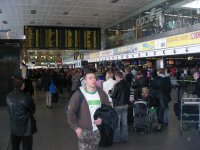 It feels like I’ve been commuting between Perpignan and Belfast over the last month or so with two trips already and a third looming.Since we have places to stay in both countries, it means that our timetable is quite flexible so I’ve spent a bit of time on SkyScanner checking out the cheapest prices and coming up with some slightly peculiar routes.
Belfast isn’t really that easy to get to from here so I usually end up flying into Dublin which has considerably more choice in terms of discount flights and seems to have lower departure taxes as well which drops the prices a little bit more. The only problem is the bus up which isn’t nearly as reliable as it used to be and on Fridays it’s quite common to have to wait for as much as three hours just to get a bus with any free seats. Of course, for me, Friday is often the day with the cheapest flights as most people are leaving Ireland for France/Spain on a long weekend therefore the flights from France/Spain that day are usually a good deal cheaper than for other days. Not that the airport seems any quieter on other days: that photo was taken on a Monday evening which was a pretty busy time as you can see.
Locally, we have a choice of four main airports though the closest (Perpignan) isn’t much use for me as it only flies to England so I’d need to get a connecting flight which makes it both too complicated and, usually, too expensive. Whilst Toulouse has, for me, the image of a large international airport it’s not really much better for me as it would also require connecting flights. That leaves me with Carcassonne and Girona which generally have one flight each per day to Dublin, usually, at a reasonable price. What complicates my life at this point is that the Carcassonne flight to Dublin is at a civilised time but the one back is generally at 9am which would require an overnight in Dublin coming back and therefore makes it too expensive. The Girona flight times are pretty much at the other end of the day with the flight to Dublin arriving around 11pm most of the time (though the schedule changes now and again and it sometimes arrives in the afternoon) and coming back around 9pm. So, generally, I end up flying out of Carcassonne and back to Girona.
What surprises me is that there still isn’t a website that lets you say something like “I’d like to fly out of an airport near A around X and back to an airport near B around Y”. At the moment, SkyScanner is the closest to that in letting you see the lowest flights between two particular airports but doesn’t let you say you’d like to fly from somewhere within X miles of a given town and return to an airport a similar distance from that town.
Although you might save a few pounds on the flight prices by varying the dates of your travel, don’t forget the swinging penalty charges applied if you’re just a few kilos overweight with your luggage. At the moment, you’ve a charge per bag of EUR 12 (return) if you declare the bag online, EUR 20 (return) if you don’t but just one kilo over the 15kg per person for checked luggage and you’re looking at EUR 8 per kilo. I’m not sure if it’s commonplace but none of our carryon baggage has been weighed on any recent trips so if you think you’re a little over on the checked luggage, it might be worth trying to squeeze the heavy items into your carryon baggage.
Copyright © 2004-2014 by Foreign Perspectives. All rights reserved.Ice Cream Vans as an indication of attitudes about the climate
 Although Northern Ireland is definitely cooler than the south of France, one surprising difference is that Northern Ireland has icecream vans at just about every possible location that you’d find crowds of people whereas France seems to have none of these.That’s indicative of quite a different attitude towards the climate in general between NI and France which we’ve seen illustrated numerous times whilst we’ve been here.
As soon as the temperature drops below around 30c over here, all the locals don their Winter coats. Not just any old Winter coat either for the coats on sale in the local shops seem more suited to Arctic conditions than the, usually, very mild Winters that we get here. Although it’s been warm enough for us to be running around in t-shirts almost all the time since March 2006 (yes, all year), the local population has been wearing their heavy coats since late September.
Perhaps the most noticeable difference that we’ve seen though is when our son was born here at the end of August. As you can imagine, it was pretty hot then (high 30s) and the maternity ward was even warmer than that. Now, I know that the rule is to wrap up babies after they’re born but with those kind of temperatures, we just put a nappy on him and nothing else. Yet, every time the nurses came into the room they insisted in wrapping him in three layers of clothing. Net effect? Well, if we’d stayed any longer he’d have been dehydrated as the sweat was just pouring out of him with all that clothing and he clearly wasn’t comfortable.
He’s still considerably behind in his vaccinations too because anytime that we’ve taken him along between roughly March and October they announce that he’s got a fever and can’t get the vaccination. Even outside that time, it’s often warm enough for him to “have a fever” so we’re lucky if we manage one vaccination per year.
So, whilst the icecream vans appear in Northern Ireland in March at perhaps 15c, you’d be unlikely to find anything similar below 25c over here.
Copyright © 2004-2014 by Foreign Perspectives. All rights reserved.Astronomy in the south of France: the moon with Venus
 I’ve always had a bit of an interest in astronomy but I’m a bit of a warm weather astronomer hence my interest in solar eclipses which are the one astronomical event which is pretty much guaranteed to occur when the temperature is well above freezing.
However, one advantage of being in the south of France now is that the nights are generally warmer and we’re also outside the city lights so have a much clearer sky. In fact, the sky is so much clearer that the moonlight is noticeably brighter in comparison and when there’s a full moon, you could almost read with the light outside.
Anyway, that’s to introduce an occasional series that I hope to do on the sights that we see in the night sky over here which, hopefully, will be illustrated with some images though I’m still trying to work out how to take night sky photos with the digital camera so bear with me.
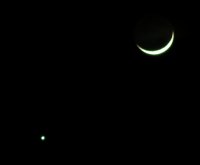
To begin with, here’s a nice photo of the crescent moon with the planet Venus taken in February.
Copyright © 2004-2014 by Foreign Perspectives. All rights reserved.
The Languedoc-Roussillon Region
 Just as France is huge, so too are some of the regions within it with the Languedoc-Roussillon area spanning a vast area stretching along the Mediterranean to Provence in the east.
Even we who should know better often think of “the Languedoc” as being countryside with a few hills yet we know that there are proper mountains less than an hour west of us (OK, not in the Languedoc). Similarly, we shouldn’t really expect to be surrounded by castles outside our own little corner of Languedoc-Roussillon. In fact, we’ve hardly explored the eastern edges of the region and have rarely passed Montpellier for that matter.
What’s quite striking is the difference in scenery that you get in travelling as little as 90 minutes from here. Last week, we had a little trip along the coast and came across the lovely Lake Saligou near Clermont L’Herault set in almost alpine scenery. I’m sure that it’s over-run with tourists in the Summer but we had the whole place pretty much to ourselves on a beautiful Spring afternoon.
This is part of our guide to the Pyrenees.
Copyright © 2004-2014 by Foreign Perspectives. All rights reserved.Buying a house in france: part 14: housing: your house in the UK
We’re looked at French housing, but what about your house in the UK?
Even if you are absolutely certain that you are going to spend the rest of your life in France, it’s best to retain your house in the UK if you can so that you have a fall-back position in case things don’t work out in France or you change your mind about living here. Not everyone is able to maintain houses in two countries of course and it will probably make finances a little tighter in France than they would otherwise be. However, once you sell your house in the UK you can find it very difficult to get back into the housing market. In our own case, our UK house went up over 40% in less than three years and effectively beyond our reach had we sold it when we moved.
If you are lucky enough to be able to keep it, you should try to rent it out. Not only will this keep the house occupied but it will help pay the mortgage etc. without needing to rely on income from France to pay for the various bills that will arise in the UK.
If you are going down the rental route, you will almost certainly need to change your mortgage to a buy to let one as few normal residential mortgages allow you to rent out your property easily. Your house insurance also needs to change to reflect the fact that you will have tenants in the house and that it may be unoccupied for extended periods of time between tenants (don’t rely on 100% occupancy!).
Although you could try to find tenants yourself, it’s much simpler to arrange the rentals through a letting agency as they can arrange for work to be done and to inspect the house before during and after each tenancy. This service usually costs around 10% of the rental income plus advertising costs of around 100 in advance of each tenancy.
Costs will continue during periods that you don’t have tenants. For instance, you are still liable for aspects of the electricity, gas and water bills. Throughout your ownership you also need to pay council tax / rates and, of course, insurance.
It’s difficult to be definitive about this decision. Keeping a house in the UK does entail a lot of costs from insurance to mortgage not to mention the additional effort that you need to put into managing your house (even if you have a letting agent). However, selling can be quite a permanent thing to do if you live in an area where prices move quickly and, to my mind, it’s best to retain your house as a fall-back should things in France not work out as you expect.
If you do decide that selling is the best option for you, it’s best to get this in motion before you leave the UK as otherwise you could find yourself liable for French capital gains tax on the proceeds of any sale.
Separately, but related to this topic, is the issue of maintaining a UK postal address. This is one thing that is definitely advantageous to do. If you can change the address for several credit cards to that of a friend or family member before you go, this will effectively move your credit history to their address which we have found to be very useful over the years.
Next week, we move onto French banking.
Copyright © 2004-2014 by Foreign Perspectives. All rights reserved.

