Archive for the ‘UK’ Category
 Posted in
The largest inland lake in the British Isles
 June 15th, 2007 |
  Author:
  As befits its status as the largest inland lake in the British Isles, Lough Neagh in Northern Ireland is host to numerous water activities in the tourist season.
What’s on offer varies around the circumferance of the lake with some areas being devoted to nature reserves, others to more active water sports and nearly everywhere various boating activities. Naturally, these are combined in various spots and in the area near the town of Antrim there is a particularly mixed bag with quite a reasonable nature reserve running along the coastline, a golf course on one side, a small café, marina and boating activities on offer ranging from a boat trip on a pirate ship to jet skis.
This particular area is quite rich in other tourist sites too with numerous small castles within perhaps 20 minutes of Antrim along with a number of historic homesteads (eg that of the Bronte sisters and a few with links to various American presidents). Well under an hour from here will let you sample exhibitions on the history of the plantation and on the emigration from Ireland over the centuries.
It’s quite an interesting spot to base a holiday and Belfast International Airport (BFS) is just around the corner.
Copyright © 2004-2014 by Foreign Perspectives. All rights reserved.Alternatives to the Woolwich Cardsaver account
Now that Barclays are scapping the excellent Woolwich Cardsaver account, are there any alternatives that give a similar level of usefulness from a savings account?
Sadly, none offer the combination of reasonable interest with international debit card access but there are a number of accounts around at the moment which offer most of the attributes of this sadly missed account.
If you don’t fail the credit check, the Egg Money card is excellent. This gives you a Mastercard debit card with no cash withdrawal charges at home and abroad (foreign exchange of 2.75% applies), good interest when in credit, an excellent rate if you’re overdrawn with it and internet access. Where it falls down is that it isn’t a true bank account so you need to quote the reference number on your card when making payments and you don’t seem to be able to get cheques written from the account if you needed to withdraw more than the £500 daily limit (although you could buy things with it). Also, since it is a credit card (albeit intended for savings), they run a credit check on you which may not suit everyone and there would normally be a charge for paying cash into the account as they don’t have any branches. Interest is about 0.75% more than Cardsaver and you even get a cash rebate on things bought using the card.
Similar to this is Cahoot which is a full bank account which offers an even greater range of facilities than the Egg Money account. Downside on this one is that there is a 1.5% withdrawal charge when used overseas (plus exchange rate charge). There’s a credit check on this one too and again no branches although you can pay money in via Post Office branches. Interest is about 0.5% more than Cardsaver.
Intelligent Finance is a more complex version of Cahoot but without the access to Post Office branches. Interest is about the same as Cardsaver if you go for their cheque account, about 2% more if you go for their savings account. Deposits are only by cheque in the post or electronically from another account.
The Easy Access Savings Account from Ulster Bank and First Reserve from Natwest offer pretty much all the facilities of Cardsaver (it’s a Solo debit card instead of Visa Electron) but with a much lower interest rate. However, as the equivalent account issued by Royal Bank of Scotland (who own Ulster Bank and Natwest) only has a cash card (Cirrus, so useable internationally) I wouldn’t depend on the debit card facility remaining. As it’s a savings account, there’s no credit check. Interest is about 1 to 1.5% below the Cardsaver rates.
Beyond the above, you’re limited to cash card based accounts, and for internationally useable ones there seems to be only one option: the Instant Access/Instant Savings Tracker accounts from Royal Bank of Scotland (Cirrus system, interest about 0.25% less than Cardsaver depending on your balance).
The best account for you depends on your needs. Cahoot is best overall in giving good interest and access to Post Office branches for deposits and withdrawals plus it’s a full current account. If you want to avoid the credit check the accounts from Ulster Bank and Natwest are the only ones with debit card access although if you want international access and can do without the debit facility, the Royal Bank’s Instant Savings Tracker account pays more.
If you drop the requirement for international access, your best bet is probably Smile‘s savings account at 4.5% (if you have their current account too) or indeed their current account on its own at around 3% (ie Cardsaver level) which is accessible through their branches and the Post Office too.
Copyright © 2004-2014 by Foreign Perspectives. All rights reserved.Woolwich changes into Barclays: the “improvements”
 Barclays Bank bought the Woolwich Building Society around seven years ago but really did very little to integrate the two outfits until now. In fact, the only visible changes to date is that the Woolwich stopped issuing credit cards under its own name and various documents started having “a trading name of Barclays Bank” or words to that effect added to them.
The original reason put forward for their purchase was to acquire the technology that Woolwich used to implement its excellent Open Plan account, an account that let you offset any savings that you have against your mortgage. Not really a great move on the whole as the Woolwich technology was extremely primitive even then and, though operational, did silly things like charge you interest when you wrote a cheque against money that you actually had in a linked savings account and then refunding that the following month.
In due course, Barclays ran up a version for themselves and improved the offering from the Woolwich.
However, now they’re finally getting around to fully integrating the Woolwich into Barclays so all existing Woolwich accounts will disappear and be replaced by the corresponding Barclays ones. Snag is, that the Woolwich offered a number of quite sophisticated savings accounts and Barclays only has very simple ones.
Naturally, Barclays is putting this across as a series of “improvements”. They list 10, so let’s look at each one:
1. You’ll have over 30,000 staff waiting to help you including many who are presently serving customers in the Woolwich.
So, you’ll have Barclays staff to look to. OK, more people, so let’s count that as a real improvement
2. You can use any of the 1,700 or so Barclays branches in the country and any Barclays Hole in the Wall„¢ machines.
Em, you already can so that’s hardly an improvement.
3. You’ll have access to Barclays telephone and online banking*, so it’s easy to manage your money when our branches are closed.
Woolwich already have phone and online banking, so that’s not an improvement.
4. You can get the same tailored service you expect from your Woolwich branch, only more so you can book an appointment with one of our Personal Bankers. And our specialists will help to make sure that all your financial needs are covered.
Actually, you’ve been able to do that for around seven years now.
5. You can choose anything from a wide range of Barclays products and specialist services.
You’ve always been able to do that.
6. You can also arrange your foreign currency and International Money Orders at any Barclays branch, at our Bureaux de Change or by calling the Barclays Travel Line on 0845 600 8090**.
You’ve always been able to do that, though hardly a recommendation given their charges.
7. You will also have peace of mind of knowing that your money remains safe with us. For instance, we offer free security software to active online customers€ .
OK, we’ll give them that one.
8. Barclays has a broader range of products and services so we can help you with your business finances as well as your personal ones.
Actually, it offers a narrower range of products though it does do business finance so let’s count that as a plus.
9. We also do more in the community. Spaces for Sports is just one example we’re investing over £30 million in helping communities to transform their sporting facilities in the UK.
Well, if memory serves, the Woolwich was pretty active in supporting local communities before it was taken over.
10. The same friendly staff will be there, helping us to stay one of the top 20 big companies in Britain to work for.
So, no change is counted as an advantage of the change?
However, what about the accounts that are changing. In fact, almost every single one is being downgraded.
Cardsaver
A very popular account which offers a Visa Electron debit card and pays quite good interest.
This becomes a savings account which offers (on request) a card which will only work in Barclays machines in the UK. Moreover, it will no longer be possible to get counter cheques so if you want to withdraw more than the cash machine limit (reduced from £400 to £300), you’ll need to open a Barclays current account. Oh, and you can’t make deposits in the ATMs any more.
So, this account has been “improved” by removing nearly all the facilities from it for which people selected it.
Open Plan for Savers
I suspect that the Barclays people have completely forgotten about this account.
This was even better in some ways as the Cardsaver account. It gave you on a savings account, a chequebook and full Visa debit card plus the ability to setup up to 12 separate savings accounts within it, each of which could have individual standing orders and direct debits against them.
This becomes a standard savings account which offers (on request) a cash card which will only work in Barclays machines and, again, a reduced limit of £300 per day. Of course, you can’t make deposits in the ATMs either.
If I’m right that they have forgotten about this account, it will cause chaos for those people who have it. All of a sudden their direct debits won’t get paid for a start. If they have remembered about it, I’d say that it could be rather a difficult account to map onto the Barclays range as it offers the equivalent to having up to 12 separate current accounts.
Almost all of the downsides arise from the fact that Woolwich was basically a savings institution when it was taken over whereas Barclays is a commercial bank. The effect of this is that the Woolwich had a much more sophisticated range of savings accounts and it would have been far simpler had Barclays adopted these rather than downgrading the accounts across the board.
After all, when the Halifax bought the Bank of Scotland, the accounts available to everyone in both institutions really did improve. But then, the Halifax was the savings institution and well aware that peoples’ savings needs aren’t met well by the offerings of banks. The Halifax/Bank of Scotland now offers everything that was on offer by both parties and indeed many products have been significantly improved by the takeover.
Barclays is in the process of taking a great step backwards in its offerings.
Copyright © 2004-2014 by Foreign Perspectives. All rights reserved.Economical international commuting
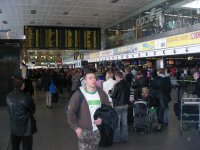 It feels like I’ve been commuting between Perpignan and Belfast over the last month or so with two trips already and a third looming.Since we have places to stay in both countries, it means that our timetable is quite flexible so I’ve spent a bit of time on SkyScanner checking out the cheapest prices and coming up with some slightly peculiar routes.
Belfast isn’t really that easy to get to from here so I usually end up flying into Dublin which has considerably more choice in terms of discount flights and seems to have lower departure taxes as well which drops the prices a little bit more. The only problem is the bus up which isn’t nearly as reliable as it used to be and on Fridays it’s quite common to have to wait for as much as three hours just to get a bus with any free seats. Of course, for me, Friday is often the day with the cheapest flights as most people are leaving Ireland for France/Spain on a long weekend therefore the flights from France/Spain that day are usually a good deal cheaper than for other days. Not that the airport seems any quieter on other days: that photo was taken on a Monday evening which was a pretty busy time as you can see.
Locally, we have a choice of four main airports though the closest (Perpignan) isn’t much use for me as it only flies to England so I’d need to get a connecting flight which makes it both too complicated and, usually, too expensive. Whilst Toulouse has, for me, the image of a large international airport it’s not really much better for me as it would also require connecting flights. That leaves me with Carcassonne and Girona which generally have one flight each per day to Dublin, usually, at a reasonable price. What complicates my life at this point is that the Carcassonne flight to Dublin is at a civilised time but the one back is generally at 9am which would require an overnight in Dublin coming back and therefore makes it too expensive. The Girona flight times are pretty much at the other end of the day with the flight to Dublin arriving around 11pm most of the time (though the schedule changes now and again and it sometimes arrives in the afternoon) and coming back around 9pm. So, generally, I end up flying out of Carcassonne and back to Girona.
What surprises me is that there still isn’t a website that lets you say something like “I’d like to fly out of an airport near A around X and back to an airport near B around Y”. At the moment, SkyScanner is the closest to that in letting you see the lowest flights between two particular airports but doesn’t let you say you’d like to fly from somewhere within X miles of a given town and return to an airport a similar distance from that town.
Although you might save a few pounds on the flight prices by varying the dates of your travel, don’t forget the swinging penalty charges applied if you’re just a few kilos overweight with your luggage. At the moment, you’ve a charge per bag of EUR 12 (return) if you declare the bag online, EUR 20 (return) if you don’t but just one kilo over the 15kg per person for checked luggage and you’re looking at EUR 8 per kilo. I’m not sure if it’s commonplace but none of our carryon baggage has been weighed on any recent trips so if you think you’re a little over on the checked luggage, it might be worth trying to squeeze the heavy items into your carryon baggage.
Copyright © 2004-2014 by Foreign Perspectives. All rights reserved.Ice Cream Vans as an indication of attitudes about the climate
 Although Northern Ireland is definitely cooler than the south of France, one surprising difference is that Northern Ireland has icecream vans at just about every possible location that you’d find crowds of people whereas France seems to have none of these.That’s indicative of quite a different attitude towards the climate in general between NI and France which we’ve seen illustrated numerous times whilst we’ve been here.
As soon as the temperature drops below around 30c over here, all the locals don their Winter coats. Not just any old Winter coat either for the coats on sale in the local shops seem more suited to Arctic conditions than the, usually, very mild Winters that we get here. Although it’s been warm enough for us to be running around in t-shirts almost all the time since March 2006 (yes, all year), the local population has been wearing their heavy coats since late September.
Perhaps the most noticeable difference that we’ve seen though is when our son was born here at the end of August. As you can imagine, it was pretty hot then (high 30s) and the maternity ward was even warmer than that. Now, I know that the rule is to wrap up babies after they’re born but with those kind of temperatures, we just put a nappy on him and nothing else. Yet, every time the nurses came into the room they insisted in wrapping him in three layers of clothing. Net effect? Well, if we’d stayed any longer he’d have been dehydrated as the sweat was just pouring out of him with all that clothing and he clearly wasn’t comfortable.
He’s still considerably behind in his vaccinations too because anytime that we’ve taken him along between roughly March and October they announce that he’s got a fever and can’t get the vaccination. Even outside that time, it’s often warm enough for him to “have a fever” so we’re lucky if we manage one vaccination per year.
So, whilst the icecream vans appear in Northern Ireland in March at perhaps 15c, you’d be unlikely to find anything similar below 25c over here.
Copyright © 2004-2014 by Foreign Perspectives. All rights reserved.

