Archive for the ‘Science & Technology’ Category
 Posted in
Where do you need to be to do your work?
 January 2nd, 2008 |
  Author:
 Not so long ago the talk was all about how we’d all be working from home by now and it all seemed terribly practical if you listened to the sales pitches but then I’m sure the flying cars did when that idea was pitched in the 1960s as transportation for the 1990s.
Realistically, the majority of people will always need to be “at work” in some way. Certainly, it doesn’t seem likely that there’ll be portable steel mills around anytime soon that would be suitable for home use and I can’t really see car manufacturing getting going as a cottage industry on any kind of large scale.
However, there are an increasing number of jobs where it doesn’t really matter where you are when you’re doing them. Whilst, blogging isn’t my main job (yet) it obviously doesn’t matter where I do it from so long as I have a half-decent Internet connection to write the stuff with and there are a lot of jobs in that category such as telesales and the like. Service and software industries in effect rather than manufacturing. Clearly we will always need a great deal of manufacturing capability around but for many service industries it doesn’t matter where you are in the world these days as ADSL is available right out in the sticks in many countries.
Naturally, for those of us working from home it’s cheaper in many ways for us. No more commuting to work for a start although that can be counteracted by having to heat your home of course (unless you’ve set yourself up on some idyllic beach).
Is it for you though? If it’s just you at home it could easily get very lonely and naturally there isn’t the office banter that you may have gotten used to.
Copyright © 2004-2014 by Foreign Perspectives. All rights reserved.Starting out with the flash
I got the Nikon SB600 flash as a Christmas present but have only just started using it a little bit.
Whilst the flash itself is light enough, adding in the four batteries makes for a pretty heavy chunk of gear to lug around when it’s attached to the camera itself. It’s an awful lot faster recycling than the on-camera flash with all those extra batteries and, of course, the more serious lamp that it has means that I should be able to use it much farther back from the action than I could with the oncamera flash.
I always think that people are incredibly optimistic about the ability of their little flash units on their compact cameras to illuminate entire stadiums sometimes. Still, at least it’s not so bad as it was in the good old days of film and they can just delete the image when it doesn’t turn out.
Must see about reading the instructions for this one at some stage as there’s lots of buttons and, of course, it links in with facilities on the camera too.
Copyright © 2004-2014 by Foreign Perspectives. All rights reserved.Should you get your satellite navigator from a specialist shop?
Buying from a specialised shop often means that you pay a little more for the same product than you would from a supermarket. After all, the supermarket operates on the basis of “pile ’em high, sell ’em cheap” which is an excellent way to go for standard items like beans and whatnot.
However, move into a specialised area like sat nav and you sometimes need that little bit of expertise even when you’re sure that you know what you’re doing.
For example, we bought a TomTom on Christmas Eve in El Corte Ingles. That’s a fairly upmarket department store and therefore there are specialised departments for such things so it’s effectively in-between the supermarkets and the specialised stores. In practice, they were quite happily selling units that had a fault. Fair enough, they obviously can’t go around opening all the boxes and testing them but any that were returned went straight back on the shelf to be sold again. Stupid, eh?
So, we returned that one and bought the next model “up” in a supermarket for ‚€20 more. Unfortunately, although the shop was close to the French border they are piled high with models that can’t be used in both Spain and France as it’s the one model from the range that doesn’t use a memory card (which isn’t obvious as they cover up the relevant information on the box with their security label). So, we’ve to return to Spain this week to see about getting a refund for that too.
Perhaps we’ll get one third time around!
Copyright © 2004-2014 by Foreign Perspectives. All rights reserved.Too many choices in palm devices
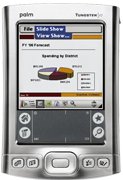 One of the problems that we have these days is that sometimes there’s just too much choice of little gadjets available.
Take the Palm series of handhelds for example.
Now, you can pretty much discount the Z22 as a teaser product or toy as it’s basically just there to fill in a gap at the bottom end of the market and not, in my view, a really serious contender.
Move up about 50% in price and you get to the likes of the Tungsten E2 shown here. That gives you a pretty wide range of funcions with everything from a sensible SD card slot to hold movies and whatnot to Bluetooth. You can even surf on this if your phone has bluetooth too.
However, add another 50% in the price and you’ll get the TX. This little baby has a much bigger screen and adds wifi to the list of functions (along with a massive list of capabilities).
Both will let you work with MS Office text and spreadsheets and you can even exchange e-mails with them.
Just to complicate your life even further, you can get the TX on ebay for much the same price as the E2 in the shops.
Copyright © 2004-2014 by Foreign Perspectives. All rights reserved.Translating pens
 Whilst I was doing the Spanish course, the big dictionary was the way to go. On degree level courses small dictionaries just don’t cut it and neither do electronic ones, most of which have a considerably fewer number of words than even the smallest of the paper dictionaries.
However, when you’re settling down to read a novel in a foreign language the only way to go is with one of the pen scanners. Large dictionaries aren’t really a runner unless you always read in the one spot as you’re never going to carry around any kind of sizeable dictionary, are you?
Normal electronic dictionaries are a bit of a pain when you’re reading too in that they’re pretty slow, particularly if you’ve to look up a couple of words in a sentence.
With the pen dictionaries all those problems disappear at a stroke. They look up a whole line of words for you in one go for a start and they’re a similar size to the smaller paper dictionaries. The only downside is that they’re a good deal more expensive than normal electronic dictionaries and indeed more expensive than even the largest paper ones.
Copyright © 2004-2014 by Foreign Perspectives. All rights reserved.

