Archive for the ‘Relocating’ Category
 Posted in
The traffic in France on the last week of the holidays
 August 17th, 2007 |
  Author:
  Actually, it’s not the last week of the holidays but the French don’t go on holiday in the last week so it’s the last week that they are on holiday.
Traffic isn’t quite the word we’re looking for either, as in many places the motorways are pretty much carparks rather than places where traffic actually moves. Many people think that they can avoid the snarlups by simply leaving the motorway when the traffic gets too heavy but, as you can see, a LOT of people think the same thing so you can look forward to tailbacks at every motorway exit.
But you’re thinking “ah, I’ll use my in car navigator and avoid the queues”. Well, no, that doesn’t work either as when the price of Tom Tom and the like dropped last year, loads of people bought them and you’ll see massive tail-backs on the recommended routes. They’re actually worse than the motorways as the navigation units tend to direct you along B roads which elsewhere would be fine but in France these are often quite windy roads and, in many cases, they’re just not up to coping with the traffic volume that the navigation units are now directing down them.
Your best plan is to find somewhere nice for today and tomorrow and stay there. Not only will this avoid needless aggravation on the roads but you’ll also miss out on the incredibly aggressive driving that this generates and indeed the corresponding jump in road accidents.
Copyright © 2004-2014 by Foreign Perspectives. All rights reserved.buying a house in France: part 26: Education in France
 Schooling in France starts from age 2 or 3 (depending on the local area) with education being compulsory from age 6 to 16.
Schools generally run Monday to Friday but on Wednesday some close or only operate in the morning and in some areas schools operate on Saturday morning. The hours are generally 9am to noon, 2pm to 5pm at all ages although the 2 and 3 year olds often only go in the mornings.
There is no “supply teacher” arrangement in France so if a teacher is off sick you will frequently get a phone call to come and collect your children.
From age 2 or 3 up to 6 you can enrol your children in nursery school (ecole maternelle) although this is not compulsory. This is more of a schooling environment than the equivalent in the UK and aims to prepare the children for entry to the next level of schooling.
For enrollment you will need to bring along ID for the child (passport or full birth certificate is equivalent to the “livret de famille” that they will ask for), proof of address (sometimes), proof that the child is insured (about EUR 10 per year) and, if the school is not in your commun, a letter from the mayor. In some cases you may be asked for proof of vaccinations. Even if your children speak no French you should have no difficulty in enrolling them in the local school at this level.
The age used is based on the calendar year so in the year in which your child is 6 they start primary school (ecole primaire) in September. The documentation required is as for the nursery school and if you want to go to a school outside your area then you’ll need a letter from your mayor too. There is usually no difficulty in getting non-French speaking children into primary school.
The secondary and high schools (college and lycee) are not tied to the local comun and operate over a wider region. Consequently you don’t need a letter from the mayor if you are going to a school out of your area. Other documentation remains the same with the additional requirement of a report from the primary school or alternatively your child will have to sit a test (UK school reports usually aren’t accepted).
For the college (age 11 to 16) you may be limited to the college in your local area as others can sometimes refuse to accept non-French speakers. Generally speaking, you shouldn’t have a problem if your child has previously attended primary school in France (ie they can speak French).
At age 17 pupils enter the lycee. These come in three varieties: general, management and technical which roughly correspond to UK high schools, business schools and technical colleges. This is the point at which children need to choose subjects though pupils in the French system study a much wider of subjects than they would at A level in the UK. As at entry to college, a report from the previous French school will help.
If your child does not speak French at this point, you may find that they need to attend a different school. What happens seems to vary widely across France with most areas accepting non-French speaking children at both college and lycee level whilst others refuse to do so at lycee level (see our post here).
Copyright © 2004-2014 by Foreign Perspectives. All rights reserved.Traffic on the first weekend of August
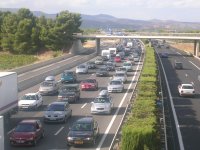 As usual on the first weekend of August, the traffic has been heavy here since shortly after breakfast and it’ll likely stay that way until early tomorrow morning.
How come?
Well, it’s the start of the holiday season in France and a number of other European countries so everyone has jumped in their car this morning and started driving. As you’d expect, by the time they get to the south of France they’re both tired and cranky (a bad combination for a driver, of course) and therefore the number of traffic accidents also leaps this weekend.
It’s best not to attempt to drive anywhere on this particular weekend. Just about every road has traffic way above the capacity which it was designed for and the queues are correspondingly long and wearisome. The queue on the left of the photo is created by having three lanes of traffic at 130km/hr going down to two lanes at 10km/hr at the border which has the overall effect that the queue gets longer and longer as the day goes on (at the time of the photo in the late afternoon, the queue was getting on for 50km!).
You might be thinking that you can avoid the traffic by going on the side-roads. Think again: everyone has already thought of that and the side roads are just as busy. Those using in-car navigation aids will find that the queues on the recommended routes are even worse as a lot of people are using those these days and, of course, they always recommend the same route.
Copyright © 2004-2014 by Foreign Perspectives. All rights reserved.Buying a house in france: part 25: Is your driving license legal when you’re living abroad?
You may have seen some debate about whether a UK driving license remains legal when you’re actually living overseas.
Mine recently came up for renewal and I thought I’d have to change it for a French one. However, when I read the small print as to how they decide if you’re UK resident or not it turns out that, according to their own definition, I am actually legally UK resident despite having lived in France for three years!
That’s one of the odd things about living here. Even after living here for three years, it is still easier for me to prove that I live in the UK than that I live in France.
Copyright © 2004-2014 by Foreign Perspectives. All rights reserved.The disappearing chambres d’hotes (B&Bs) in France
 Every year I send an e-mail to all the B&B and self-catering properties listed on the Our Inns websites telling the people what we’ve done with the sites during the year and the kind of improvements that we’re planning for the coming year.
Each year, I get a trickle of returned e-mails representing those properties that have been sold within the previous year. This year has been particularly sad in that almost 10% of the original people listed on the site have dropped out of the market and aren’t traceable. Now, if we charged for a listing we’d expect to have people drop out each year but the free listings that we provide just keep going.
Why do they give up on B&B (and, so far, it’s been exclusively the B&B properties)?
Well, many people come to France with rose coloured glasses courtesy of the many “moving to France” series that you get these days. In those, there are never any insurmountable problems but in real-life there are problems that you just don’t want to deal with day in day out. For instance, whilst none of the people on those series speak French (with the notable exception of Patrick & Collette of Chaos in the Castle fame), you DO need to speak French to run a B&B here (but not if you’re running a gite).
For others, it’s their first experience of dealing with paying guests on a regular basis and it’s just not their thing. Again, with rose-tinted glasses it might seem an idyillic lifestyle but in reality it’s pretty hard work.
Then there’s those that have never run a business before let alone one in France and don’t appreciate how much money is required to get a place fully operational. Others haven’t considered pricing. For instance, we’ve just heard of one more upcoming dropout who are packing it in because they were constantly full and it was just too much work yet they’re in a property which they could easily have charged almost twice as much and still been full but been able to employ someone.
Finally, some people who think they’re really committed francophiles, find that they just can’t stick life in France. Yes, it can seem the perfect lifestyle whilst on holiday but that very laid-back aspect of it which seems initially very appealing can become an annoyance when you want to get things done.
So, every year whilst we get a flow of new properties coming onto the sites we know that we’ll also see a trickle of the existing properties departing.
Copyright © 2004-2014 by Foreign Perspectives. All rights reserved.

