Santiago de Compostella – what is it really like?
 September 3rd, 2006 |
  Author:
 Santiago is world famous for its magificent cathedral and the thousands of pilgrims that it attracts throughout the year, but what is the town really like?
In fact the section of the town that is most famous is actually quite small. It’s very easy to walk right around the famous section in under an hour if you don’t dawdle and in fact almost all of the tourists and pilgrims (it’s often difficult to distinguish between them) see a very small portion of the town which is consequently incredibly crowded. Even in the evening you can find it difficult to get a table in a restaurant, despite the large number of them in this area.
However, it doesn’t take much of a walk to get outside the touristy parts of the town. Almost everyone appears to cross the road from the park and walk along the Rua Franco to the cathedral which makes this, of course, one of the most crowded streets in the town. But, if instead of going straight towards the cathedral, you turn right within a few hundred yards you’ll find yourself in the modern section of the town which is full of “normal” shops and almost completely devoid of tourists. You almost get the impression that the inhabitants of the town like it that way as you’re immediately into a very Gallician area with signs in the local language rather than Spanish.
Whereas the tourist sections are lively at night with street theatre, in the modern town you don’t get any of that and the streets are almost deserted when it gets dark. If you’re looking for nightlife it seems to be best to stick to the areas around the cathedral as we found that most things seemed to close down around 10pm in the new town with just a few things such as some restaurants and cinemas staying open a little later than that. If you want to watch a film, bear in mind that in the new town all the films are in Spanish and there are no subtitles.
If you’re looking for a quiet stroll in the evening, try some of the numerous parks in the new town. In many cases, you’ll find that you have the places pretty much to yourself which makes a welcome change from pushing through the crowded streets in the cathedral area. There aren’t nearly as many restaurants in this area but it’s very easy to get a table and, of course, you get much more authentic Gallician food than you’ll find in the restaurants in the tourist area.
Copyright © 2004-2014 by Foreign Perspectives. All rights reserved. Posted in
Is there such a thing as customer service in France?
Customer service is one of those wooly concepts that few people really think about most of the time. OK, just about every place has a “customer service” department in some form but as far as most people are concerned, it’s where you go when you’ve some kind of problem. Change of address? Just see Customer Service? Want a refund? Customer Service deals with that.
At the other extreme you have the likes of First Direct where there doesn’t seem to be a “customer service” department as such because everyone you talk to considers that it’s their business to be serving you. In fact, in over 10 years of using them, I’ve only once or twice been referred to someone else and that’s been for a specialist thing like buying shares or whatever.
What we all forget though is that “customer service” isn’t something that the Customer Service department do. It’s done in part by everyone in the various companies that we deal with.
Except in France.
Here, the customer very definitely is considered an inconvenience to be tolerated. Not just in the dreadful companies either.
Consider Carrefour, one of the largest retailing company in the world. In France, it charges EUR 25 for a charge card that can only be used in its own stores. In Spain it offers a Visa card free of charge. Why? Simply because the French will tolerate such behaviour and the Spanish won’t.
Last year we ordered heating oil from them because they said on their adverts that we could pay by card. I even checked that when I called to order the oil. As it happened we were out the day that it was delivered so the delivery guy left a phone number for us to call to make the payment. We called them. Nope, we don’t do that, call this other number. Nope, we don’t do that, call this number instead. Turned out that was the number we had just called so they said a supervisor would call us back. A month later a reminder arrived to say we’d not paid so I faxed them with the card details. About two months later a further, slightly threatening letter arrived telling us to pay up or else. I posted a recorded delivery letter this time (businesses often ignore anything that isn’t recorded delivery in France). A week later, I got a call from a guy who wouldn’t take my card details for the payment but said that he’d get someone else to phone me back. No phone call but a month later we get a letter saying that our case had been passed on to the debt collectors and adding EUR 100 or so of charges. I faxed and posted yet another recorded delivery letter itemising the above saga and telling them to come and collect the money (legally businesses in France must accept cash). Finally, I got a call from the debt collection guy who admitted that in fact they don’t accept payment by card because the machines that they had issued to the delivery guys don’t work. So, in Carrefour the customer is definitely a nuisance to be passed on to someone else if at all possible.
Just two weeks ago I was in Santiago. We could have had breakfast in the place we were staying but instead thought that it would be nicer to have it in the town instead. As it happened we got a little lost on the way (and had a very pleasant tour of the town along the way) so were looking for something to eat around 11am. We had loads of choice and ended up in a nice little cafe just behind the cathedral. In France, we’d have had no choice at all: outside noon to 2pm restaurants simply won’t serve food. In fact this reaches the peak of absurdity in Perpignan airport where the restaurant is only open from noon to 2pm yet until quite recently there were no flights at that time ie no customers!
This nonsense extends to almost all areas of retailing. Whereas elsewhere most shops open during lunch to catch everyone else, here almost all shops lie closed.
Even three years down the line, it still confuses us. For instance, last year a couple came to us enquiring about us hosting their wedding reception. We gave them a few ideas for the meal but said that we could change that around to suit them, never thinking anything about that. Turns out that we were the only restaurant to offer them the chance to tailor the meal to suit them. In France, when you go to a restaurant asking about hosting your reception, the restaurant give you their wedding menu and that’s it: take it or leave it, you certainly can’t make any changes. How crazy is that?
At the end of last year we had someone from a French hotel staying with us. One comment that he made really struck us as symtomatic of the low level of customer service that is experienced throughout France: “This is France. You always greet guests in French”. Actually, no, you don’t: you should, of course, greet them in their own language where possible. At least it’s “of course” everywhere else in the world, just not in France.
Why is it like that here yet completely different in Spain? I think because the French just put up with it whereas the Spanish won’t.
So in France, customer service means telling the customers to clear off and come back sometime that it suits the employees.
Arnold
Copyright © 2004-2014 by Foreign Perspectives. All rights reserved.Protests in Gallicia against the fires
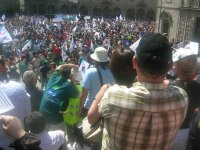 You may have seen news of the extensive fires in the Gallician countryside over the last couple of weeks.
Naturally, in the summer fire breaks out in numerous areas of Spain but a considerable number of these were set deliberately. I was staying at the University of Santiago and the fires came within about 1km of the university campus which is rather too close for comfort. Think of the heat and smoke coming from a log fire in your home and magnify that 1000 fold and you’ll get some idea of the problems that this causes. Surprisingly though, some homes on the hill opposite the university seemed to be virtually intact despite having been surrounded by the intense forest fires. I wonder though if they were quite so unscathed as they appeared to be when seen from a distance?
The fires were largely spent by the time I arrived but by that time the population had begun to hold a series of protest rallies. Interestingly for me was that they felt very much like the protest rallies that you see now and again in Northern Ireland so I guess this is another sign of the celtic heritage of the region. Even the slogans were quite similar with “Ulster says No” translating to “Nunca Mais” (Never Again) and, of course, the use of bagpipes. All that was absent was the police in riot gear!
Arnold
Copyright © 2004-2014 by Foreign Perspectives. All rights reserved.First day at school in France
 James started his education in France today in a nice little country school not far from us.
Frankly, we were quite amazed how easy it was to get him accepted at the school. Back in June we found out that the enrollment for the school closed on June 23rd so it was a bit of a rush to get to the school to find out what they needed from us to enrol him there. A birth certificate, of course, then they wanted a copy of his insurance (all of EUR 10 a year), medical certificate and, as we don’t live in the schools commune, a letter from our mayor to say that he was OK about James going to their school. Very surprisingly, they didn’t consider farming him out to some school for non-French speakers which is the usual tactic in this area.
So far, he seems very happy with the school and couldn’t wait to get back after lunch.
We’re told that he’ll be speaking his first French words in a few weeks. You’d think that he would grow up bilingual but that’s not usually the case unless you put the kids into a bilingual school. Just before we bought this place we met someone who would “obviously” be bilingual: he was born in France around 20 years ago to English parents. In fact, although he had a perfect english accent he wasn’t fluent in english. How come? Well, 20 odd years ago there was no satellite TV, no Amazon and few brits in that particular area of France. Net effect was that the only english he heard was that of his parents so his accent is perfect but when he reached maybe 12 or 13 he started to go out with his friends more than being in with his parents. So, his english is that of a 12 or 13 year old. For instance, although he was working as an estate agent, he didn’t know the names for parts of houses because, of course, those are words that you learn as an adult. All his specialist vocabulary would be French too as it’s hardly likely that his parents would have spoken to him about geography or physics. These days it’s much easier as the children can watch UK TV, read books in english and even get magazines but you do need to make a point of developing their english if you want them to be truly bilingual.
One other thing to watch if you’re moving here with kids is that once they hit 16 they won’t get any education unless they’re either fluent (and “able to get by” doesn’t count) or you move to an area with a relatively large expat population. What happens in areas like this is that at 16 they are sent to CIPPA which is a France-wide organisation with the objective of getting kids prepared to go into the lycée (ie age 17-18 school). Now, that’s fine if you’re in an area where the main reason that kids aren’t able to go into the lycée is that they don’t speak French because they’ll teach them French. However, in our area CIPPA is almost exclusively aimed at getting children from French speaking countries with low education standards up to the required standard and they don’t teach French: in fact in our area it appear to be impossible to get into a school after age 16 unless you speak fluent French and there is nowhere for such kids to actually learn French either. Funnily enough, everyone assumes that there is “some place” that will teach your child French at age 16 but having spent almost three years being passed from one such organisation to another around here, I think I can safely say that there isn’t such a place.
Actually, we started off pretty sure that there was no problem getting kids into school regardless of their age. You never see any problems like that on the “moving to France” TV programmes for sure but I guess that arriving at enrollment with a TV crew in tow helps remove any problems that there might be. However, in “real life”, when you start off at a school their first reaction is to send you off to the CIO to have your educational level tested. Fair enough, but CIO can’t actually test a child that doesn’t speak French so they send you on to another outfit (can’t remember the initials). The other guys just send you straight to CIPPA who, as noted above, are worse than useless in this area if you don’t speak French. CIPPA in turn immediately send you back to have tests of your ability done which, of course, the CIO can’t do if you don’t speak French but, eventually, CIPPA do accept you. Not that there’s much point as we found that they just brand non-French speakers as being lazy and lacking in enthousiasm when they can’t answer question papers in French and hand back a blank answer sheet at the end of the day. So, if you’re unlucky enough to be directed to CIPPA in an area with few non-French living there, you may as well give up any hope of your child receiving an education in France.
Arnold
Copyright © 2004-2014 by Foreign Perspectives. All rights reserved.Is Galicia really in Spain?
The rolling green fields that you see as the plane comes in to land are the first indication that this isn’t the Spain of the costas.
The coastline is quite different from that of the southern costas. Whereas Marbella is nothing like the small port that it grew out of, the port of A Coruna is still very much the centre of activities of the town. Yes, developments have more or less swamped the small old town but they are developments for a thriving town and not the wall to wall hotels and apartments of one of the costa ports.
Towns like Santiago do get their fair share of tourists but even there the tourists are confined to quite small sections of the town. Move outside those and you’ll find a real town.
So, no, this isn’t the tourist Spain that you probably already know. It’s an altogether different place.
It’s different in other respects too. For one thing, this is one of the areas of Spain that was never conquered by the Arabs so along with the other northern coastal provinces is one of those that has always been Spain.
The impact of that is most evident in the culture of the area. It has a very celtic undertone to it all with bagpipes (albeit without tartan designs) being almost as commonplace as they are in Edinburgh. In fact, in many respects Santiago feels like a smaller and warmer version of Edinburgh. Strangely though, the local language (Gallego/Gallician) isn’t a celtic based one.
Would you like to go there though? If you’re just aiming to lay on the beach and get a tan, probably not as all that green scenery is indicative of a good deal of rainfall. On the other hand, if you’re looking for a part of Spain with more culture than you’ll find in Marbella and less people than you find in Seville then it’s a good choice.
If I’ve convinced you then there are a growing number of transport options available to you with flights to Santiago and A Coruna in Galicia and others further east in Asturias plus the port of Santander just a few hours drive further on. These are all bookable via the links at the right. There aren’t massive quantities of tourist accommodation but you’ll find sufficient if you book ahead.
Arnold
Copyright © 2004-2014 by Foreign Perspectives. All rights reserved.

