Archive for the ‘French & Spanish’ Category
 Posted in
Learning Spanish in France
 February 13th, 2007 |
  Author:
 It’s still hard for me to believe but somehow or other I find myself on the final course of the Open University Spanish course and even harder to believe that one course after that should give me a BA (Hons) Modern Language degree.
My original plan was that I’d do enough French to be able to live here but once we’d reached that point I figured that I might as well carry on and pick up the diploma so two years ago I added Dip French after my name. With that completed and us receiving growing numbers of Spanish guests, the logical step was to do the first of the Spanish courses but once you start these things it seems hard to stop so here I am doing the final year.
Coming here just after the final year of the French segment started worked out very well. It wasn’t easy as we were very busy that year but the daily practice in spoken and written French helped the final mark no end I’m sure. With the Spanish it’s a completely different story. The two languages are similar enough that in the past I always had to “forget” my French when learning Spanish but, of course, that isn’t really an option this time around which makes it quite an uphill struggle at times. Still, the next coiurse should be easy as it’s in English, shouldn’t it? Unfortunately, it turns out that the last course I need to do to get that modern languages degree is supposedly the hardest one in the university so I’m half-thinking of doing a humanities course prior to it to get into the subject a little better.
Copyright © 2004-2014 by Foreign Perspectives. All rights reserved.Buying a house in France: part 6: Do you need to be able to speak French to live in France?
This is a question that many would like to ask but few are brave enough to actually ask it. The answer is different depending on where in France you choose to live.
If you are aiming for a brit-enclave such as Brittany or the Dordogne, the answer is probably “no” as in those areas it’s quite possible to live within the English-speaking community and to rely on those that make their livelihood supporting it. The only potential difficulty is the mayor’s office (“mairie”) but in the majority of cases they will be able to deal with you in English too. There’s no problem with the likes of tax, electricity and the phone company as all three plus similar outfits have at least one office set up to deal with English speakers (and if there is only one office, that office can deal with you where-ever you are).
Outside the brit-enclaves, it’s a different story and, for the most part, you will need to speak French quite well although it is still possible to deal with tax, electricity, etc. via their English speaking branches. Where you will encounter difficulties is in dealing with the plumber, electrician, school and mayor’s office. Even though we speak degree level French we have found that, for example, some electricians refuse to understand us because they simply don’t want to be bothered working for non-French.
If you aren’t English, then you’ll also find that the French are a good deal more willing to speak English to you. One of the shop local assistants claimed not to speak English for almost three years until they found out that we were from Northern Ireland and Australia when they suddenly became quite fluent English speakers.
So, yes, you could move to France and live here without speaking any French. However, in most cases, you’ll find live that little bit easier as your level of French improves.
Copyright © 2004-2014 by Foreign Perspectives. All rights reserved.Buying a house in France: part 5: Local languages
This is one aspect of French life that is really simple. This is France, so everything is in French.
Well, almost. You didn’t expect it to be so simple as that, did you?
There are various regional languages in France from Breton in Brittany to Catalan in Catalonia. For the most part, these languages are barely paid lip service by the French authorities. For example, the capital of the Pyrenees-Orientale departments bills itself as “Perpignan le Catalán” yet in reality the Catalan language is only represented by the bilingual signs outside villages in Catalonia and the odd article in the magazines distributed by the Conseil Regionale. This lack of support for the language is effectively killing the language in France so, for example, our neighbour’s father speaks Catalán as a native tongue, he speaks it as a second language and his children don’t speak it at all.
Things are very different just over the border where more and more of the signs have dropped bilingualism and are only in Catalán. Even the brochures in the shops are almost exclusively Catalán only. In fact, Catalán is pushed so much that in a recent shopping trip to Girona one or two of the shop assistants all but refused to serve us when we asked for some things in Spanish.
I think it’s sad that the children can’t speak to their grandparents in their native language in France but Spain has definitely taken it too far and I feel sure that it will end up as being very devisive.
This series is available in reference form on our Living in France pages.
Copyright © 2004-2014 by Foreign Perspectives. All rights reserved.Buying a house in France: part 2: becoming fluent in French
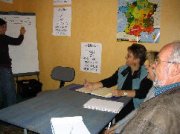 We introduced our series on buying a house in France in the last part of the series. Planning your move is essential, the next most important thing is acquiring fluency in the language.
This aspect will take you the longest period of time so it’s best to start work on it first. You might think that it’s an impossible thing to do or that it will take many years. Fortunately neither is the case and even if you are starting from no knowledge whatsoever of the language you can become fluent in as little as two or three years.
When I started off with the French after a long break, I was expecting it to take many years before I became fluent but in reality it was only two and could have been done in one. So how did I do it?
I was starting off from a very rusty O-Level (GCSE) so thought that a couple of years of night classes would be best to get my French back up to speed again after such a long break. Those night classes (2 hours a week for 20 weeks per year) took me up to roughly A-level conversational French but that’s not really fluency in the sense that I couldn’t chat in French.
The next step was to join a conversation class with the Alliance Francaise in September. I thoroughly recommend them but you need to be aware that the classes can be incredibly intimidating initially and you have to be stubborn enough to just keep going regardless of how dreadful you feel you are doing.
The Alliance Francaise classes operate at a much higher level than A-level French. At A-level you are expected to be able to talk about a range of topics if you know what the topic is in advance (hence you can’t chat at that level), the level above at that is to be able to chat about a range of topics which you don’t know in advance. Alliance Francaise operates at the level about that ie you should be able to talk about anything without being told the topic in advance.
Now you might think that there is absolutely no way you could do that. However, even a GCSE gives you all the vocabulary and grammar that you need. What the Alliance Francaise classes do is to force you to use that knowledge in real time and that’s why the classes are so intimidating at the start.
Anyway, the following September I started the Open University course L120 and did the related residential LXR122 that July. Whilst the Alliance Francaise classes are brilliant for getting your current level of French working much better they aren’t very good for improving your level of French so that’s where the Open University courses come in.
Right in the middle of the residential it was like someone had flicked a switch and all of a sudden I heard the French as though it were English. I’d to meet some French relatives after the course that Summer and was able to chat to them with no effort ie fluently.
So to get to fluency, one route is GCSE, Alliance Francaise and then Open University first year with the residential. I’m sure that’s less time than you expected!
The one thing that is key with learning French is to be stubborn enough to keep going to the classes regardless of how dreadful you feel you are doing. Yes, you will be really bad at the start but the trick with learning languages is to keep going regardless. That’s one reason why I feel it’s essential to be in a class rather than attempting to learn the language on your own. On your own you can easily grind to a halt on some topic which you just can’t understand but in a class environment, the class will force you to simply skip that topic and move on which is OK because you’ll come back to it later.
Our next issue is on staying fluent which, if anything, is more difficult as it feels much more like a chore.
Copyright © 2004-2014 by Foreign Perspectives. All rights reserved.Won’t our kids grown up bilingual in France?
If you’re moving to France with kids, you probably think that, naturally, they’ll grow up to be bilingual.
Think again. If your kids are broadly between 7 and 17 when you get here, then their current level of English is the highest that it will ever be. Surely not? Well, think about it: if you move to an area without wall to wall brits, then their friends are going to be French and once they start going out with their friends around 10-ish then it will be their French that gets better and better, not their English. If you send them to a French school, it will be the French names for countries that they learn in geography, the French names for chemicals in chemistry, etc.
In fact, it’s worse than that might appear to be. We have friends who arrived here about 5 years ago and are now finding that it’s starting to become difficult to speak to their ten year old daughter. The two sisters always chat to each other in French and so begins their loss of English. I’ve seen what happens in such cases years down the line in that we met Christopher who was similarily born in France to English parents but whilst able to speak French fluently, wasn’t fluent in English and we found it almost impossible to communicate with him in English as it had so many gaps in it. In fact, he had more key gaps in his English than many a foreigner learning English has. All the little phrases that tie things together are specifically taught to foreigners, but he never learnt those.
So what can you do? Well, where Christopher’s parents lost out was that they didn’t make a point of developing his English language abilities. When he was born there was no satellite TV, no Amazon, few British shops, and no discount airlines. These days, you can create a little bit of “home” in the midst of France by letting your kids watch the TV as though they were still in the UK (one of the worst things you can do is to let them watch French TV). As indeed should you for otherwise you’ll find yourself becoming more and more of a foreigner when you return “home” or talk to friends & relatives that you left behind. You need to buy the English childrens’ story books and teach them the nursery rhymes that they won’t learn in a French school. Take them back “home” on holiday too. It’s not just English that you need to teach them but British culture too.
But go further than that: as they begin school, use the Wednesday afternoons to bring their English reading and writing up to speed when they’re young. Later on, you’ll need to consider a bilingual or international school or perhaps boarding school in the UK.
Yes, it sounds like a lot of hard work. It is. But unless you want to lose the ability to communicate with your kids, it’s work that you need to do.
Copyright © 2004-2014 by Foreign Perspectives. All rights reserved.

