Archive for the ‘Education’ Category
 Posted in
Learning Spanish in Galicia with the Open University
 September 5th, 2006 |
  Author:
 I spent the third week of August in Santiago de Compostela on an intensive residential as part of the Open University’s Spanish programme.
When you get all the documentation about the residential school a few months in advance the immediate reaction of most people is “Ahhhhh!!!! I can’t do this!” but in reality the relaxed atmosphere makes it seem relatively easy once you get going on it. As it’s part of a second year university course, right from registration on Saturday through to checking out on Friday, everyone is quite insistent that Spanish is spoken all the time. It might seem hard at the time but the idea is to force you to think in Spanish and to do that the best approach is to “live” in Spanish as far as possible.
As it was going to be quite a packed week, I went on the Friday which made for quite a relaxing Saturday (or would have done if I’d not walked right round Santiago in the morning) as the enrollment doesn’t start ’til after 2pm and the course doesn’t formally start until 7pm with the introductory lecture and first introductory class. Usually the first class seems to be amongst the hardest as if you’re not that fluent it’s often difficult to keep the Spanish operational late into the evening.
Sunday was quite short and not really as good as it could have been. In the French residential you have to write up a questionnaire in the morning and then go around the town interviewing people but in the Spanish one, we were given the questionnaire which I didn’t find to be nearly as useful in terms of learning and using Spanish. One unexpected problem we found that the very high proportion of tourists on the Sunday meant that we were often asking tourists the questions rather than the locals.
For the rest of the week, classes generally run all morning with the afternoons being effectively free though included in that “free” time is a visit to the cathedral and La Coruna. Surprisingly, Friday was actually quite a full day as it usually winds down with people leaving for their flights but the departure times in Santiago are quite convenient for the course so just about everyone was there until lunchtime.
Was it a good course though? I think so. Yes, it didn’t seem intensive but with around 20 hours Spanish classes in a week that’s what it was. The relaxed atmosphere makes it feel easier than it is but you do work hard and are tired at the end of each day. One thing that did surprise me was that all of the lecture rooms that were available to us were very much lecture rooms. The fixed rows of seats don’t really fit in that well with modern language teaching as it tends to involve a lot of group work and therefore moveable tables are much better. I assume that this seating arrangement is typical for Spanish universities but don’t really know for sure.
Strangely for a language course, the OU doesn’t have a residential for the final year of the Spanish course when most people feel that they’d need it most. Net effect is that a group of the tutors got together and set up what is effectively the OU residential in Alicante. Unfortunately, it isn’t part of the OU and therefore they can’t really advertise it as such so it’s a much smaller affair and only runs one week. It’s also quite expensive at around £500 for the week. However, there are alternatives to that and indeed the University of Santiago runs two week courses for around £400 so, at the moment, I’m thinking that I’ll do that next year: almost twice as much Spanish for £100 less seems like a good deal to me.
Copyright © 2004-2014 by Foreign Perspectives. All rights reserved.Won’t our kids grown up bilingual in France?
If you’re moving to France with kids, you probably think that, naturally, they’ll grow up to be bilingual.
Think again. If your kids are broadly between 7 and 17 when you get here, then their current level of English is the highest that it will ever be. Surely not? Well, think about it: if you move to an area without wall to wall brits, then their friends are going to be French and once they start going out with their friends around 10-ish then it will be their French that gets better and better, not their English. If you send them to a French school, it will be the French names for countries that they learn in geography, the French names for chemicals in chemistry, etc.
In fact, it’s worse than that might appear to be. We have friends who arrived here about 5 years ago and are now finding that it’s starting to become difficult to speak to their ten year old daughter. The two sisters always chat to each other in French and so begins their loss of English. I’ve seen what happens in such cases years down the line in that we met Christopher who was similarily born in France to English parents but whilst able to speak French fluently, wasn’t fluent in English and we found it almost impossible to communicate with him in English as it had so many gaps in it. In fact, he had more key gaps in his English than many a foreigner learning English has. All the little phrases that tie things together are specifically taught to foreigners, but he never learnt those.
So what can you do? Well, where Christopher’s parents lost out was that they didn’t make a point of developing his English language abilities. When he was born there was no satellite TV, no Amazon, few British shops, and no discount airlines. These days, you can create a little bit of “home” in the midst of France by letting your kids watch the TV as though they were still in the UK (one of the worst things you can do is to let them watch French TV). As indeed should you for otherwise you’ll find yourself becoming more and more of a foreigner when you return “home” or talk to friends & relatives that you left behind. You need to buy the English childrens’ story books and teach them the nursery rhymes that they won’t learn in a French school. Take them back “home” on holiday too. It’s not just English that you need to teach them but British culture too.
But go further than that: as they begin school, use the Wednesday afternoons to bring their English reading and writing up to speed when they’re young. Later on, you’ll need to consider a bilingual or international school or perhaps boarding school in the UK.
Yes, it sounds like a lot of hard work. It is. But unless you want to lose the ability to communicate with your kids, it’s work that you need to do.
Copyright © 2004-2014 by Foreign Perspectives. All rights reserved.First day at school in France
 James started his education in France today in a nice little country school not far from us.
Frankly, we were quite amazed how easy it was to get him accepted at the school. Back in June we found out that the enrollment for the school closed on June 23rd so it was a bit of a rush to get to the school to find out what they needed from us to enrol him there. A birth certificate, of course, then they wanted a copy of his insurance (all of EUR 10 a year), medical certificate and, as we don’t live in the schools commune, a letter from our mayor to say that he was OK about James going to their school. Very surprisingly, they didn’t consider farming him out to some school for non-French speakers which is the usual tactic in this area.
So far, he seems very happy with the school and couldn’t wait to get back after lunch.
We’re told that he’ll be speaking his first French words in a few weeks. You’d think that he would grow up bilingual but that’s not usually the case unless you put the kids into a bilingual school. Just before we bought this place we met someone who would “obviously” be bilingual: he was born in France around 20 years ago to English parents. In fact, although he had a perfect english accent he wasn’t fluent in english. How come? Well, 20 odd years ago there was no satellite TV, no Amazon and few brits in that particular area of France. Net effect was that the only english he heard was that of his parents so his accent is perfect but when he reached maybe 12 or 13 he started to go out with his friends more than being in with his parents. So, his english is that of a 12 or 13 year old. For instance, although he was working as an estate agent, he didn’t know the names for parts of houses because, of course, those are words that you learn as an adult. All his specialist vocabulary would be French too as it’s hardly likely that his parents would have spoken to him about geography or physics. These days it’s much easier as the children can watch UK TV, read books in english and even get magazines but you do need to make a point of developing their english if you want them to be truly bilingual.
One other thing to watch if you’re moving here with kids is that once they hit 16 they won’t get any education unless they’re either fluent (and “able to get by” doesn’t count) or you move to an area with a relatively large expat population. What happens in areas like this is that at 16 they are sent to CIPPA which is a France-wide organisation with the objective of getting kids prepared to go into the lycée (ie age 17-18 school). Now, that’s fine if you’re in an area where the main reason that kids aren’t able to go into the lycée is that they don’t speak French because they’ll teach them French. However, in our area CIPPA is almost exclusively aimed at getting children from French speaking countries with low education standards up to the required standard and they don’t teach French: in fact in our area it appear to be impossible to get into a school after age 16 unless you speak fluent French and there is nowhere for such kids to actually learn French either. Funnily enough, everyone assumes that there is “some place” that will teach your child French at age 16 but having spent almost three years being passed from one such organisation to another around here, I think I can safely say that there isn’t such a place.
Actually, we started off pretty sure that there was no problem getting kids into school regardless of their age. You never see any problems like that on the “moving to France” TV programmes for sure but I guess that arriving at enrollment with a TV crew in tow helps remove any problems that there might be. However, in “real life”, when you start off at a school their first reaction is to send you off to the CIO to have your educational level tested. Fair enough, but CIO can’t actually test a child that doesn’t speak French so they send you on to another outfit (can’t remember the initials). The other guys just send you straight to CIPPA who, as noted above, are worse than useless in this area if you don’t speak French. CIPPA in turn immediately send you back to have tests of your ability done which, of course, the CIO can’t do if you don’t speak French but, eventually, CIPPA do accept you. Not that there’s much point as we found that they just brand non-French speakers as being lazy and lacking in enthousiasm when they can’t answer question papers in French and hand back a blank answer sheet at the end of the day. So, if you’re unlucky enough to be directed to CIPPA in an area with few non-French living there, you may as well give up any hope of your child receiving an education in France.
Arnold
Copyright © 2004-2014 by Foreign Perspectives. All rights reserved.Santiago de Compostela pilgrimage or tourist attraction?
Is the Camino de Santiago a real pilgrimage these days? I had the chance to visit the city numerous times over the course of last week and the area in and around the cathedral was constantly thronged with people and even more so on Sunday.
Does that mean that they are real’ pilgrims though? Well, I suspect that the majority are, at least in part, for when we went outside the central part of the old town we found virtually no tourists at all. In fact in the new town I don’t think that there were any. That in itself is quite unusual as you would normally see some tourist overspill’ into the non-touristy sections of any town.
In tourist terms, there seems to be next to nothing touristy’ about the place on the whole. Yes, it certainly has the ancient building around the centre, but it doesn’t have the tourist shops in anything like the numbers that you’d expect given the number of visitors which implies that a fair number are pilgrims rather than tourists. It certainly does have loads of restaurants but even pilgrims have to eat so that’s not something that says tourist’. And at night, it is very lively with street theatre all around the central section and spilling out into the park but, again, even pilgrims do things at night.
However, I wouldn’t say that all of the pilgrims are quite in the mould of pilgrims of old. The pilgrim who looked haggard from his/her walk along the camino was very rare and most arrived in pretty good shape with modern day backpacks in place of the cloth bag or whatever passed for the equivalent in days of old. Considerable numbers come on bicycles too as evidenced by the number of bikes being packed in the airport. Actually the airport is something of an indication of pilgrimage activity with a massive list of destinations for such a small airport.
One rather major thing that makes life as a pilgrim somewhat easier these days is that you now only have to walk 100km to get your Compostela (200km on a bicycle) which seems like nothing in comparison to those who walked goodness knows how many miles down France and across Spain to get it not so long ago. Let’s face it: 100km is nothing. Even I would consider doing that!
Overall, I’d say that there is, if not a majority, then a sizeable minority of proper’ pilgrims. It’s just that these days, the route isn’t nearly so hard going as it was in olden days. Things have changed considerably when you see credit card’ listed as one of the essential items to take on your pilgrimage.
Arnold
Copyright © 2004-2014 by Foreign Perspectives. All rights reserved.Learning Spanish in Santiago
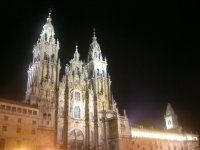 I spent last week on an intensive Spanish course in the University of Santiago so this weeks entry is all about that.
Santiago is quite a small town and I managed to walk round pretty much all of it on the Saturday just prior to starting the course. Inside the surroundings of the old town it’s pretty much packed with tourists everywhere but when I ventured out into the new town surrounding it on Wednesday afternoon I found that it was just as nice with a number of nice parks but virtually no tourists. It was much more pleasant because of that as the tourists tend to congregate along a very limited number of routes through the town.
If you want to see a service in the cathedral, go very early on Sunday as the pilgrims and tourists are at their maximum then.
If you want to watch a film whilst you’re there, bear in mind that they will be in Spanish only (ie no subtitles) so you’ll need quite good Spanish to follow them.
The town remains quite lively at night too. The new town quietens down around 10pm but the old town remains lively well after midnight with numerous bars and cafes open until very late (or early!). Around the cathedral area you’ll find numerous lively groups of musicians playing well into the night with one particularly entertaining act under the arches in the building directly opposite the cathedral. If you’re in a rush, be wary of the elderly troubadours with their engaging, if overlly long, patter selling CDs of love songs along the streets leading out of the cathedral square. In the park on the way back to the university we even found quite an elaborate and engaging puppeteer act.
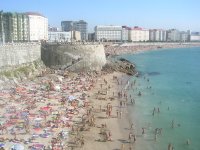 On Tuesday we were off to A Coruna which is on the coast. Quite a different town than Santiago obviously but still with a small old town where you can see a number of churches. It’s still quite a major port and a much larger town than Santiago although you can still manage to walk around the main tourist sights in an afternoon (ie the port area, old town and Hercules Tower).
But, what about the course? Well, it consisted of around three or four hours per day of classes plus a number of workshops on aspects of the Spanish language and Spanish culture. That might not sound like a lot but it’s hard to keep going in a foreign language for as long as that and everyone was quite tired at the end of the days (running from 9am to 10pm Sunday to Thursday). As it was largely a series of conversation classes, the progressive improvement in Spanish ability wasn’t so obvious as it is in normal classes but I’m confident that I speak Spanish a lot better now and was able to try that out this morning with some Spanish guests that we have. Not sure if I’d say I’m fluent at the moment but I’m further on the way than I was a week ago.
Arnold
Copyright © 2004-2014 by Foreign Perspectives. All rights reserved.

