Archive for the ‘Education’ Category
 Posted in
Buying a house in France: part 5: Local languages
 February 2nd, 2007 |
  Author:
 This is one aspect of French life that is really simple. This is France, so everything is in French.
Well, almost. You didn’t expect it to be so simple as that, did you?
There are various regional languages in France from Breton in Brittany to Catalan in Catalonia. For the most part, these languages are barely paid lip service by the French authorities. For example, the capital of the Pyrenees-Orientale departments bills itself as “Perpignan le Catalán” yet in reality the Catalan language is only represented by the bilingual signs outside villages in Catalonia and the odd article in the magazines distributed by the Conseil Regionale. This lack of support for the language is effectively killing the language in France so, for example, our neighbour’s father speaks Catalán as a native tongue, he speaks it as a second language and his children don’t speak it at all.
Things are very different just over the border where more and more of the signs have dropped bilingualism and are only in Catalán. Even the brochures in the shops are almost exclusively Catalán only. In fact, Catalán is pushed so much that in a recent shopping trip to Girona one or two of the shop assistants all but refused to serve us when we asked for some things in Spanish.
I think it’s sad that the children can’t speak to their grandparents in their native language in France but Spain has definitely taken it too far and I feel sure that it will end up as being very devisive.
This series is available in reference form on our Living in France pages.
Copyright © 2004-2014 by Foreign Perspectives. All rights reserved.Buying a house in France: part 3: staying fluent in French
In many ways, the hardest part of learning a language is maintaining your fluency.
If you have reached a good level of French before you move, you need to put the effort into maintaining that level of fluency which can often seem like a chore. If possible, you should continue with further courses through, for example, the Open University but if that’s not possible you should at least try to maintain your existing level of spoken and written French. Your current level of fluency will determine how you can go about this. For a basic to intermediate level of French you can subscribe to magazines such as La Vie Outre-Manche and Le Rendez-Vous Français which are available through Concorde French or Champs-Elysées. If your French has progressed further, you could try reading a novel which isn’t nearly such a major undertaking as you might think (see Amazon France) or perhaps buy a French newspaper (Le Figaro is best, Le Monde is a much harder read) which are also available online. For spoken French, Sky has TV5 on the basic subscription; the best programme to watch is the news. By far the best way to maintain your spoken French is to practice it and the Alliance Française classes are wonderful for that.
You might think that you can ignore all the above once you’ve moved to France but that’s usually not the case. In practice, you can find that after the first six months or so (when you use French a lot), you hardly use French at all day to day. To keep your French up you should read the French newspapers and watch French TV whenever possible and don’t reject the idea of further French courses either. The key thing is to keep using your French whenever you can because if you don’t you’ll find that your level of French will drop quite quickly.
Our next installment covers what to do about French for your children.
Copyright © 2004-2014 by Foreign Perspectives. All rights reserved.Buying a house in France: part 2: becoming fluent in French
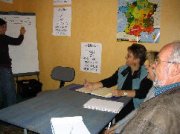 We introduced our series on buying a house in France in the last part of the series. Planning your move is essential, the next most important thing is acquiring fluency in the language.
This aspect will take you the longest period of time so it’s best to start work on it first. You might think that it’s an impossible thing to do or that it will take many years. Fortunately neither is the case and even if you are starting from no knowledge whatsoever of the language you can become fluent in as little as two or three years.
When I started off with the French after a long break, I was expecting it to take many years before I became fluent but in reality it was only two and could have been done in one. So how did I do it?
I was starting off from a very rusty O-Level (GCSE) so thought that a couple of years of night classes would be best to get my French back up to speed again after such a long break. Those night classes (2 hours a week for 20 weeks per year) took me up to roughly A-level conversational French but that’s not really fluency in the sense that I couldn’t chat in French.
The next step was to join a conversation class with the Alliance Francaise in September. I thoroughly recommend them but you need to be aware that the classes can be incredibly intimidating initially and you have to be stubborn enough to just keep going regardless of how dreadful you feel you are doing.
The Alliance Francaise classes operate at a much higher level than A-level French. At A-level you are expected to be able to talk about a range of topics if you know what the topic is in advance (hence you can’t chat at that level), the level above at that is to be able to chat about a range of topics which you don’t know in advance. Alliance Francaise operates at the level about that ie you should be able to talk about anything without being told the topic in advance.
Now you might think that there is absolutely no way you could do that. However, even a GCSE gives you all the vocabulary and grammar that you need. What the Alliance Francaise classes do is to force you to use that knowledge in real time and that’s why the classes are so intimidating at the start.
Anyway, the following September I started the Open University course L120 and did the related residential LXR122 that July. Whilst the Alliance Francaise classes are brilliant for getting your current level of French working much better they aren’t very good for improving your level of French so that’s where the Open University courses come in.
Right in the middle of the residential it was like someone had flicked a switch and all of a sudden I heard the French as though it were English. I’d to meet some French relatives after the course that Summer and was able to chat to them with no effort ie fluently.
So to get to fluency, one route is GCSE, Alliance Francaise and then Open University first year with the residential. I’m sure that’s less time than you expected!
The one thing that is key with learning French is to be stubborn enough to keep going to the classes regardless of how dreadful you feel you are doing. Yes, you will be really bad at the start but the trick with learning languages is to keep going regardless. That’s one reason why I feel it’s essential to be in a class rather than attempting to learn the language on your own. On your own you can easily grind to a halt on some topic which you just can’t understand but in a class environment, the class will force you to simply skip that topic and move on which is OK because you’ll come back to it later.
Our next issue is on staying fluent which, if anything, is more difficult as it feels much more like a chore.
Copyright © 2004-2014 by Foreign Perspectives. All rights reserved.What degree do you want to do?
When I started studying with the Open University way back in February 2002 it was just so that I could get my French up to speed sufficiently to let us move to France which I managed by July of that year.
With them, you need to attach each course you do to a qualification so I attached the French to their general degree and also to the French Diploma.
Of course, although I was fluent enough by the end of the first course, momentum tends to get you to sign up for the next course in the sequence and by December 2004 I found myself the proud owner of a Diploma in French. I still get it out now and again in case it was all a dream!
Well, by that point we’d been picking up a growing number of Spanish guests so I figured that I should do a little Spanish to help me speak to them and to improve what was a dreadful Spanish translation of the website. Yet again, momentum carried me on a bit and, all being well, next year I’ll have a Spanish Diploma.
Remember that general degree that I was attaching all the courses to? Well, the French and Spanish diplomas added together are enough to get it!
Of course, now that I’ve reached that point, I’ve started thinking about the degree itself and it seems that by doing just one more course I can get BA Hons Modern Languages.
The other thing that I’ve noticed is that there’s a whole raft of degree titles that I could get by doing just one or two more courses…. A friend who did the French with me is close to having options such as BA Hons Humanities, BA Hons European Studies, BA Hons Humanities and European Studies,…..
In fact, the very first OU course that I did wasn’t the French but a small astronomy course. That course wouldn’t count towards the language degree of course so would be left over after I pick up the degree which may create a little bit of momentum to use that as the start of a future BSc degree….
Copyright © 2004-2014 by Foreign Perspectives. All rights reserved.Our plans for the coming Winter
The transition from “Summer Mode” when you’re completely full pretty much all the time, to “Winter Mode” when there’s almost always a room or two free happens very suddenly.
It’s important to keep on top of that transition as you can easily stock up on, say, butter only to find that you’re still sitting with the same box of butter a month later and have to throw it out when it reaches the expiry date. Non-perishables aren’t so bad really but we only finished off the soap we bought in mid-August last year almost exactly a year later.
Most noticeable perhaps are the French. We don’t get that many arriving ’til around July 15th when all of a sudden we’re pretty much full of them. They stop just as suddenly too around the Saturday nearest August 20th. Last year we turned away 12 separate couples on Saturday August 21st yet it was six weeks after that before we had any more French staying with us!
Just cutting out the almost daily restocking trips from the Summer frees up a substantial amount of time for us. No more do we spend over 7 hours a week just driving the sheets back and forth to the laundry, and that’s before you even consider that we don’t need to make up the rooms and tables every day. This year we’re actually fairly full for September with more in than we had July last year. However, we can get away with not “working” the rooms too hard and the longer stays typical of the Autumn make life considerably easier.
So what do we do with all this “spare time”?
Well, first off we need to catch up with administration that just doesn’t get done over the Summer. Then there’s the small matter of my upcoming Spanish exam which is coming up in less than 2 weeks. The combined effect of the Spanish plus the admin backlog means that we don’t really have free time ’til about mid-October.
At that point, we need to get going on running up our to-do list for the coming year as it’s very easy to find yourself in March with nothing done. We’ve not yet sat down and written it out in detail but broad objectives at the moment are:
– maintenance of the house side of things;
– review of the hotel rooms to see what needs doing;
– refresh of the hotel website (a never ending task);
– complete overhaul of the pyreneesthemes.com site: we started regrouping that last year but it needs to be organised more logically;
– integration of the villarenters.com and sales properties with ourgites.org and ourholidayrentalhomes.com;
– spot of marketing of the ourinns sites;
– tidy up of the foreignperspectives.com site.
Not to mention finishing off the Spanish books (though, surprisingly, I will be pretty close to doing that before the exam for a change). I’m also hoping to organise a residential for myself in Santiago next July. Next year will probably be different as I hope to be starting the English course in October which, hopefully, will be the final one of my BA (Hons) Modern Languages.
As well as the work-related things, we’re also hoping to get away for at least one short-break and hopefully more than that.
Copyright © 2004-2014 by Foreign Perspectives. All rights reserved.

