Archive for the ‘Places’ Category
 Posted in
Buying a house in France: part 6: Do you need to be able to speak French to live in France?
 February 9th, 2007 |
  Author:
 This is a question that many would like to ask but few are brave enough to actually ask it. The answer is different depending on where in France you choose to live.
If you are aiming for a brit-enclave such as Brittany or the Dordogne, the answer is probably “no” as in those areas it’s quite possible to live within the English-speaking community and to rely on those that make their livelihood supporting it. The only potential difficulty is the mayor’s office (“mairie”) but in the majority of cases they will be able to deal with you in English too. There’s no problem with the likes of tax, electricity and the phone company as all three plus similar outfits have at least one office set up to deal with English speakers (and if there is only one office, that office can deal with you where-ever you are).
Outside the brit-enclaves, it’s a different story and, for the most part, you will need to speak French quite well although it is still possible to deal with tax, electricity, etc. via their English speaking branches. Where you will encounter difficulties is in dealing with the plumber, electrician, school and mayor’s office. Even though we speak degree level French we have found that, for example, some electricians refuse to understand us because they simply don’t want to be bothered working for non-French.
If you aren’t English, then you’ll also find that the French are a good deal more willing to speak English to you. One of the shop local assistants claimed not to speak English for almost three years until they found out that we were from Northern Ireland and Australia when they suddenly became quite fluent English speakers.
So, yes, you could move to France and live here without speaking any French. However, in most cases, you’ll find live that little bit easier as your level of French improves.
Copyright © 2004-2014 by Foreign Perspectives. All rights reserved.February in the vineyards of the south of France
 The last of the vines are prunned in December and by mid-January the white vans start to appear throughout the vineyards in the south of France.
This is the time of year when the vines that aren’t free-standing are reattached to their supports. As usual, this task proceeds at the typical speed of such things in France ie slowly and only on good days. Fortunately, there are many such days at this time of year and I’m writing this piece on one of those where it’s very much t-shirt weather for me.
The landscape retains the stark look that you see until after Easter when the grapes start to grow once again as you can see from the Year in the Vineyards feature. Whilst in January things can be very quiet with even Queribus closed for the month, by February preparations are underway for the full-scale reopening in March so it’s not so quiet as you might expect. For example, just 90 minutes or so from us the ski resorts are in full swing.
Copyright © 2004-2014 by Foreign Perspectives. All rights reserved.Buying a house in France: part 5: Local languages
This is one aspect of French life that is really simple. This is France, so everything is in French.
Well, almost. You didn’t expect it to be so simple as that, did you?
There are various regional languages in France from Breton in Brittany to Catalan in Catalonia. For the most part, these languages are barely paid lip service by the French authorities. For example, the capital of the Pyrenees-Orientale departments bills itself as “Perpignan le Catalán” yet in reality the Catalan language is only represented by the bilingual signs outside villages in Catalonia and the odd article in the magazines distributed by the Conseil Regionale. This lack of support for the language is effectively killing the language in France so, for example, our neighbour’s father speaks Catalán as a native tongue, he speaks it as a second language and his children don’t speak it at all.
Things are very different just over the border where more and more of the signs have dropped bilingualism and are only in Catalán. Even the brochures in the shops are almost exclusively Catalán only. In fact, Catalán is pushed so much that in a recent shopping trip to Girona one or two of the shop assistants all but refused to serve us when we asked for some things in Spanish.
I think it’s sad that the children can’t speak to their grandparents in their native language in France but Spain has definitely taken it too far and I feel sure that it will end up as being very devisive.
This series is available in reference form on our Living in France pages.
Copyright © 2004-2014 by Foreign Perspectives. All rights reserved.British food in France
 One of the first signs of the arrival of the brits in an area of France is the occassional appearance of the Sunday Times. Closely followed by that are the British food sections in the local supermarkets.We observed this process in action locally as neither the Sunday Times nor British food aisles were in any of the local supermarkets in April 2004. Within 12 months the Sunday Times started to appear in newsagents in Estagel and most of the local supermarkets had at least a token representation of British goods at extortionate prices.
A few years on and the local supermarkets offer a fairly reasonable choice as you can see. Prices aren’t what they might be though with baked beans costing 49p in the UK being sold at the equivalent of around 87p for instance. However, that’s for specialist food so to speak as the existence of the British section has also been accompanied by various brit-foods appearing elsewhere in the supermarket at local prices. For instance, Carrefour even put out their own brand salt & vinegar crisps and Leclerc sell proper bacon these days.
Noticeable too is that it really is a British section and not just an English one. After all, who but the Scots drink Irn-Bru?
What is a little odd is that the Catalán food has started to disappear into the ethnic foods section when in the past it was spread around the supermarkets.
Copyright © 2004-2014 by Foreign Perspectives. All rights reserved.The booming housing market in Belfast
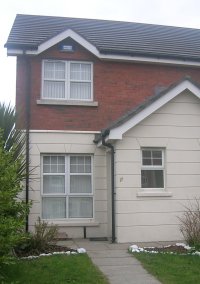
As you’ll know if you have been following our little saga, we may be living in the south of France but we actually watch BBC Northern Ireland for the news & weather.
So, you would think that we would be aware of a boom in house prices in Northern Ireland, wouldn’t you? We certainly did but in practice it’s one of the things that you need to be living in the country to really notice. We knew that the house prices were going up but just assumed that it was the same drifting up that there has always been whereas in fact it’s been quite a boom lately which we only knew about when a friend from back home mentioned it in passing in an e-mail.
For example, our own house was valued at £117,500 in February 2005 and £130,000 in September 2006 which is a reasonable enough rise in the price. However, right now an identical house has just been sold for £180,000 which is a pretty staggering rise in just a few months. It doesn’t seem to be an isolated jump either as my parents house has gone from around £130,000 at the start of 2005 to £250,000 now.
Unfortunately for anyone wanting to buy their first house, the salaries locally don’t seem to have experienced anything like the increase to warrant such high prices and as a result the rental market seems to be growing quickly too. For example, we had new tenants in our house in under three weeks when ordinarily it would take a few months to find new tenants. What’s also happening is that the earnings multiples on mortgages are moving up with five times income the norm vs just three times only a few years ago.
Who is driving this rise though? Well, as I’m sure you remember Northern Ireland had the “troubles” for most of the last 30 years. What happened over that time is that whenever there was an uptick in violence then the number of people leaving Northern Ireland went up correspondingly. The overall effect is that there are a considerable number of people who consider Northern Ireland as home but who live elsewhere. A side effect of that was that house prices in Northern Ireland were unrealistically low in comparison to elsewhere in the UK yet in the 1960s (before the troubles) prices in Belfast were comparable to those in London.
Now that peace seems more solidly based, those people are starting to come back and they’re driving the house prices through the roof right across the province. In effect, the prices are jumping to catch up with where they would have been had the troubles not happened.
Is there any more of a rise to come though? It would appear so in that the prices still haven’t caught up with those of properties in outer London which they were comparable with in the 1960s. That would imply a price for my parents house of over £500,000 ie about double it’s current price.
Copyright © 2004-2014 by Foreign Perspectives. All rights reserved.

