Archive for the ‘Tourist Events’ Category
 Posted in
Port Aventura: poorly maintained and not safe for children
 October 29th, 2006 |
  Author:
 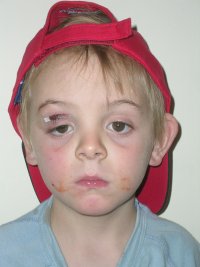 You kind of expect parks aimed at kids to be child-safe, don’t you?
Port Aventura is aimed mainly at children from around 7 or 8 up as most rides are limited to those 1.2m or taller (it charges full-price from age 4 but I’ve yet to see a 4 year old that clears 1.2m) but does have a number of small playground areas for fairly young children.
We went right through the Polynesian area of Port Aventura without finding a ride suitable for our 4 year old so he was very keen to get into the playground in the Chinese area of the park when we reached it.
Within about ten minutes, he’d fallen on one of the slides. Well, several by then as that’s what kids do. However, the final one he fell on turned out to be a very rusty metal one with lots of jagged pieces of metal sticking up and so he cut his eyelid quite badly.
We were very surprised to see how poor the maintenance was and would have expected that particular slide to have been replaced long ago. Additionally, whilst we were expecting the park staff in the area to make a point of assisting us with a child with a potentially quite serious eye injury, we were just vaguely directed to the medical centre. It also set us wondering if the rides are similarly poorly maintained and just awaiting a major accident to have that discovered.
To some extent, the excellent Port Aventura medical centre suggests to me that the number of accidents caused by various aspects of the park are fairly significant and that the park isn’t nearly as safe as it should be.
So, do be careful in Port Aventura with your kids even in the “safe” areas for infants because they aren’t as safe as they should be.
Copyright © 2004-2014 by Foreign Perspectives. All rights reserved.What SHOULD you be able to carry onboard a plane?
In days gone by you could carry quite a selection of items onboard: case (up to 110 cm total dimensions) plus an assortment “personal items” which include such things as a handbag, coat, umbrella, walking stick, camera, a reasonable amount of reading material, essential medication, binoculars and briefcase or laptop. Bring a child and you can add a child seat and can take the pram up to the aircraft door.
Those are the former “official” items that you could bring but, as we’ve all seen, you could bring on bags substantially larger and, of course, you could always buy more stuff in the shops and dutyfree after you checked in which consequently was never weighed and had the overall effect that some people could barely carry the bags onto the plane. So, in reality, nobody paid much attention to the official list of items but even if you did, there was a very substantial chunk of luggage that could legimately be taken onto the plane. That’s before you even consider the exceptions that were always made.
Fly from the UK today and you’ll find that things are a good deal more strict. The case is now down to 55cm (essentially a laptop bag) and the personal items have all but disappeared from the allowances. It’s been a while since you could take a syringe on without proving that you were diabetic but even liquid medicines now require a prescription to prove that you need them.
Also out are the exceptions. So that precious cello that can’t go in the unpressurised baggage hold can’t go which is causing some grief with musicians who travel around.
OK, I do accept that the security risk at the moment means that there will need to be limitations on what can be carried through security checks. However, that’s the point: it’s the security checks that are limiting what can be carried on. The only real reason that you can carry on a 55cm bag is that business in the UK would grind to a halt if laptops couldn’t be carried around as airlines simply aren’t equipped to carry large numbers of fragile items in the hold. Is a 55cm bag packed with electronic equipment “less risky” onboard than a cello? Quite obviously it isn’t: a cello looks very simple on an x-ray, a laptop is anything but simple.
So why not the cello? Well, simply because the authorities don’t want to complicate the life of the security people with growing lists of exceptions. The large number of passengers passing through security checks means that yes/no decisions need to be taken quickly and at very low levels. The people on the ground screening your luggage almost certainly don’t know why they are excluding certain items, just that if an item isn’t on their list then it’s not permitted. Which is, of course, the problem – they need to be educated as to why each restriction is in place. For instance, all liquids, gels and the like are out because numerous explosives come in that form but I’d be willing to bet that the majority of people checking your luggage don’t know that’s the reason.
With some education, perhaps we could get back to a sensible carryon allowance. A 110cm bag full of clothes is much easier to check than a 55cm one with a laptop. For one thing, the complex electronics that make up a modern laptop could easily conceal a bomb timer; that’s even before you consider the battery which usually isn’t transparent on a scanner. In practical terms, I suspect that one extra bag needs to be permitted to carry passports, tickets and the like but I’d be inclined to call a halt beyond that for the majority of people.
Copyright © 2004-2014 by Foreign Perspectives. All rights reserved.The view of the world from Visa pour l’Image in Perpignan: very depressing
 The world as seen by photojournalists is a very depressing place. Going by going by the photographs on show for Visa pour L’Image you’d think that half the world was at war, the other half was in the midst of revolutions and all children were malnourised.
Of course, that’s only natural. There’s not nearly so much interest in peaceful places and well-fed children from the point of view of photojournalism.
As usual, the evening show was fantastic. Over the first six days of the festival they go through two months of the year in photos, have several awards, and run a sequence of portfolios on a theme. Last night’s theme was revolution which covered the past revolutions from Cuba, Venezuela, Bolivia, Argentina and Columbia and gave an excellent account of each in pictures (by and large the photos are allowed to stand on their own with no commentary). Separately from those they run about half a dozen separate portfolios on various themes from a review of the work of Joe Rosenthal (who took the famous photo of the marines putting up a flag on a hill in the Pacific) to one on the plight of child rape victims in South Africa (who are as young as THREE).
That’s the world as seen through the lenses of the photojournalists who were exhibiting their work over the past week in Perpignan.
Usually, we’re fairly full with journalists and photographers at this time of year but only had a few this year. Those that have attended before have commented about the lower numbers of people around the festival and even a cursory look at the numbers in the streets shows that there are a good deal fewer people around this year. On the whole, that’s not so much an indication that the festival is standing to wind down into obscurity but rather that there’s quite simply too much going on elsewhere in the world at the moment.
So if you want to see fantastic photographs, come to Perpignan before September 17th but be warned that, whilst brilliant, the vast majority of the images present a very depressing view of the world that we live in.
Copyright © 2004-2014 by Foreign Perspectives. All rights reserved.Airport security in practice
When the panic button was pressed in the UK in August, the effects were seen here the next day, but did it have any lasting effect?
The small shop in our local airport doesn’t sell much wine or honey these days as it mainly sold those whilst people were wandering around after they’d checked their luggage. The wineries are none too pleased as there was a considerable amount of wine taken home as hand-luggage before the scare. A pilot who was staying with us recently thought that he’d be able to get his little case of wine onboard by showing his pilots license ’til I reminded him that the guys that flew the planes into the twin towers also had a pilots license.
I was expecting at least some increased level of security on my flight from Barcelona to Santiago but if anything the security was much lower than I’d been expecting. Thanks to the wonders of online check-in I was never even asked if I’d any sharp objects in my luggage, if I’d packed it myself, etc. In fact, the only contact that I had with anyone prior to boarding the plane was when someone had a fairly cursory glance at my passport just before I walked out onto the tarmac.
What about the increased security in the UK airports though? Delays in flight arrivals are much more common as the increased security level means that minor discrepancies result in flights being held until the source is identified. Earlier in the week one of the flights was an hour late because someone had dropped their boarding card for instance. Is that crazy? No, because the effect of the error was that it looked like someone who should have been on board the flight actually wasn’t.
What doesn’t seem so sensible is the very arbitrary reduction in the maximum size of carryon luggage. Is it really a co-incidence that the size corresponds to that of a laptop bag? I doubt that very much. The other aspect is that it now takes much longer to collect luggage from flights as almost everyone has checked baggage these days (quite a nice little earner for the likes of Ryanair with their charge for checked luggage).
I also can’t see that the security staff will maintain their vigilance in picking out potential terrorists. In todays world what they will more than likely do is to stop and question anyone who looks Muslim. OK, I will grant that this tactic will presumably pick out a higher proportion of potential terrorists than just picking out people at random in that the threat is, in practical terms, originating from the Muslim world. However, it’s also going to alienate Muslims in general and it may well sway the views of some middle of the road Muslims towards the anti-west mind-set which isn’t in anyone’s interest.
To indicate how ridiculous this kind of method of picking out potential terrorists can be, consider the flights from Belfast to London 10 years ago. They were all met by a couple of officers from the Metropolitan police. The ONLY people that they stopped to question were men walking by themselves. I used to travel back and forth from Belfast to London quite frequently so was able to experiment with this. If I was travelling on my own, all that I needed to do to avoid being stopped was to walk alongside a woman. Any woman: I didn’t need to speak to her, or do anything other than walk alongside her. I wonder how long it will be before the security people start picking out their subjects for questioning on the basis of some equally silly thinking to “single guy alone = terrorists”?
Arnold
Copyright © 2004-2014 by Foreign Perspectives. All rights reserved.Using credit cards in French petrol stations: one step forward, two back
 Whilst most countries in the world tend to move forward in terms of the use and usability of technology, it’s often the case in France that it’s one step forward, two backward.
Case in point: just a few weeks ago we noticed that Carrefour had, at last, started to accept foreign cards in their petrol stations and we thought that this was the first sign of the “promised land” of being able to use foreign cards in all petrol stations. Sadly, no. A matter of days later, the only petrol station that we know of within about 100 miles of us that did accept foreign cards on Sunday installed brand new petrol pumps and no longer accepts foreign cards!
This seems particularly short-sighted in light of the experience of the petrol station closest to the airport. Last year, it was “upgraded” from a manned station to being fully automated. Previous to that, there were always queues of cars getting petrol. Now, there are never any queues because the bulk of their potential customers can’t use the pumps anymore. Funnily enough, the pumps offer the choice of four languages but just don’t accept any foreign cards.
Why is that though? After all, even in France the old style cards will be phased out by the end of this year and just about all the other countries in Europe seem to be issuing new chip & PIN cards.
Petrol stations aren’t the only example of this craziness. The ultimate expression of that is the village of Tautavel which lives on tourism. Last year, due to the complications that the combined introduction of foreign chip & PIN cards plus the various banks upgrading their machines to accept them, all the tourist shops decided to stop accepting cards altogether. So, what happens now if you arrive at the till will EUR 100 or so of souvenir pots etc. is that they’ll point you towards the cash machine across the road. Now, for French people, that’s fine as they have debit cards and therefore don’t pay any more to withdraw cash from the ATM than they would to use their card in the shop BUT almost all foreigners use credit cards and therefore would have to pay cash advance fees plus interest.
Overall effect? Well, it’s fine for the French or for those who are buying small quantities of souvenirs but the customers wanting to make larger purchases just walk away. The shops can’t understand why: after all, in their eyes, there’s no difference in cost for the customer as they’re pretty much entirely unaware of the extra costs they’re asking their customers to pay.
The other consequence is that several of the shops are looking rather shaky and seem sure to close. I suspect that the same could easily happen to the airport petrol station too.
Arnold
Copyright © 2004-2014 by Foreign Perspectives. All rights reserved.

