Archive for the ‘Society’ Category
 Posted in
Buying a house in France: part 19: Post Office and Co-Operative bank accounts in France
 May 3rd, 2007 |
  Author:
  For historic reasons, the various post offices and co-operative banking organisations in Europe maintain loose connections with their opposite numbers in other countries and it’s therefore often useful to open accounts with these organisations before you move.For instance, the co-operative bank offer a service called Tipanet which offers quite cheap international money transfers: around £8 as compared to the £25 that a normal bank would charge you. In the UK, it’s the Co-Operative Bank that does this, in France it’s Banque Populaire. The co-operative movement is quite frequently used by various unions and in France Banque Populaire offers special deals to public servants.The post office links are even more widespread and various special arrangements exist between considerable numbers of national post offices for their account holders. However, information on these isn’t widely distributed and it can take a little searching to find out about them. One advantage that almost all give you is that a post office account effectively gives you government issued proof of address once your first statement arrives.
DIY in France

DIY is one of the most popular activities in France if the constant flow of traffic into the DIY (bricolage) shops is anything to go by.
One reason for this is that it’s next to impossible to get anyone to do odd-jobs here so many more people are forced down the DIY route than would otherwise be the case. The range of items for sale is much larger than that in the equivalent places in the UK. Electical equipment runs right up to professional gear in the larger stores and you can buy everything required to build a house from scratch which is also a fairly popular activity. I well remember one old couple wheeling out everything that they needed to floor a room in their house from the floorboards to the tools required.
The popularity of the activity is most noticeable just prior to public holidays when it’s best to avoid these places unless you’ve a considerable amount of time to spare as the queues are just unbelieveable.
Naturally, whilst it might be a popular activity, that doesn’t mean that the work is necessarily done terribly well. Not that the workmanship of the professionals is always better of course as you can see from the not quite perfect sign from this DIY store.
Copyright © 2004-2014 by Foreign Perspectives. All rights reserved.Where should I go on holiday? Where should I take my vacation?
I was reminded by Jimmy over at Your Credit Advisor the other day that Americans and Europeans treat holidays in very different ways and as my readership is split more or less equally between the two, I thought I’d share some thoughts and ideas that us Europeans have which could be even more useful to the American readership in a little series on holiday/vacation planning.
Where you should go is really determined by how much time you have available. That in turn creates five basic types of holidays:
1. Daytrips.
2. The short break consisting of anything from a few days up to about a week.
3. Normal holidays, usually 10 to 14 days.
4. Extended holidays of three to six or seven weeks.
5. The “big trip” of several months to a year or more.
In practical terms, the big trip type holiday is almost always best considered as a series of extended holidays with 4 to 6 weeks in each location. Usually this is limited to students on their gap year although retired people also take similar scale holidays. The world is your oyster with this scale of holiday but in practice most people seem to give a theme to their big trip so you could have someone staying in various countries in the far east, or perhaps a series of essentially citybreaks around the world, exploring Africa, etc.
Whilst our American readership probably counts 3 weeks as an extended vacation, in Europe almost everyone gets four weeks vacation time per year (not counting public holidays) so it’s quite common for Europeans to take quite substantial holidays as a matter of course each year.
Typical extended holiday destinations are vacations like New England, round the world trips (usually with a week or two in each of two or three countries), the west coast of America, Australia, Europe, etc. For this type of trip you need a fairly substantial number of places to go and things to do which, in general, means covering a fairly large area of one or more countries. I separate them out from “normal holidays” because this scale of trip needs a bit of planning to make the most of your time. If you take our New England trip as an example, you’ll see that we needed to work out a rough route and that in turn meant taking the decision that there were various places we’d not be able to see because of the backtracking it would entail to reach them.
Short breaks are just that: a mini holiday. The key thing to note on a short break is that you lose both the first and the last day of your vacation because you’ll be getting to/from the airport. Therefore, a typical long-weekend holiday might count as four days (ie Friday through to Monday) but in reality you only get two of those days at your destination. This means that you’re best to concentrate on a single location for this type of holiday and that in turn usually means a citybreak. Two days in most cities is enough to see the majority of the highlights. However, the short time available means that you will benefit most by researching the location thoroughly in advance. For this, I find that EyeWitness is by far the best series of guidebooks to use as they’re aimed at exactly this market so you’ll find top 10 lists, maps, best restaurants, etc. With the growth in discount airlines in Europe, this type of holiday has really taken off in recent years.
Whilst I’m sure that daytrips in America are always local, it’s possible to take daytrips to various European cities. Normally, these leave the airport very early (6am is common) and return quite late thus giving you a fairly full day in the city that they fly to. Coach trips taking you round most of the highlights of the city are usually included in the price. To make the most of these, it’s best to buy the EyeWitness guidebook for the city a month or more in advance. Bear in mind that you’re not required to take the coach trip. It will almost certainly be the easiest way to reach the city centre but once there be prepared to get off and go around the sights that YOU want to see, which may not be the sights that the trip covers.
Normal holidays are where European and American practice differs greatly. I do appreciate that when Americans come to Europe on vacation that they want to see the “big sights” and make the most of their vacation time, but rather than trying to do Europe in a single two week trip, it’s much better to choose one European country and cover that well. After all, you can always come back. The other problem is that in “doing Europe” in one go, you will constantly be bumping into other American tourists doing exactly the same thing. You’ll see little crowds of them around the Eiffel Tower, the Tower of London, etc. Not only that, but the costs of those “do Europe” trips are VERY high and you don’t really experience Europe culture properly either.
A normal holiday for a European is something like two weeks in a Spanish resort, two weeks in a French villa, perhaps two weeks in Florida. The one thing that they have in common is that on a two week trip, there’s usually only one country involved.
This article is part of our series on holiday planning which covers things like how to book your holiday, how to take your holiday money, what to pack, etc.
Copyright © 2004-2014 by Foreign Perspectives. All rights reserved.Buying a house in france: part 18: banking & finance: French banks

Most French banks are what would be termed building societies in the UK and consequently the banking scene is fairly different in nature in France.
There are only two proper banks, Societe Generale and BNP Paribas. These both operate nationwide networks but their branches are largely confined to the towns so they may not be entirely practical if you live in an isolated village.
As in other countries the Post Office and co-operative movement operate their own banks offering some advantageous accounts which we’ll be covering separately.
The majority of banks are effectively small regional building societies. For example, the Credit Agricole you see in Normandy is a totally different outfit to that which you’ll see in Paris. Although it is possible to open an account in one region and operate it via the branches in another region, this will entail delays in having your deposits credited and limits the facilities you have access to. So, I can’t use the deposit machines in Perpignan with the card from my account in Normandy.
The other banks worth looking into are those of the various supermarkets. By and large these are re-branded versions of some of the banks covered above but not always, for example Auchan operates its own bank. Generally speaking, the charges for these accounts are lower.
The main postal banks are those operated by Axa (a full-service bank) and Ing (savings accounts only).
One difficulty that you will have in opening any of the accounts is that you are usually required to provide proof of income. If you are living in France, they will ask for proof of a French income and this can take several years to acquire so it’s generally better to open an account with one of the banks before you move here or very shortly after you get here.
Copyright © 2004-2014 by Foreign Perspectives. All rights reserved.Perpignan shopping
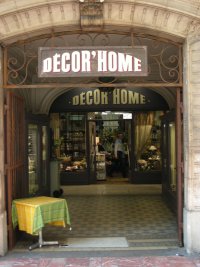
At first glance, the shopping district in Perpignan seems to be quite small and compact. It’s mostly a pedestrian area and even those areas where it isn’t, the streets are narrow enough to really slow down both the speed and the volume of the traffic considerably so it ends up with a very calm feel to it.
After a while though, you realise that there are a whole lot more shops than you first saw because many are set back from the street in little courtyards like the one you can see here. In fact, we’ve only really started to discover the true size of the shopping area recently as many of these little courtyards contain not one but often four or five of the little shops.
They’re all different too. This one is relatively ordinary in that it’s effectively just got a longer than normal entrance hall but others come with statues, waterfalls, and the like. The range of shops is much greater than those directly on the main street where you’ll generally find the international shop brands. It’s in these little courtyards that you find the more unique shops.
Of course, the biggest plus point of this arrangement is that in the Summer, the courtyards are a good deal cooler than the street. Airconditioning isn’t that widespread here at the moment so these little courtyard shops and restaurants provide a welcome break from the intense July and August heat.
Anyway, if you’re here on a visit, keep an eye out for them and explore some of the courtyard shops of Perpignan.
Copyright © 2004-2014 by Foreign Perspectives. All rights reserved.

