Archive for the ‘Society’ Category
 Posted in
Updating the photos for the website
 September 7th, 2006 |
  Author:
  These days when people buy a holiday accommodation property one of the first things that they think of is their website. That’s no bad thing although many people think that their website is all the marketing that they need. Still, it’s a start.
However, where a lot of people go wrong is that once they’ve produced their website, they think that’s it. It’s not as if it needs maintenance like the building obviously does, is it?
Well, yes, it does need maintenance. Oh, it will continue to work for many years but it’ll get more and more dated as time goes on which is never good. If you don’t think that’s true, pick any website that’s been around for a while and look at what it was like even 5 years ago never mind 10 using the Way Back Machine [www.archive.org]. I think you’ll find that any successful website has changed substantially over that period of time.
I’ll touch on the various aspects of our 2007 update over the coming months but one aspect that is critical is the photography. Some people consider that they should get a professional photographer in to take their photos and that will get you the best photos of your place on the day they come to take them. The key point there is that they are the best photos “on the day”; why settle for that if you’re living there and can wait until the light is perfect, there are no clouds in the sky, etc.? Saying that you don’t have a suitable camera is no excuse as good digital cameras are available from £100 these days whereas a professional photographer could charge you anything up to £500. More importantly than the money saved is that if you are taking the photos, you can update them for no extra cost and it’s not long before you need to update them by the time you consider that you’ve repainted a room, bought a new chair, even added a plant it doesn’t take long before the photo of a room becomes completely out of date.
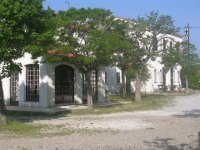
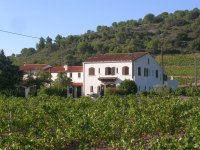 Anyway, we’ve started updating our property photos yet again and have moved to a new viewpoint for this year. The top photo is the one we’ve been using for about 18 months or so, the lower one is close to what we’re going to run with for the coming year (I forgot to get all the shutters open this morning, so have to retake it tomorrow morning).
The place seems quite different in the second photo, doesn’t it? Yet virtually nothing has changed on the outside of the building (we’ve been concentrating on the inside).
Arnold
Copyright © 2004-2014 by Foreign Perspectives. All rights reserved.Will your child have any problems getting into school in France?
If you’ve been watching the “moving to France” TV series that seem to be on almost non-stop these days, you’d think that there would be no problem in getting kids into school here. After all, the kids just seem to go to the local school and if they don’t speak French, it doesn’t seem to be a problem. Perhaps you’re thinking that the presence of a TV crew eases the process considerably and I’ve no doubt that it does. However, we’ve friends and aquaintances in other regions of France and they’ve never had a problem in getting their children enrolled in school regardless of age or ability in French.
Things are different in the Pyrenees Orientale though.
If your child isn’t a fluent French speaker by the time they hit 16, then they will not be educated by any school in the state education system within the Pyrenees Orientale. What happens at that age is that you are passed onto Inspection Academic who in turn pass you on to the College Albert Camus and specifically the CIPPA class so that you can learn French and thereby get into an appropriate lycee (for age 17-18). There is only one problem with that scenario: Madame Benzine runs CIPPA as a remedial class for children from French speaking countries and just treats any non-French speakers as an inconvenience to be gotten rid of as soon as possible. The net effect of that is that if your child has no other option than CIPPA (and they won’t be given any other option if they reach 16 and don’t speak French fluently here), then that’s the end of their education.
Surely, not? Don’t children have some right to education up to 18? I thought so, but apparently the French locally read the fact that schooling is optional after age 16 as meaning that they don’t need to provide it and in particular don’t need to provide any means to teach you French after age 16. Having said that, everyone in the administrative side of education seems to think that CIPPA does actually teach French (and perhaps it is supposed to) but Madame Benzine chooses to ignore that and seems to go out of her way to encourage non-French speakers to leave the class as soon as possible. “You missed a class because your car was being repaired and the bus drivers were on strike? You should have walked in”. “How? It’s over 30km: it would have taken five or six hours”. “I gave him a question sheet every morning and he didn’t answer any of the questions on it. He has no motivation.” Emmm, he can’t read French and couldn’t understand the questions. “It’s mathematics: of course he could understand it:. He’s just lazy. ” Actually, no, because the questions are entirely in French. That’s the kind of person running CIPPA in Perpignan.
It’s not much easier from age 11 to 16 either, as all colleges that don’t have to take your child, quite simply won’t take them if they don’t speak fluent French (and I do stress “fluent”: they won’t accept anything less). Instead, they will direct you toward the Inspection Academic in Perpignan who in turn will pass directly to the CIPPA class. If your child is in that age range, you can get them accepted into the college designated for your commune but even then it’s not always easy but never accept the CIPPA option if your child is in that age range.
What about primary school then? That’s a little easier than the college as they are attached to the various mairies therefore the one associated with your commune will have to take your children from age 6 to 11. However, those not attached to your commune will usually refuse to accept your child unless they happen to be fluent French speakers. Would you be happy with your 11 year old having to get up around 6am to catch the first bus into town, then changing buses in the centre of town to get to a remedial class in a country where they don’t speak the language? That’s the option you’ll be given if you don’t push the matter with your own mairie.
We have, surprisingly, managed nursery school with, so far, no problems. However, we fully expect that James will encounter problems getting into primary school in this area. Even now, the local doctor couldn’t understand why he couldn’t speak French. Why would he? If we spoke French to him he’d just end up with a dreadful French accent not to mention bad grammar and vocabulary. Oh, and he’d not learn to speak English.
The strange thing is that the French always talk about integrating immigrants into French society. I don’t know about elsewhere, but in the Pyrenees Orientale, it’s definitely all talk because there’s certainly no support given to you if your children don’t speak fluent French.
The other strange thing is that the teachers (except Madame Benzine) all seem to be quite supportive of the kids and fully expect that children of all ages will pick up the language fairly quickly. The problem seems to be that the administrators simply won’t let them try and without the approval of an administrator you just can’t get into a school.
Arnold
Copyright © 2004-2014 by Foreign Perspectives. All rights reserved.Learning Spanish in Galicia with the Open University
I spent the third week of August in Santiago de Compostela on an intensive residential as part of the Open University’s Spanish programme.
When you get all the documentation about the residential school a few months in advance the immediate reaction of most people is “Ahhhhh!!!! I can’t do this!” but in reality the relaxed atmosphere makes it seem relatively easy once you get going on it. As it’s part of a second year university course, right from registration on Saturday through to checking out on Friday, everyone is quite insistent that Spanish is spoken all the time. It might seem hard at the time but the idea is to force you to think in Spanish and to do that the best approach is to “live” in Spanish as far as possible.
As it was going to be quite a packed week, I went on the Friday which made for quite a relaxing Saturday (or would have done if I’d not walked right round Santiago in the morning) as the enrollment doesn’t start ’til after 2pm and the course doesn’t formally start until 7pm with the introductory lecture and first introductory class. Usually the first class seems to be amongst the hardest as if you’re not that fluent it’s often difficult to keep the Spanish operational late into the evening.
Sunday was quite short and not really as good as it could have been. In the French residential you have to write up a questionnaire in the morning and then go around the town interviewing people but in the Spanish one, we were given the questionnaire which I didn’t find to be nearly as useful in terms of learning and using Spanish. One unexpected problem we found that the very high proportion of tourists on the Sunday meant that we were often asking tourists the questions rather than the locals.
For the rest of the week, classes generally run all morning with the afternoons being effectively free though included in that “free” time is a visit to the cathedral and La Coruna. Surprisingly, Friday was actually quite a full day as it usually winds down with people leaving for their flights but the departure times in Santiago are quite convenient for the course so just about everyone was there until lunchtime.
Was it a good course though? I think so. Yes, it didn’t seem intensive but with around 20 hours Spanish classes in a week that’s what it was. The relaxed atmosphere makes it feel easier than it is but you do work hard and are tired at the end of each day. One thing that did surprise me was that all of the lecture rooms that were available to us were very much lecture rooms. The fixed rows of seats don’t really fit in that well with modern language teaching as it tends to involve a lot of group work and therefore moveable tables are much better. I assume that this seating arrangement is typical for Spanish universities but don’t really know for sure.
Strangely for a language course, the OU doesn’t have a residential for the final year of the Spanish course when most people feel that they’d need it most. Net effect is that a group of the tutors got together and set up what is effectively the OU residential in Alicante. Unfortunately, it isn’t part of the OU and therefore they can’t really advertise it as such so it’s a much smaller affair and only runs one week. It’s also quite expensive at around £500 for the week. However, there are alternatives to that and indeed the University of Santiago runs two week courses for around £400 so, at the moment, I’m thinking that I’ll do that next year: almost twice as much Spanish for £100 less seems like a good deal to me.
Copyright © 2004-2014 by Foreign Perspectives. All rights reserved.Santiago de Compostella – what is it really like?
Santiago is world famous for its magificent cathedral and the thousands of pilgrims that it attracts throughout the year, but what is the town really like?
In fact the section of the town that is most famous is actually quite small. It’s very easy to walk right around the famous section in under an hour if you don’t dawdle and in fact almost all of the tourists and pilgrims (it’s often difficult to distinguish between them) see a very small portion of the town which is consequently incredibly crowded. Even in the evening you can find it difficult to get a table in a restaurant, despite the large number of them in this area.
However, it doesn’t take much of a walk to get outside the touristy parts of the town. Almost everyone appears to cross the road from the park and walk along the Rua Franco to the cathedral which makes this, of course, one of the most crowded streets in the town. But, if instead of going straight towards the cathedral, you turn right within a few hundred yards you’ll find yourself in the modern section of the town which is full of “normal” shops and almost completely devoid of tourists. You almost get the impression that the inhabitants of the town like it that way as you’re immediately into a very Gallician area with signs in the local language rather than Spanish.
Whereas the tourist sections are lively at night with street theatre, in the modern town you don’t get any of that and the streets are almost deserted when it gets dark. If you’re looking for nightlife it seems to be best to stick to the areas around the cathedral as we found that most things seemed to close down around 10pm in the new town with just a few things such as some restaurants and cinemas staying open a little later than that. If you want to watch a film, bear in mind that in the new town all the films are in Spanish and there are no subtitles.
If you’re looking for a quiet stroll in the evening, try some of the numerous parks in the new town. In many cases, you’ll find that you have the places pretty much to yourself which makes a welcome change from pushing through the crowded streets in the cathedral area. There aren’t nearly as many restaurants in this area but it’s very easy to get a table and, of course, you get much more authentic Gallician food than you’ll find in the restaurants in the tourist area.
Copyright © 2004-2014 by Foreign Perspectives. All rights reserved.Protests in Gallicia against the fires
 You may have seen news of the extensive fires in the Gallician countryside over the last couple of weeks.
Naturally, in the summer fire breaks out in numerous areas of Spain but a considerable number of these were set deliberately. I was staying at the University of Santiago and the fires came within about 1km of the university campus which is rather too close for comfort. Think of the heat and smoke coming from a log fire in your home and magnify that 1000 fold and you’ll get some idea of the problems that this causes. Surprisingly though, some homes on the hill opposite the university seemed to be virtually intact despite having been surrounded by the intense forest fires. I wonder though if they were quite so unscathed as they appeared to be when seen from a distance?
The fires were largely spent by the time I arrived but by that time the population had begun to hold a series of protest rallies. Interestingly for me was that they felt very much like the protest rallies that you see now and again in Northern Ireland so I guess this is another sign of the celtic heritage of the region. Even the slogans were quite similar with “Ulster says No” translating to “Nunca Mais” (Never Again) and, of course, the use of bagpipes. All that was absent was the police in riot gear!
Arnold
Copyright © 2004-2014 by Foreign Perspectives. All rights reserved.

