Archive for the ‘Politics’ Category
 Posted in
Indicators of peace
 July 8th, 2007 |
  Author:
 Northern Ireland hasn’t been in the international news much lately but that’s not really an indication of peace as such, more an indication that violence isn’t happening which isn’t quite the same thing (welcome as non-violence always is, of course).
In fact the first indications of the arrival of peace was on its way started quite a number of years ago and, to my mind, was the arrival of the supermarket chain Tesco in 1997. Prior to that the only UK supermarket chain operating in Northern Ireland was Marks & Spencer which had opened in 1967, 2 years prior to the start of the troubles, and hadn’t bothered expanding much since then. Nothing really says that peace is coming quite like big chunks of cash being invested.
However, the more certain arrival of peace (as opposed merely to reducing violence) was really only in the last few years and that has been marked in two very noticeable ways. Firstly the investments being made in the local economy are massive these days: you can’t drive more than a mile or two in Belfast without seeing building works of some kind. That’s also an aspect of the second point which is that there has been a large scale migration to Northern Ireland by everyone from the Poles to those that left because of the violence. Combine those two and the booming of the economy is very noticeable.
One very obvious side-effect of that mass immigration is that the house prices are going through the roof (hence the building work everywhere, of course) which is effectively a catching up on rises that didn’t happen in the last 30 years. The banks don’t seem to know what has hit them and mortgages are now available for up to 8 time salary (vs the maximum of 3 times just 3 or 4 years ago).
Anyway, at least Northern Ireland can now stand as an example of what it’s like when you do get to the end of the violence. Hopefully, it’ll provide an encouraging example to areas of the world that are still immersed in a culture of violence such as Colombia.
Copyright © 2004-2014 by Foreign Perspectives. All rights reserved.Is it right to support terrorism when you’re just trying to protect people?
Kyle over at immigration orange always has thought provoking articles and one of the most thought provoking that he has had recently was his piece on the support of terrorists in Colombia by Chiquita Brands.
Chiquita didn’t just decide to support terrorists for the sake of killing people, it justified paying $1.7 million by considering it as protection money for its employees. Does that make it right though? Well, no, it doesn’t but it’s only one high profile example of people making decisions that are expedient at the time.
However, that’s the least of the problems that such support causes. Although the public perception of their aims might be different, terrorist organisations often co-operate with one another and some of that money from Chiquita no doubt found its way back to fund killing of people in Northern Ireland. Would Chiquita be quite so happy if some of their money is found to have been used to fund terrorism in America too?
The fundamental problem is that a number of products that everyone buys are produced in countries where peace is something that might come in the future and the reality of the present day is violence from one or more groups within the country. Doing business in a country like that does entail problems and there is no short-term way around that.
Unfortunately the short-term alternatives aren’t great either. Chiquita and others pulling out of Colombia doesn’t make the problem go away as others will take over the plantations and those bananas will still be sold internationally. In fact, if that wasn’t the case the impact on the Colombian economy could be catastrophic which wouldn’t be good for the cause of peace either: as seems very clear with the recent experiences in Northern Ireland, a strong economy makes the incentive for terrorism dry up very quickly.
We can’t know for sure what Chiquita’s money was used for but $1.7 million is an awful lot of money that would have been much better spent in the cause of peace.
Copyright © 2004-2014 by Foreign Perspectives. All rights reserved.A playground for Mo
 I’m sure that it’s been there for ages but I just noticed that the playground in the ground of the Stormont Estate had been dedicated to the memory of Mo Mowlam.Mo was one of the many politicians who have fallen by the wayside along the path to peace in Northern Ireland. As Secretary of State for Northern Ireland from 1997 to 1999 it was she who presided over the Good Friday Agreement which is essentially the basis that has established peace although, as can only be expected, it did take quite a while after the signing of that agreement way back in 1998 before various pieces of the puzzle fell into place and a few years after that before people in NI and elsewhere finally got around to accepting that peace had apparently arrived.
Whilst most politicians end up with something or other named after them, it does seem particularly appropriate that Mo gets a playground. Even in the hectic schedule that she had during her time in NI, she still managed to get the time to get a special royal garden party for children organised in 1999. Yes, there were heaps of people behind the scenes doing the legwork for that but she made it very clear on the day that she regarded the children as important and personally led a posse of them around Hillsborough Castle. Somehow I just can’t picture Patrick Mayhew doing something similar.
As well as the childrens’ garden party, she was the one that opened up the grounds of the Stormont Estate more generally to the public and there seem to be a good deal more people using them these days than there were before her time and, of course, the playground is one aspect of that opening up.
Anyway, thanks Mo. It’s a great playground.
Copyright © 2004-2014 by Foreign Perspectives. All rights reserved.Is global warming a good thing?
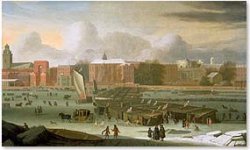
Almost all of the press coverage that you see is of the view that global warming is a “bad thing” and we should be getting the finger out to stop it happening. But, is it?
This is a painting by Hondius in 1684 of one of the regular Frost Fairs taking place on the Thames. In fact both the Thames and the Baltic Sea froze over quite regularly in the 1600s.
That was prior to the industrial revolution of course and combined with a much lower population, pollution at that time was considerably less than it would have been 150 or so years later. The “Black Country” wasn’t named that for nothing as it was filled with major league polluters during the industrial revolution.
Did the industrial revolution stop us getting into another ice age? Nobody can really say as there are just too many variables in the equation: you’ve everything from the industrial revolution raising pollution levels considerably to sunspot cycles and to top it all the records over the period simply weren’t accurate or complete enough to really give a definitive answer.
What if the alternative to global warming were global cooling? Would that be a “good thing”?
Copyright © 2004-2014 by Foreign Perspectives. All rights reserved.So it’s Sarkozy: what now for France?
The margin was relatively slim (53/47) but France has, much to my surprise, chosen the president that it needs at this time.
His first hundred days are likely to be turbulent ones and I suspect that last nights riots across France are merely a taster of things to come. Many of his policies seem to run against the deep socialist grain of French thought and practices.
The 35 hour week is to be reviewed. That was one of the planks of job creation from the socialist era. Reduce the time that anyone is allowed to work and everyone will have more work, won’t they? Well, perhaps in theory if you drop the permitted working hours by 10% you might think that employers will need 10% more people to get through the work but that’s only going to work with cuts much larger than 10%. As is clear everywhere else in the world, semi-parttime workers get through just as much work as full-time workers do.
Immigration rules are to be tightened up. This one seems pretty strange coming from the son of immigrants. The counterpart to this is that he seems likely to work with the countries in northern Africa to form a kind of African Union to help improve the economies of those countries.
France is to become a little bit more capitalist too as he plans to reduce the regulations on businesses to make the job creation process much easier. Taxes too are to be reduced to improve the incentive to work.
Will he have the strength of character to follow through on these reforms is the biggest question though. I think he will: he seems to have that inner strength that is so necessary to do it.
Copyright © 2004-2014 by Foreign Perspectives. All rights reserved.

