Archive for the ‘Culture’ Category
 Posted in
How to be an illegal immigrant in France and avoid deportation
 April 25th, 2007 |
  Author:
 One wonders whether that title will attract the attention of the French authorities but it probably won’t.
We’ve been living here for over three years now with no residence permit (Carte de Séjour) for Wendy and now pretty much accept that she’ll almost certainly never get one. Now, in every other country that would be something of a problem in that Wendy would be deported indeed she would already have been deported. Not in France though.
How come we can do that?
Well, what we did was apply for her Carte de Séjour within 90 days of us arriving here. Actually, we applied for the European version of that ie the Carte de Séjour Europeenne but that wouldn’t really have mattered as it turns out.
The CdS is something of an unusual beast in that the only documents that the authorities are legally allowed to ask for are a passport and a proof of relationship. This being France, they actually asked for around 30 separate documents which we refused to provide and there things stopped. We received no further contact from the Prefecture (who are responsible for issuing it) but did enquire a few times and they said they were awaiting for documentation from us (ie the documents that we had refused to supply).
About a year later, we thought we’d have another go. Different staff this time, and we managed to get somewhat further, eventually ending up with a letter from OMI (the immigration department) asking for EUR 220. As noted above the only things that they can legally ask for are a passport and proof of relationship, there’s no mention of money in the European law because they’re not allowed to ask for any. So, I sent off a letter pointing this out. No response.
Late last year, we made a start yet again. Turns out that they had lost the file (although, funnily enough, they seemed able to refer to some information that it contained!). Anyway, different staff again and we were assured that the permit was on its way. The temporary permit arrived in due course and, as it’s about to expire, we enquired. That in turn triggered off the letter from OMI with a bill this time of EUR 275 so I must dig out my own letter again.
So, if you fancy being an illegal alien in France, it’s really very easy. Once you get here, apply for your Carte de Séjour but leave out a few documents that they’re asking for. This totally throws the system apparently as we were told several times that our file had been put to the one side awaiting the documents which, of course, were never going to arrive. Eventually, your file is put away and nobody is ever likely to follow up on it after that happens.
This relies on one aspect that seems innately French: they obey authority and said authority assumes that it will be obeyed ie if they demand some document, then obviously it will arrive. Step outside that framework and it totally throws the system.
So, if you fancy being an illegal immigrant in Europe, don’t bother with the UK as they’ll deport you for sure. Head for France, apply for your Carte de Séjour but omit at least one document asked for and then just settle into life here.
Copyright © 2004-2014 by Foreign Perspectives. All rights reserved.Strawberry, honey, truffles, you name it, they’ve got a festival for it!
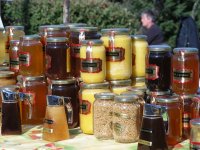 With start of April starts the onslaught of the festivals for just about every fruit, vegetable or drink you could name.The one problem with them is that you’ve really no idea in advance whether or not a given festival will be a popular one or just a few stalls trying to sell some obscure vegetable.
One of the best we’ve been to lately was the strawberry festival at Bellesta which is a village quite close to us but one we’d not been to before. They were lucky enough to hold the festival on a particularly sunny day following some of the last of the Winter rain. Combine that with the Vide Grenier (car boot sale or flea market) and the village was seriously struggling under the weight of traffic and people looking for parking spots on the day.
In fact, there were only two small stalls selling strawberries but the other stalls gave a very good representation of the local produce ranging from excellent honey as you can see, through the spicy sausages that you find everywhere here, and olives. Strangely, the wine makers didn’t have a big presence but then there are numerous wine festivals from now through to harvest time.
The majority of the festivals are only publicised locally so it’s potluck as to whether or not you’ll see the sign for one as you travel along the road. Larger villages are generally a better bet than small ones but really you can get a wonderful experience from even the tiniest village which is, of course, as happens in what we’d call church fetes.
Copyright © 2004-2014 by Foreign Perspectives. All rights reserved.Ice Cream Vans as an indication of attitudes about the climate
 Although Northern Ireland is definitely cooler than the south of France, one surprising difference is that Northern Ireland has icecream vans at just about every possible location that you’d find crowds of people whereas France seems to have none of these.That’s indicative of quite a different attitude towards the climate in general between NI and France which we’ve seen illustrated numerous times whilst we’ve been here.
As soon as the temperature drops below around 30c over here, all the locals don their Winter coats. Not just any old Winter coat either for the coats on sale in the local shops seem more suited to Arctic conditions than the, usually, very mild Winters that we get here. Although it’s been warm enough for us to be running around in t-shirts almost all the time since March 2006 (yes, all year), the local population has been wearing their heavy coats since late September.
Perhaps the most noticeable difference that we’ve seen though is when our son was born here at the end of August. As you can imagine, it was pretty hot then (high 30s) and the maternity ward was even warmer than that. Now, I know that the rule is to wrap up babies after they’re born but with those kind of temperatures, we just put a nappy on him and nothing else. Yet, every time the nurses came into the room they insisted in wrapping him in three layers of clothing. Net effect? Well, if we’d stayed any longer he’d have been dehydrated as the sweat was just pouring out of him with all that clothing and he clearly wasn’t comfortable.
He’s still considerably behind in his vaccinations too because anytime that we’ve taken him along between roughly March and October they announce that he’s got a fever and can’t get the vaccination. Even outside that time, it’s often warm enough for him to “have a fever” so we’re lucky if we manage one vaccination per year.
So, whilst the icecream vans appear in Northern Ireland in March at perhaps 15c, you’d be unlikely to find anything similar below 25c over here.
Copyright © 2004-2014 by Foreign Perspectives. All rights reserved.An Australian, an Irishman and a Frenchman…
An Australian, an Irishman and a Frenchman were sitting in a pub.
Australian: Gee, it’s wet today.
Irishman: Sure is, almost as wet as we get in the west coast of Ireland.
Frenchman: You’re not French. You’re not allowed to criticise the weather in France. I’m going to start a poster campaign against you and have someone come round and smash your place up.
Australian: Wow, do you mean that the weather in France is just the same as it is here in Belfast today?
This one is specially for SuperFrenchie 🙂
Copyright © 2004-2014 by Foreign Perspectives. All rights reserved.Buying a house in france: part 14: housing: your house in the UK
We’re looked at French housing, but what about your house in the UK?
Even if you are absolutely certain that you are going to spend the rest of your life in France, it’s best to retain your house in the UK if you can so that you have a fall-back position in case things don’t work out in France or you change your mind about living here. Not everyone is able to maintain houses in two countries of course and it will probably make finances a little tighter in France than they would otherwise be. However, once you sell your house in the UK you can find it very difficult to get back into the housing market. In our own case, our UK house went up over 40% in less than three years and effectively beyond our reach had we sold it when we moved.
If you are lucky enough to be able to keep it, you should try to rent it out. Not only will this keep the house occupied but it will help pay the mortgage etc. without needing to rely on income from France to pay for the various bills that will arise in the UK.
If you are going down the rental route, you will almost certainly need to change your mortgage to a buy to let one as few normal residential mortgages allow you to rent out your property easily. Your house insurance also needs to change to reflect the fact that you will have tenants in the house and that it may be unoccupied for extended periods of time between tenants (don’t rely on 100% occupancy!).
Although you could try to find tenants yourself, it’s much simpler to arrange the rentals through a letting agency as they can arrange for work to be done and to inspect the house before during and after each tenancy. This service usually costs around 10% of the rental income plus advertising costs of around 100 in advance of each tenancy.
Costs will continue during periods that you don’t have tenants. For instance, you are still liable for aspects of the electricity, gas and water bills. Throughout your ownership you also need to pay council tax / rates and, of course, insurance.
It’s difficult to be definitive about this decision. Keeping a house in the UK does entail a lot of costs from insurance to mortgage not to mention the additional effort that you need to put into managing your house (even if you have a letting agent). However, selling can be quite a permanent thing to do if you live in an area where prices move quickly and, to my mind, it’s best to retain your house as a fall-back should things in France not work out as you expect.
If you do decide that selling is the best option for you, it’s best to get this in motion before you leave the UK as otherwise you could find yourself liable for French capital gains tax on the proceeds of any sale.
Separately, but related to this topic, is the issue of maintaining a UK postal address. This is one thing that is definitely advantageous to do. If you can change the address for several credit cards to that of a friend or family member before you go, this will effectively move your credit history to their address which we have found to be very useful over the years.
Next week, we move onto French banking.
Copyright © 2004-2014 by Foreign Perspectives. All rights reserved.

