Archive for the ‘Culture’ Category
 Posted in
Buying a house in France: part 13: housing: the buying process
 March 29th, 2007 |
  Author:
  In many ways, the house buying process in France is quite similar to that in the UK but there are important differences.
Once you’ve found a place, the first stage is to sign a Promis d’Achat (promise to buy). If the seller accepts this, then you have your house as they aren’t allowed to even show it to anyone else (ie no gazumping), subject to you following through with the later stages of the purchase, of course. Signing this commits you to buy the place at the agreed price but only commits the seller to sell to you if they accept this contract.
Since it commits you to buying, you MUST add a “subject to mortgage” clause if you plan on getting a mortgage for the purchase. The mortgage clause needs to include the bank that will be giving you the mortgage, the rate and the term of the mortgage so if you are hoping to get a French mortgage you’ll need to see the bank first. If you haven’t done so already, you should open a French bank account at this stage (links to the various banks are in the Foreign Perspectives directory) During the next two weeks or so the notary will draw up the Compris d’Achat which is the sale contract and will come with an inventory of what’s included in the price and a completion date for the sale. You need to pay a deposit of 10% (sometimes 5%) to the notary at this point. Although you and the seller can use the same notary, it’s best to have your own one (this doesn’t cost any extra as the notaries split the fees). Read the inventory very carefully as what is understood to be included in France is very different to what is understood in the UK. For instance, you can be left with bare wires where light fittings used to be and even gaps where there used to be doors.
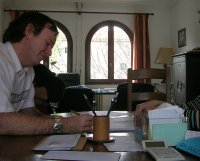
On the completion date, you go along to the office of the sellers notary and sign for the property. You need to sign every single page of the contract so allow an hour or perhaps two to do this. Once completed, the property and everything in it is yours. Unlike in the UK, everything you find within the property at that point belongs to you which sometimes includes the likes of unwashed dishes in the sink but can also include furniture and the like eg in our case we acquired a very nice desk valued at 9,000‚€!
Once the sale is completed, the estate agent will arrange to have the electricity, phone, etc. transferred into your name. If you are buying a commercial property (eg B&B) you must be registered with the Chambre of Commerce before these can be transferred into your name.
Copyright © 2004-2014 by Foreign Perspectives. All rights reserved.The French Royal election campaign
 In years gone by the French were one of the most backward nations in the world with their use of the Internet. They stuck resolutely to their France-only Minitel system and, for the most part, refused to have anything to do with the American-dominated Internet.
That situation is changing very quickly. For example, whilst we had our first ever online reservation from a French person just two Summers ago, nowadays they are commonplace. So, it’s not surprising that the election campaign has gone online in an equally big way. Blogs are coming to be an expected part of that with the Royal campaign blog started early on and campaigning even taking place on SecondLife. Not so long ago, I’d have said that the SecondLife campaign office was totally crazy but apparently the swing against the recent EU referendum was started with the blog from an obscure teacher in Marseille so it would appear possible to swing public opinion in the real world from our vantage point in the virtual one, even in France.
But what about the real politics? Royal prefers intuition to ideology and is said to be good on the “small things” that arise in truly local politics and weak on the bigger picture. She is deliberately vague and promises to consult the people which are, in some ways, excellent approaches. The problem is that when one consults the people one finds out what the people want, not necessarily what they need.
Where she is more specific there are clear contradictions in her policies. In her economic policy objectives she wants to raise the minimum wage substantially, to abolish the CNE labour law (which makes hiring & firing easier for small companies) and to promote even more mass-unionisation (in an already highly unionised country), all clear job destroyers. Yet, on the other hand, she also hopes to create 500,000 youth jobs, generate training opportunities for longer term unemployed youths and even review the 35 hour week. Those two groups of objectives seem to be in clear opposition. Throughout her policies there is the underlying strand of more state intervention with talk of state aid (barely mentioned elsewhere in the world), increased tax on dividends (thus discouraging investment), state regulation of banking fees (no doubt to support the indigenous banks) and renationalisation of EDF/GDF.
What about Sarkozy though? Well, to our eyes he appears more of a “normal” western European politician with his hopes to encourage the job creators to return home to France, to cut taxes and generally free up the state burden on the population. However, he’s unlikely to do much about the farming subsidies or go far to address France’s head in the sand approach to globalisation.
The problem that both face on behalf of the country is that, whilst they might complain about their taxes, the French like their cozy system of benefits and jobs for life. After all, why would anyone want to bother working a 40 hour week when they could work a 35 hour week for the same salary? For that matter, if Royal’s proposal to take unemployment benefit to 90% of that received from one’s previous job, why would anyone want to work at all? This approach is quite typically French in totally ignoring what the rest of the world is getting up to. That, of course, is the main problem with French politics. For example, when an attempt was made to make it easier to hire & fire young people in early 2006, the predictable result was riots in the streets and, equally predictably, a climbdown by the government. Whilst the people needed jobs, what they wanted were jobs for life.
I suspect that this time around the French people will get what they want which is pretty much what Royal has on offer. However, what they need is Sarkozy, if he’s strong enough to push through his policies in spite of certain opposition to a number of them.
Copyright © 2004-2014 by Foreign Perspectives. All rights reserved.Winter in the south of France: global warming in action?

The photo shows the kind of weather we were expecting to get this February but in reality that photo was taken in January 2006.
Naturally, everyone went out and bought snow chains after the snow that you see in the photo. In fact, that is the only day that we have had snow in three years. All that snow landed in a matter of hours one day in January last year, was completely gone the next day and a few days afterwards we were back into the t-shirts.
This year we’ve not had any snow yet and have been in the t-shirts almost every day since February last year. Even the usual wind that comes mainly in the Winter in this area has kept away so we’ve been eating lunch outside nearly all of the time. Even more peculiar is the sight of the locals sunning themselves in the cafés around the town when ordinarily they wear really serious Winter clothing from mid-September through to the following May but with temperatures regularly over 20c for ages, even they are starting to adjust their habits.
Since we’re now equipped with snow chains, we were hoping to head out to one of the local ski resorts a few times over the Winter but even they have only been opened relatively recently compared to the more normal November to March. Net effect is that instead of ski-ers staying with us we’ve had normal tourists looking for somewhere a little warmer than more northerly parts of Europe.
Copyright © 2004-2014 by Foreign Perspectives. All rights reserved.Language and culture: are they inextricably interlinked?
I participated in quite an extended debate on an excellent English language website written by a French expat living in America recently.
Along the way a number of issues were raised which I never really thought a great deal about before and it was interesting to see a French view expressed on many of them. One in particular was their view that you just couldn’t separate language from culture. From a French perspective the two are indivisible: you can’t have French culture without it being in the French language.
In the English speaking world the two are quite separate. India clearly isn’t an Anglo-saxon culture yet they speak English and even Hong-Kong remained very much a Chinese culture even when it was a British colony. Yet, the French would seemingly argue that both India and Hong-Kong are Anglo-Saxon.
Even the French world has examples of the separation these days. France24 put out a full English-language news service yet it is still quite clearly a French channel. Perhaps the most interesting example though is of the TV series Nikita which although based on the French film of the same name was made entirely in English yet still came across as a French series.
The other thing that I found odd was that they seemingly considered all English speakers to be Anglo-Saxon which I suppose is reasonable if you start with the premise that language and culture aren’t separable.
It was also a little strange to come across a group of people from a fairly major language grouping who were so defensive about their language. You’dt from a group speaking very much a minority language, not from speakers of one of the top 15 world languages. For instance, they have a law that says all government services must of be offered in French. OK, it’s France so you would expect them to be in French but why should that require a law?
Copyright © 2004-2014 by Foreign Perspectives. All rights reserved.Is neutrality ethical in wartime?
 Frenchless in France raised the issue of how ethical it really was for Switzerland to be neutral during the war.
I’ve always thought of it being a noble thing to be neutral but as she pointed out there is another side to that neutrality. Swizerland turned away many refugees that could have escaped persecution under the Nazi regime. Yes, there were many Swiss who did help a great many refugees but as a nation they rejected all of them. Aside from that there is the issue as to what would have happened had the war gone Hitler’s way. Would that neutrality have been respected had Switzerland found itself surrounded by Nazi occupied countries? I think not.
I’m sure that it is useful to have a neutral venue like Swizerland to hold peace talks and the like but it seems to me that it can come at a terrible price during wartime.
Copyright © 2004-2014 by Foreign Perspectives. All rights reserved.

