Archive for the ‘Immigration’ Category
 Posted in
The traffic in France on the last week of the holidays
 August 17th, 2007 |
  Author:
 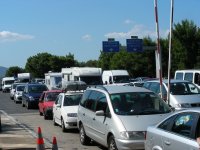 Actually, it’s not the last week of the holidays but the French don’t go on holiday in the last week so it’s the last week that they are on holiday.
Traffic isn’t quite the word we’re looking for either, as in many places the motorways are pretty much carparks rather than places where traffic actually moves. Many people think that they can avoid the snarlups by simply leaving the motorway when the traffic gets too heavy but, as you can see, a LOT of people think the same thing so you can look forward to tailbacks at every motorway exit.
But you’re thinking “ah, I’ll use my in car navigator and avoid the queues”. Well, no, that doesn’t work either as when the price of Tom Tom and the like dropped last year, loads of people bought them and you’ll see massive tail-backs on the recommended routes. They’re actually worse than the motorways as the navigation units tend to direct you along B roads which elsewhere would be fine but in France these are often quite windy roads and, in many cases, they’re just not up to coping with the traffic volume that the navigation units are now directing down them.
Your best plan is to find somewhere nice for today and tomorrow and stay there. Not only will this avoid needless aggravation on the roads but you’ll also miss out on the incredibly aggressive driving that this generates and indeed the corresponding jump in road accidents.
Copyright © 2004-2014 by Foreign Perspectives. All rights reserved.Traffic on the first weekend of August
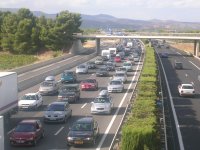 As usual on the first weekend of August, the traffic has been heavy here since shortly after breakfast and it’ll likely stay that way until early tomorrow morning.
How come?
Well, it’s the start of the holiday season in France and a number of other European countries so everyone has jumped in their car this morning and started driving. As you’d expect, by the time they get to the south of France they’re both tired and cranky (a bad combination for a driver, of course) and therefore the number of traffic accidents also leaps this weekend.
It’s best not to attempt to drive anywhere on this particular weekend. Just about every road has traffic way above the capacity which it was designed for and the queues are correspondingly long and wearisome. The queue on the left of the photo is created by having three lanes of traffic at 130km/hr going down to two lanes at 10km/hr at the border which has the overall effect that the queue gets longer and longer as the day goes on (at the time of the photo in the late afternoon, the queue was getting on for 50km!).
You might be thinking that you can avoid the traffic by going on the side-roads. Think again: everyone has already thought of that and the side roads are just as busy. Those using in-car navigation aids will find that the queues on the recommended routes are even worse as a lot of people are using those these days and, of course, they always recommend the same route.
Copyright © 2004-2014 by Foreign Perspectives. All rights reserved.Nanny at the airport
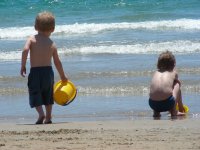 One of the stranger aspects of us living here is the different way that James & John refer to things.
As we’re in France, they aren’t picking up english from kids at school as they’d normally do but rather picking it up from home and the TV. This means that it’s possible for us to pick out where they’ve learnt a word. So, by and large, they “speak cooking” with an Australian accent and they “speak computer” with a Belfast accent.
It’s also interesting that whilst both James & John refer to “Granda” and “Nanny here”, James who used to be looked after by my parents has “Granda’s Nanny”, John who was born here has “Nanny at the airport” as that’s usually the last place that he sees her.
We think that it was because Wendy was looking after James a lot more when he was younger than I was that he has developed a largely Australian accent but with us both being around much more equally since John was born he has a much more pronounced Belfast accent. You’d have thought that since James has been here over 60% of his life now that his accent would have become more balanced but it hasn’t done, or at least not yet so I guess that it’s the first couple of years that are the most important in terms of accent
Copyright © 2004-2014 by Foreign Perspectives. All rights reserved.Indicators of peace
Northern Ireland hasn’t been in the international news much lately but that’s not really an indication of peace as such, more an indication that violence isn’t happening which isn’t quite the same thing (welcome as non-violence always is, of course).
In fact the first indications of the arrival of peace was on its way started quite a number of years ago and, to my mind, was the arrival of the supermarket chain Tesco in 1997. Prior to that the only UK supermarket chain operating in Northern Ireland was Marks & Spencer which had opened in 1967, 2 years prior to the start of the troubles, and hadn’t bothered expanding much since then. Nothing really says that peace is coming quite like big chunks of cash being invested.
However, the more certain arrival of peace (as opposed merely to reducing violence) was really only in the last few years and that has been marked in two very noticeable ways. Firstly the investments being made in the local economy are massive these days: you can’t drive more than a mile or two in Belfast without seeing building works of some kind. That’s also an aspect of the second point which is that there has been a large scale migration to Northern Ireland by everyone from the Poles to those that left because of the violence. Combine those two and the booming of the economy is very noticeable.
One very obvious side-effect of that mass immigration is that the house prices are going through the roof (hence the building work everywhere, of course) which is effectively a catching up on rises that didn’t happen in the last 30 years. The banks don’t seem to know what has hit them and mortgages are now available for up to 8 time salary (vs the maximum of 3 times just 3 or 4 years ago).
Anyway, at least Northern Ireland can now stand as an example of what it’s like when you do get to the end of the violence. Hopefully, it’ll provide an encouraging example to areas of the world that are still immersed in a culture of violence such as Colombia.
Copyright © 2004-2014 by Foreign Perspectives. All rights reserved.Bastille Day in Paris
In France, it’s called “le quatorze juillet” but everywhere else it’s definitely Bastille Day on July the 14th.
This is the biggest celebration in France and, whilst it’s marked by processions everywhere in France, Paris is definitely the best place to see it.
The centre of Paris becomes a huge pedestrian zone over the course of the morning up until the parade is finished. The metro system usually isn’t fully operational either and the stations close to the route are closed in the run-up to the start of the parade around 10am. After the various roadblocks are removed, the traffic is much worse than normal (hard as that may be to believe if you’ve experienced the normal Paris traffic!). Therefore, to see the parade you’ll need to be staying somewhere within walking distance of the centre; it’s not too late to book a hotel and there’s also the option of one of the network of apartments, many of which are quite central (we stayed in the Citadine at Les Halles).
 Unless you’re up very early, you’ll probably get a better view of the parade in one of the side streets rather than attempting to force your way through the massive crowds along the main parade going down the Champs-Elysee. You’ll miss seeing the president if you do this but realistically you’ve little chance to do that anyway as the best spots are taken up very early in the day. If you’re really set on seeing the president, the thing to do is to walk to the Elysee Palace just after the parade where you’ll see a continual stream of dignatories heading in for lunch.
 The evening sees the fireworks show based around the Eiffel Tower. The crowds here are massive but that doesn’t matter as by far the best way to get to the perfect spot is on one of the evening dinner cruises down the Seine. If you choose the second sitting, the boat arrives at the perfect spot just as the fireworks are starting. Although the prices obviously aren’t cheap, they are far from the astronomical level that you might expect on such a day and sailing down the Seine on the evening of Bastille Day is by far the most civilised way to end the day.
What about the Bastille itself? Well, the prison was demolished in 1789 by the revolutionary government and today Place de la Bastille is a massive roundabout.
Copyright © 2004-2014 by Foreign Perspectives. All rights reserved.

