Archive for the ‘Immigration’ Category
 Posted in
Don’t rent your car from ADA if you want any kind of customer service
 August 31st, 2007 |
  Author:
  ADA have been after me for quite a while now to add their logo to my sites, so here it is.
As you know, we’ve been renting a far from them since our own was wrecked by a tractor way back at the end of May. In that we’re quite a good customer for them you’d think that we would be due some brownie points for that, wouldn’t you?
Well, we’ve been renting the car for so long that they need it back as they’ve to return it to the leasing company and we agreed to make the changeover today.
We’d arranged to change it over at the airport as the town centre location is a bit of a nightmare to get in and out of plus it doesn’t have terribly long working hours.
Anyway, we dropped James off at school and off we went to the airport.
First off, we were going to have to pay for all the damage to the car. Kind of peculiar seeing as it was already damaged when we picked it up, eh?
Next he said he had a little two seater car for us. Yes, a car smaller than we had ordered and useless to us as we need at least a four seater. So, whereas other car hire firms would have been upgrading our car after such a long rental, ADA were going to make quite a downgrade.
Finally, he said he’d to do an authorisation on our card for another EUR 600. Now, that wouldn’t matter too much with a UK credit card but a French debit card it does. In particular it means that EUR 1200 would have been blocked in our account and in fact we’d not have been able to extend the car rental next week as planned.
Nope, he couldn’t do anything about any of that.
So, we’re sans-voiture. We’re also down EUR 70 as we needed to get a taxi to the school to collect James.
Next time, if there is one, I’ll tell them to collect the car if they want it because we certainly aren’t going to be helpful to them when there is zero service in response.
Copyright © 2004-2014 by Foreign Perspectives. All rights reserved.Is it really cheaper buying online?
Clearly it’s normally cheaper buying stuff online where no delivery is involved so, yes, buy your software online if it can be delivered via download. However, for big stuff it’s not necessarily the case that buying online is really cheaper.
Take our planned new car for instance….
The list price is EUR 13,000, the online price is EUR 12,000. However, few people pay the list price and in fact we have already gotten the offered price down to EUR 12,600 and hope to get that down a good deal more.
Even at that price though there’s little real difference from the online price. For one thing, if we get the online car delivered, they add EUR 600 ie the price would be the same. Even if we collect it ourselves that costs a fair bit as it’s in Paris and we’re in the south of France so if we drive up to get it that’s EUR 50 each way in tolls, plus EUR 50 in petrol each way, plus at least three hotel nights at around EUR 50 each: total, a minimum of EUR 350 and more than likely over EUR 400 but even that is before you count at least three days worth of meals which could easily add another EUR 200.
OK, so a car is a pretty big item to deliver and therefore it’s none too likely that you’ll find them on Amazon anytime soon but even for relatively light things the postage charge can exceed the savings that you make online unless the discount is very substantial.
Copyright © 2004-2014 by Foreign Perspectives. All rights reserved.Crazy car insurance companies in France
As you may recall, GAN insurance announced that our car was considered a write-off at the end of May.
Just this morning we have received the bill plus reminder that we’ve not paid the insurance for this year yet.
No, we don’t have a car at the moment but in France that doesn’t mean that you can get out of paying the insurance unless you’ve notified the insurance two months prior to the renewal that you don’t want it anymore. Yes, that is two months before they’ve told you how much it’s going to cost so the net effect is that it’s impossible to shop around for insurance in France.
In fact, if we don’t tell them by recorded delivery letter, in about two or three weeks we will receive notice that they are taking us to court for not renewing the insurance. A few weeks after that the letter giving us the court date will arrive. You might think that “obviously” they can’t win in court but in fact they can under French law. However, should it get that far, we won’t be using French law but rather European law which over-rides many French laws including this particular area of French insurance.
In that this appears to show that they haven’t acknowledged our claim, I’m tempted to ask them for a document saying that and insure our new car elsewhere.
Copyright © 2004-2014 by Foreign Perspectives. All rights reserved.Being obnoxious to get a reduction
By far the vast majority of our guests enjoy staying here but in the French holiday season we always get a few who go out of their way to find fault and always save up those faults to report them to us in the morning.
They’re always French because that’s how the French seem to go about demanding a reduction in the bill as they don’t believe that they should pay the extra required in the summer.
It’s easy to pick these ones out as they barely speak to you as you’re checking them in and showing them to the room. Whilst the French almost always take breakfast, these ones don’t as that’s another thing which makes the room too expensive.
Then, in the morning, they pick on one or two things which weren’t 100% right for them, demand a reduction and then threaten to report you to all and sundry. It’s always in that sequence too: they demand the reduction THEN they say they’ll report you to all in sundry ie it’s very much blackmail.
Thankfully they’re few and far between but we just received a particularly obnoxious variety of the species a few days ago. He actually found one thing that really was wrong with the room although as it was something which could be fixed in under 5 seconds he clearly couldn’t tell us about it when he arrived or he’d not have anything to complain about so instead he let a dripping cistern keep him awake all night.
He had a particularly interesting line of argument with the cistern. Seemingly he thought that a dripping cistern was enough to have the Prefecture close us down. That certainly would have an interesting effect if they did that because they’d need to close down just about every hotel in the world if that was enough reason to close a place.
As usual, he was rude and offensive, becoming more and more so as he realised that we weren’t going to give him a reduction in the price and he even continued in this vein as he left with assorted rude and offensive gestures as he left (narrowly missing a tree as he was steering with one hand).
Oh well, at least the summer season is pretty much over so that should be the last such example of the species we get until next year.
Copyright © 2004-2014 by Foreign Perspectives. All rights reserved.The rush is over
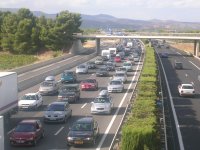 Whilst yesterday we rebooked a room within 10 minutes of putting it onto the system, tomorrow that won’t happen no matter how low we price the rooms because the French will have all gone home.
The fact that they all go home at the same time creates chaos on all of the roads in France. Whilst we notice the French retreat from Spain, of course they are doing exactly the same thing all over Europe so that the roads in all directions are packed with cars and drivers who have been on the road far too long.
It kicks off from before dawn and will run well into the early hours of Sunday morning. It’s one of the days of the year when we get requests for breakfast at 6am (nope, it’s 8am at the very earliest) as the French usually take to the roads around dawn. Others go to the opposite end of the day and we’ve one family who are planning on setting out later this evening with the hope that the traffic will have tailed off by then (it won’t).
Definitely not a day when you would want to be on the road in France!
Copyright © 2004-2014 by Foreign Perspectives. All rights reserved.

