Archive for the ‘Relocating’ Category
 Posted in
Buying a house in France: part 19: Post Office and Co-Operative bank accounts in France
 May 3rd, 2007 |
  Author:
  For historic reasons, the various post offices and co-operative banking organisations in Europe maintain loose connections with their opposite numbers in other countries and it’s therefore often useful to open accounts with these organisations before you move.For instance, the co-operative bank offer a service called Tipanet which offers quite cheap international money transfers: around £8 as compared to the £25 that a normal bank would charge you. In the UK, it’s the Co-Operative Bank that does this, in France it’s Banque Populaire. The co-operative movement is quite frequently used by various unions and in France Banque Populaire offers special deals to public servants.The post office links are even more widespread and various special arrangements exist between considerable numbers of national post offices for their account holders. However, information on these isn’t widely distributed and it can take a little searching to find out about them. One advantage that almost all give you is that a post office account effectively gives you government issued proof of address once your first statement arrives.
DIY in France

DIY is one of the most popular activities in France if the constant flow of traffic into the DIY (bricolage) shops is anything to go by.
One reason for this is that it’s next to impossible to get anyone to do odd-jobs here so many more people are forced down the DIY route than would otherwise be the case. The range of items for sale is much larger than that in the equivalent places in the UK. Electical equipment runs right up to professional gear in the larger stores and you can buy everything required to build a house from scratch which is also a fairly popular activity. I well remember one old couple wheeling out everything that they needed to floor a room in their house from the floorboards to the tools required.
The popularity of the activity is most noticeable just prior to public holidays when it’s best to avoid these places unless you’ve a considerable amount of time to spare as the queues are just unbelieveable.
Naturally, whilst it might be a popular activity, that doesn’t mean that the work is necessarily done terribly well. Not that the workmanship of the professionals is always better of course as you can see from the not quite perfect sign from this DIY store.
Copyright © 2004-2014 by Foreign Perspectives. All rights reserved.Buying a house in france: part 18: banking & finance: French banks

Most French banks are what would be termed building societies in the UK and consequently the banking scene is fairly different in nature in France.
There are only two proper banks, Societe Generale and BNP Paribas. These both operate nationwide networks but their branches are largely confined to the towns so they may not be entirely practical if you live in an isolated village.
As in other countries the Post Office and co-operative movement operate their own banks offering some advantageous accounts which we’ll be covering separately.
The majority of banks are effectively small regional building societies. For example, the Credit Agricole you see in Normandy is a totally different outfit to that which you’ll see in Paris. Although it is possible to open an account in one region and operate it via the branches in another region, this will entail delays in having your deposits credited and limits the facilities you have access to. So, I can’t use the deposit machines in Perpignan with the card from my account in Normandy.
The other banks worth looking into are those of the various supermarkets. By and large these are re-branded versions of some of the banks covered above but not always, for example Auchan operates its own bank. Generally speaking, the charges for these accounts are lower.
The main postal banks are those operated by Axa (a full-service bank) and Ing (savings accounts only).
One difficulty that you will have in opening any of the accounts is that you are usually required to provide proof of income. If you are living in France, they will ask for proof of a French income and this can take several years to acquire so it’s generally better to open an account with one of the banks before you move here or very shortly after you get here.
Copyright © 2004-2014 by Foreign Perspectives. All rights reserved.Perpignan shopping
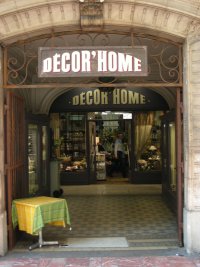
At first glance, the shopping district in Perpignan seems to be quite small and compact. It’s mostly a pedestrian area and even those areas where it isn’t, the streets are narrow enough to really slow down both the speed and the volume of the traffic considerably so it ends up with a very calm feel to it.
After a while though, you realise that there are a whole lot more shops than you first saw because many are set back from the street in little courtyards like the one you can see here. In fact, we’ve only really started to discover the true size of the shopping area recently as many of these little courtyards contain not one but often four or five of the little shops.
They’re all different too. This one is relatively ordinary in that it’s effectively just got a longer than normal entrance hall but others come with statues, waterfalls, and the like. The range of shops is much greater than those directly on the main street where you’ll generally find the international shop brands. It’s in these little courtyards that you find the more unique shops.
Of course, the biggest plus point of this arrangement is that in the Summer, the courtyards are a good deal cooler than the street. Airconditioning isn’t that widespread here at the moment so these little courtyard shops and restaurants provide a welcome break from the intense July and August heat.
Anyway, if you’re here on a visit, keep an eye out for them and explore some of the courtyard shops of Perpignan.
Copyright © 2004-2014 by Foreign Perspectives. All rights reserved.How to be an illegal immigrant in France and avoid deportation
One wonders whether that title will attract the attention of the French authorities but it probably won’t.
We’ve been living here for over three years now with no residence permit (Carte de Séjour) for Wendy and now pretty much accept that she’ll almost certainly never get one. Now, in every other country that would be something of a problem in that Wendy would be deported indeed she would already have been deported. Not in France though.
How come we can do that?
Well, what we did was apply for her Carte de Séjour within 90 days of us arriving here. Actually, we applied for the European version of that ie the Carte de Séjour Europeenne but that wouldn’t really have mattered as it turns out.
The CdS is something of an unusual beast in that the only documents that the authorities are legally allowed to ask for are a passport and a proof of relationship. This being France, they actually asked for around 30 separate documents which we refused to provide and there things stopped. We received no further contact from the Prefecture (who are responsible for issuing it) but did enquire a few times and they said they were awaiting for documentation from us (ie the documents that we had refused to supply).
About a year later, we thought we’d have another go. Different staff this time, and we managed to get somewhat further, eventually ending up with a letter from OMI (the immigration department) asking for EUR 220. As noted above the only things that they can legally ask for are a passport and proof of relationship, there’s no mention of money in the European law because they’re not allowed to ask for any. So, I sent off a letter pointing this out. No response.
Late last year, we made a start yet again. Turns out that they had lost the file (although, funnily enough, they seemed able to refer to some information that it contained!). Anyway, different staff again and we were assured that the permit was on its way. The temporary permit arrived in due course and, as it’s about to expire, we enquired. That in turn triggered off the letter from OMI with a bill this time of EUR 275 so I must dig out my own letter again.
So, if you fancy being an illegal alien in France, it’s really very easy. Once you get here, apply for your Carte de Séjour but leave out a few documents that they’re asking for. This totally throws the system apparently as we were told several times that our file had been put to the one side awaiting the documents which, of course, were never going to arrive. Eventually, your file is put away and nobody is ever likely to follow up on it after that happens.
This relies on one aspect that seems innately French: they obey authority and said authority assumes that it will be obeyed ie if they demand some document, then obviously it will arrive. Step outside that framework and it totally throws the system.
So, if you fancy being an illegal immigrant in Europe, don’t bother with the UK as they’ll deport you for sure. Head for France, apply for your Carte de Séjour but omit at least one document asked for and then just settle into life here.
Copyright © 2004-2014 by Foreign Perspectives. All rights reserved.

