The optimism of French tax authorities
 November 11th, 2007 |
  Author:
 We’ve just received yet another ludicrous bill from one of the French tax offices.
Apparently since we didn’t return the 2005 figures for the business until a few weeks ago and haven’t yet returned the 2006 figures (both thanks to our duff accountants), we must obviously have earned EUR 155,000 in 2006 and therefore they are taxing us on the basis of that. Since 2005 was our first full year with the business we were still investing substantial sums and therefore didn’t make any money at all in 2005 and it’s only in 2006 that things started heading towards a more normal level. Sadly, still a long way short of EUR 155,000 though.
As in all areas, they are incredibly optimistic about the performance of the French post office too and seem to believe that a letter which they printed on October 31st would be delivered within two days even though they didn’t even post it until the 6th of November!
Anyway, we’ll have yet another go at rattling the cage of our accountants to see if they can head off the attempt to collect on one of the largest direct debits I’ve seen (which’ll bounce anyway as the sum involved is actually more than our total income for the year!). Still, at least that should give me the opportunity to change back to paying them by cheque: it’s never a good move to pay any French tax place by direct debit as we’ve found.
Copyright © 2004-2014 by Foreign Perspectives. All rights reserved. Posted in
Anybody for Dusseldorf?
We thought we had settle on Baden-Baden for our Christmas trip but when we started thinking about the flight departure time we realised that it was much too early to be realistic so we’ve restarted our hunt.
At the moment, Dusseldorf is in the front position. It’s a fair sized city in Germany so should have the Christmas markets although seeing as they close up on December 23rd it’s possible that we’ll not actually see them. Still, it seems like a nice city to visit with lots of things to see and a very active tourist office which is always a good sign.
However, there’s also the possibility of a trip to one of the Spanish islands. Downside of them is that the flight times are pretty much all “package holiday departures” ie they’re either very early in the morning or very late at night. Those times pretty much dictate that we’d need a night in a hotel in Barcelona probably both before and after the holiday which, of course, increases the overall cost.
Anyway, we’re hoping to finalise things and actually click on the “book it” button today.
Copyright © 2004-2014 by Foreign Perspectives. All rights reserved.Change of plans!
We dithered around too long with the decision on Aarhus and the flight prices went against us which is a shame as it looks like a seriously cute place to be at Christmas.
Therefore, we’re back to our original thought which is of Baden-Baden in southern Germany. That has the advantage of having loads of choice in terms of hotels so the prices are lower than we’d expected to be paying. It’s also in Germany so we should get to see some of the famous German Christmas markets.
Now, “all” we have to do is to check out the flight prices one final time before we hit the “book it” button…
Copyright © 2004-2014 by Foreign Perspectives. All rights reserved.Opening a non-resident bank account: the general requirements
When I put on my post about opening an American bank as a non-resident, I was amazed at the number of people who checked it out and of those quite a number would like to know how to open a Swiss account.
Opening accounts in both America and Switzerland used to be very easy but with increasing anti-terrorism legislation around the world many banks felt that they could no longer cope with the additional identity checks that the legislation seems to require of them. I say “seems” because it doesn’t really require any more of them than it does of someone living next door to the branch but they generally don’t make a whole lot of money on non-resident accounts anyway so it’s easier for them to use “the law” as an excuse to say no to non-residents.
However, for most “normal” countries all you actually need is a proof of address (ie an electricity or landline phone bill) plus a copy of your passport (usually this must be certified). More obscure countries sometimes ask for an apostile which is more of a hassle to provide.
For America, Switzerland and the United Kingdom, the only things required are the proof of address and passport. In the case of America, 9/11 has meant that the banks prepared to open an account with minimal hassle has reduced drastically but includes Bank of America, Citibank, HSBC and, the ever-present, e-trade. Aside from e-trade, it’s easier to open an account with one of these banks if you already have an account with them in your own country and you may have one already as Bank of America issues a lot of credit cards in Europe under the MBNA name.
In the case of the UK, it’s easier to open a non-resident account with one of the branches in the offshore islands (Jersey, Guernsey, the Isle of Man or Gibraltar) as they are more accustomed to dealing with non-resident accounts. Don’t worry about that “offshore” tag as those islands banking systems are fully integrated with the mainland.
For Switzerland it’s generally fairly easy though some banks will now refuse non-resident accounts due to the expense of running them whilst others will charge you extra. You cannot open an account with SwissPoste these days, despite numerous websites listing it as a possibility and indeed charging you for the privilege of providing you with the information. The major banks (UBS, Credit Suisse) will still permit non-resident accounts and are unlikely to stop doing so as a large proportion of their client-base is non-resident but now charge around SF 75 per year to maintain the accounts if you’re non-resident. However, if you just want a Swiss account by far the best appears to be via SwissQuote which is a free multi-currency account and offers the option of a debit card too (there’s a charge for the debit card).
What are Certified & Apostilles? To get a document certified, you usually just need to go along to your bank and have them stamp the copy and write “original seen” on it. Sometimes banks ask for it to be certified by a lawyer but usually a bank is sufficient for them. An apostille is a certification that the person doing the original certification is known and what’s asked for usually is a “state-level” apostille. This means, usually, that you need to send off your passport to the department of your home government which deals with international affairs (usually called the State Department but is the Foreign & Commonwealth Office in the UK) who will provide you with an apostilled copy.
If you’re interesting in more details on these options, either subscribe to this category here (international-banking) or check out the information on our Expat Banking site. I’ll be slowly but surely working through the various countries here and on that site, the next being Switzerland and after that probably the offshore British islands.
Copyright © 2004-2014 by Foreign Perspectives. All rights reserved.Now we need a hotel in Aarhus, Denmark
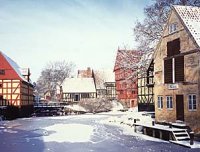 We’ve sort-of decided on Aarhus in Denmark for our Christmas break. Let’s face it, how much more Christmasy could a place look than that in the photo (of Den Gamle By, the open air museum of historic Denmark that’s in the town)?
It also fulfills our criteria of being walkable, having enough to do for a few days, “doing” Christmas and, as I say, it even looks Christmasy.
Normally, we’d book the flights first then look for a hotel but as it’s Christmas we’re checking that there is a suitable hotel before we book the flights this time as it’s easy to be caught out at peak periods like that.
Copyright © 2004-2014 by Foreign Perspectives. All rights reserved.

