September – busier than you’d think
 September 20th, 2007 |
  Author:
 From around June to August we expect to not be able to do anything that isn’t directly concerned with looking after guests. Non-essential administration just piles up, not to be looked at ’til September.
With the lower level of reservations in September, you’d expect that we’d be able to get stuck into that backlog of administration but that usually doesn’t happen ’til October as September represents the final month before the exam for my course so I end up needing to spend more time working on the Spanish which certainly makes up for any lower number of guests.
Also, some of that non-essential administration generally gets to move into the category of “essential” or at least “needing done” when it’s left undone for a few months which takes up the level of work required.
In fact, it’s not ’til well into October that we start to feel that we’re beginning to get on top of things again.
Copyright © 2004-2014 by Foreign Perspectives. All rights reserved. Posted in
The new Suzuki is here!
We figured that when the guy said that it would be here in October, that would really mean early November at best but he’s just called to say that it’s arrived which has thrown us a little.
For a start, we need to get the money organised to pay for it which’ll take us at least a day to do.
Then we need to sort out the insurance. Well, we’ve started on that already in that we got an online quote from MAAF which was getting on for EUR 200 cheaper than the renewal for the Alto insurance was from GAN. Yeah, I know, we don’t have the Alto any more but they still sent out the insurance renewal anyway.
Finally, for a change, I’d actually renewed the car rental early so I’d to cancel that as the new rental period kicks in tomorrow.
Copyright © 2004-2014 by Foreign Perspectives. All rights reserved.A nice but unanticipated surprise
When Wendy and me started experimenting with the possibilities of running paid posts in our blogs it was just coming into the Summer and all the time it seemed to be a fight to get even a $5 post on some sites.
However, as we edge out of the Summer, we’re now in the situation where there are getting on for a hundred opportunities that are open to us each time we log in. OK, granted maybe half of those are only $5 but just a few months ago we were looking at something like a dozen available at any one time and most were $5. Tonight the first 30 are over $7.
That extra choice also brings the advantages that many more of the opportunities fall into the category of “interesting” and that the wordcount asked for can be as little as 50 words for payouts of $15.
What we’re also learning to do better is to check the opportunities available at an appropriate time. All of the main sites offering these paid post schemes are currently based in America so our original approach of writing the paid posts in the morning isn’t a good move as all we got was the leftovers from the night before. Simply checking in the evening instead pretty much doubled our takings overnight and combine that with the additional opportunities available over the Winter mean that we’re doing even better than that as we get more on top of the best strategies to use with these schemes.
Also starting to become noticeable is that the increased number of postings on the blogs is starting to attract other interest in the blogs. Nothing major from that as yet but ’tis early days.
Copyright © 2004-2014 by Foreign Perspectives. All rights reserved.Will your grandchildren be able to see your photograph?
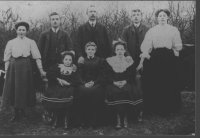 I’m sure that many of you have photos just like this one. It was taken in 1909 and shows my great grandparents and their whole family at that time.
You won’t have terribly many photos like that because at that time having your photograph taken was a grand event and, as you can see, everyone dressed up for the occasion. In fact, that remained the case for quite some time afterwards and it was really only as we edged into the 1950s that the number of photographs taken went up with cameras getting into the hands of amateurs in large numbers.
So, chances are, that you have quite a lot of photos from the 1950s and in increasing numbers through to the 1990s.
And then we all began to go digital and took even more photos than we ever did before.
Yet, how many of those digital photos will be printed? Don’t forget that it’s almost certainly only going to be those that are printed that will be available to future generations. Your grandchildren certainly won’t have anything capable of reading that SD card with your wedding photos on it for sure. Ah, but you wiped it when you copied the photos onto the computer, didn’t you?
But what about those photos on the computer? Have you taken a backup copy of them? You certainly can’t depend on the hard disc lasting forever so if you haven’t a second copy of them, chances are that you’ll lose them sooner or later. Even if you do make backup copies, how good are you at maintaining them? After all, backup discs wear out too. And, of course, there’s the issue that your grandchildren probably won’t be able to read that backup disc anyway, unless you’ve made a point of copying it onto the latest type every 3 to 5 years (don’t forget that USB drives have only been available for around 5 years and probably won’t be around for another 5).
So, despite us taking lots more photos, I suspect that our grandchildren will only have a very small selection of them to look at ie those that we’re printed out over the years.
As for video? No chance. Right through the 1980s you probably recorded your video on VHS but now that those players are starting to be phased out, have you bothered to copy those tapes onto your computer or onto DVDs? If you don’t do it within the next five years or so, you could find that you no longer have something capable of playing the tapes.
Copyright © 2004-2014 by Foreign Perspectives. All rights reserved.The changing mix of guests
The profile of guests that we receive changes quite dramatically throughout the year but it’s September that tends to provide the most enjoyable mix for us.
July and August always seems filled with people racing from A to B and, on the whole, just using us as a waypoint in their travels. In the very peak periods we get a lot of the overflow from the beach resorts which means that there are a fair number of people staying with us who really wanted to be at the beach and this therefore represents the peak of our problem guests too.
Early September sees a dramatic change in the profile. For a start, that coincides with the Visa pour l’Image photojournalism festival and we generally get some journalists staying with us then which always makes for a more interesting time. By mid-September we usually get some people staying for quite a long time using us as a base to explore the region. As we’ve fewer people staying at this time, we get to interact much more with those that are with us which makes for a more enjoyable time: we’ve already had the traditional storyteller from last week and this week it’s a historian who’s been filling in loads of gaps in our knowledge of the history of this area.
Copyright © 2004-2014 by Foreign Perspectives. All rights reserved.

