Perpignan shopping
 April 26th, 2007 |
  Author: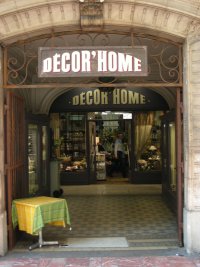
At first glance, the shopping district in Perpignan seems to be quite small and compact. It’s mostly a pedestrian area and even those areas where it isn’t, the streets are narrow enough to really slow down both the speed and the volume of the traffic considerably so it ends up with a very calm feel to it.
After a while though, you realise that there are a whole lot more shops than you first saw because many are set back from the street in little courtyards like the one you can see here. In fact, we’ve only really started to discover the true size of the shopping area recently as many of these little courtyards contain not one but often four or five of the little shops.
They’re all different too. This one is relatively ordinary in that it’s effectively just got a longer than normal entrance hall but others come with statues, waterfalls, and the like. The range of shops is much greater than those directly on the main street where you’ll generally find the international shop brands. It’s in these little courtyards that you find the more unique shops.
Of course, the biggest plus point of this arrangement is that in the Summer, the courtyards are a good deal cooler than the street. Airconditioning isn’t that widespread here at the moment so these little courtyard shops and restaurants provide a welcome break from the intense July and August heat.
Anyway, if you’re here on a visit, keep an eye out for them and explore some of the courtyard shops of Perpignan.
Copyright © 2004-2014 by Foreign Perspectives. All rights reserved. Posted in
How to be an illegal immigrant in France and avoid deportation
One wonders whether that title will attract the attention of the French authorities but it probably won’t.
We’ve been living here for over three years now with no residence permit (Carte de Séjour) for Wendy and now pretty much accept that she’ll almost certainly never get one. Now, in every other country that would be something of a problem in that Wendy would be deported indeed she would already have been deported. Not in France though.
How come we can do that?
Well, what we did was apply for her Carte de Séjour within 90 days of us arriving here. Actually, we applied for the European version of that ie the Carte de Séjour Europeenne but that wouldn’t really have mattered as it turns out.
The CdS is something of an unusual beast in that the only documents that the authorities are legally allowed to ask for are a passport and a proof of relationship. This being France, they actually asked for around 30 separate documents which we refused to provide and there things stopped. We received no further contact from the Prefecture (who are responsible for issuing it) but did enquire a few times and they said they were awaiting for documentation from us (ie the documents that we had refused to supply).
About a year later, we thought we’d have another go. Different staff this time, and we managed to get somewhat further, eventually ending up with a letter from OMI (the immigration department) asking for EUR 220. As noted above the only things that they can legally ask for are a passport and proof of relationship, there’s no mention of money in the European law because they’re not allowed to ask for any. So, I sent off a letter pointing this out. No response.
Late last year, we made a start yet again. Turns out that they had lost the file (although, funnily enough, they seemed able to refer to some information that it contained!). Anyway, different staff again and we were assured that the permit was on its way. The temporary permit arrived in due course and, as it’s about to expire, we enquired. That in turn triggered off the letter from OMI with a bill this time of EUR 275 so I must dig out my own letter again.
So, if you fancy being an illegal alien in France, it’s really very easy. Once you get here, apply for your Carte de Séjour but leave out a few documents that they’re asking for. This totally throws the system apparently as we were told several times that our file had been put to the one side awaiting the documents which, of course, were never going to arrive. Eventually, your file is put away and nobody is ever likely to follow up on it after that happens.
This relies on one aspect that seems innately French: they obey authority and said authority assumes that it will be obeyed ie if they demand some document, then obviously it will arrive. Step outside that framework and it totally throws the system.
So, if you fancy being an illegal immigrant in Europe, don’t bother with the UK as they’ll deport you for sure. Head for France, apply for your Carte de Séjour but omit at least one document asked for and then just settle into life here.
Copyright © 2004-2014 by Foreign Perspectives. All rights reserved.How should you take your holiday money? Cash? Travellers Cheques? Credit Cards? Debit Cards?
 I find that very few people give any thought to how they should take their money when they go on holiday beyond saying they’d like $200 or whatever to the travel agent and thereby getting ripped off. So, to help you decide, here’s a little guide:
The first thing to do is to check what currency is used at your destination. If it’s a mainstream currency such as dollars or euros then it’s best to take the money in that form. However, if you’re going off to less mainstream countries, check which of the principal currencies is most commonly used there (if in doubt, take dollars). Sometimes you can’t get the currency used outside the country or can’t get sensible amounts of it so you need to take dollars or euros eg India used to only allow you to import £5 of their currency which wasn’t really worthwhile getting.
What about taking cash? Well, if you’re in America then it’s always worthwhile to take, say, $100 with you (nothing larger than a $20 bill) and likewise for those living in euro-land. However, if that’s not the currency of the country you’re going to, it’s going to be expensive to convert to the local currency. The other option is to buy some of the local currency before you go but beware that this is usually quite expensive and not as cheap as you would think from the advertisements eg when I bought $150 for about £100 in a shop advertising that the commission was £3.50, the actual charge was over £10 ie 10%. The other main downside of cash is that if it’s stolen, it’s gone as holiday insurance rarely covers cash to any significant amount so if you are taking it, limit the amount to $100 or so. If you buy foreign currency on a card, it counts as a cash advance with all the charges that implies.
Travellers cheques (or travelers checks) are much better than cash in that they can be replaced fairly easily if stolen (keep a note of the numbers, date bought and where you bought them). However, they are equally expensive to purchase and there is often a charge to cash them too. If you’re going to America or Canada you can use dollar cheques as though they were cash in shops (even where they say “no checks accepted”). Again, take them in the currency of the country you’re going to if it’s a mainstream one, otherwise dollars or euros. If you have any left over after your holiday, keep them rather than cash them in your bank as you can use them later (there is no expiry date) and this will save you paying the commission again. If you buy travellers cheques on a card, it counts as a cash advance with all the charges that implies. Make sure that your travellers cheques come with the Visa or Mastercard or American Express brands as others may not be accepted. You can’t use American Express travellers cheques in Cuba or Vietnam nor any issued by American banks.
Credit/Charge cards are used nearly everywhere these days. If you don’t have a card already, you should get one (Visa or Mastercard) even if you only plan to use it for emergencies. Bear in mind that not everywhere accepts them though and also that not all places take both Visa and Mastercard. If pushed, you can get cash on these cards either in an ATM or over the counter in a bank but save this for emergencies only as you’ll get charged a cash advance fee, currency conversion fee and interest. The exchange rate used is much better than you’ll get for either cash or travellers cheques so that $150 that I got would have cost me around £2.75 vs the £10 that I was charged had I used the card in a shop, around £7 had I used it to get cash (assuming I’d paid the full balance when I returned home). In those countries which don’t have ATMs, you can usually still use the card to buy things and get cash over the counter in banks. I say usually because it isn’t always the case eg in India we couldn’t use the card in shops and the banks weren’t practical either.
Credit/Charge cards come in four basic international-use versions. Visa/Mastercard are the most accepted worldwide but note that in some countries one may be more accepted than the other and in particular don’t rely on shops accepting both cards so, if you can, take both types. American Express is the next most accepted but it is widely accepted only in countries that are “American/British” influenced; the one principle advantage it has is that it can be replaced by any American Express office although note that these are not very widespread and may be difficult to get to. One thing to avoid is their Travellers Check Card: best to get one of their proper cards if you can, but only if it’s free in your country. Diners Club is very far behind Amex in acceptance worldwide and not worth paying for. You cannot use cards issued by American banks in Cuba or Vietnam which notably includes MBNA (owned by Bank of America). Discover isn’t accepted outside America. JCB acceptance is patchy: good where Japanese tourists are common, poor otherwise.
Debit cards are almost always branded Visa/Electron/Plus or Mastercard/Maestro/Cirrus and work in the corresponding systems however sometimes you may be issued with a card which can only be used in your own country: check that one of the Visa/Electron/Plus or Mastercard/Maestro/Cirrus symbols are on your card as if they aren’t you probably can’t use the card internationally. Charges are as per credit cards except that you don’t get charged interest on cash advances.
Cash cards are often limited to the country in which they are issued but if they have a Plus or Cirrus symbol on them, you can use them abroad too (this was to have changed in 2008 with the introduction of the Single European Payment Area ie all European cards should be useable in all European countries, but hasn’t [as of 2010]). Charges are usually the same as for debit cards in ATMs. The principle advantage of having a cash card is that they are a lot less attractive for thieves as they can’t be used without the PIN.
Prepaid cards are becoming increasingly popular with travel agents, mainly because they see it as a way of getting even more commission than they can on travellers cheques. Whilst buying these from a travel agent is usually just a way to pay them even more commission, there are some very good ones around which will save you a lot. See our detailed article for more on these. For example, had I got my $150 on a card, the cost would have been close to zero if I had used the pretty much perfect FairFX card.
As well as the above options you also have a choice of providers of the various methods of payment. Travellers cheques may be offered “commission free” by your bank (and the UK Post Office), although note that this is not the same as “free” eg my $150 would have cost around £7 “commission free” (vs £10 with commission).
In the UK, the Nationwide Building Society offer a totally free debit card (ie no transaction fees, no ATM fees, no currency conversion fees) [sadly withdrawn from November 2010] so my $150 would have cost nothing; their credit card is almost as good in that it’s free for purchases but is a bit expensive for cash advances. Most UK cheque accounts come with a debit card with Maestro or Visa Debit facilities. For a UK cash card you seem to be limited to Royal Bank of Scotlands Instant Savings account and the Coventry Building Society’s cash cards (both Plus system).
In America you can get quite a range of systems listed on the card eg NYCE, Star, etc. but in reality the only two that matter are Plus and Cirrus for cash, Visa and Mastercard/Maestro for debit/credit card use as none of the others are accepted internationally. The costs for international use are rarely clearly laid out on American card agreements and smaller banks may not even know how much you’ll be charged for using your card abroad.
If you use one of the banks within the Global Alliance banks (BNPParibas, Bank of Nova Scotia, Bank of America, Barclays, Deutsche Bank and Westpac) you can use machines from one of the other Global Alliance banks without transaction charges (currency conversion fees still apply).
This article is part of our series on holiday planning which covers things like how to book your holiday, how to take your holiday money, what to pack, etc.
[updated October 2010]
Copyright © 2004-2014 by Foreign Perspectives. All rights reserved.A new variant on the Technorati favourites scheme: MyBlogLog
Just when you were thinking that the work is all over, here comes another variant of the favourites scheme.
This one seems a little simpler at first sight, if that’s any relief!
OK, the steps:
- Signup at MyBlogLog, if you haven’t done so already. Recommended anyway as that lets you add things like the “recent readers” widget that you see on this site.
- Join my community by clicking here, then “join community”.
- Write a comment here to let me know you’ve done it.
I will in turn join your community ASAP. If I’ve not done that within two days, post a reminder as a comment to this post.
New entrants:
- AnitokidJoin the Community
- Tech Lock-RahulJoin the Community
- Technix UpdateJoin the Community
- Techno Diary
- Foreign PerspectivesJoin the Community
- Julies Journal – Join the Community
- Nathan Drach – Join the Community
- the.[ED]ition – Join the Community
- Wireless LAN Security – Join the Community
- Make Money with a 13 year old – Join the Community
- Allaedin´s Blog – Join the Community
- Bob Buskirk.com – Join the Community
- Jon Lee – Join the Community
- Everyday Weekender – Join the Community
- Bryan’s Rants – Join the Community
- Shawn Knight – Join the Community
- Kelly Cho – Join the Community
- Reformat This – Join the Community
- Ms. Danielle – Join the Community
- The Man of Silver – Join the Community
- Nate Whitehill – Join the Community
- Leo Chiang – Join the Community
- Garry Conn – Join the Community
- Samanathon – Join the Community
- Mr. Gary Lee – Join the Community
- Feats of a Chilean Dot Com Entrepreneur – Join the Community
The originals:
Why do people convert hotels to B&Bs?
 We’ve been following the progress of two of the hotels that we looked at before settling on the place we’re currently running.The first of these that we saw before we met up with the estate agents was a bit large for us in that it was a 30 bedroom place though very central in Perpigian. They were only selling the business too which put us off it as well. Still, quite a thriving place that had been running since around 1850. Just over two years ago, it sported a big sign that said it had been converted into apartments which seemed fair enough as there are loads of apartments in Perpignan and they generally seem to be doing quite well. Not so the hotel though as within the last year, that plan has been dropped and they’re now doing some serious conversion work on it for yet another purpose.
The second of these was the first that we were shown round by an estate agent. It’s the Hotel Maillol which was a four storey 13 bedroom place that was very much on our shortlist as it ticked pretty much all of the boxes on our requirements list. Not only that but it was going for EUR 300,000 which seemed incredibly good value in that it was pulling something like EUR 100,000 a year (very little of it declared though). Occupancy was good and growing and it was pretty much right in the heart of Perpignan yet positioned at the end of a short street so very quiet.
In fact, the price was so good that there were a number of people bidding on it and it didn’t sell for several months ie just over three years ago. Not too long after that, we noticed that there was some serious redevelopment work being undertaken on it which is still ongoing, much to our surprise. Well, after all it was in such a good location that an upgrade to a more luxurious place was an obvious thing to do and would probably have let them keep the occupancy figures up whilst taking the price from EUR 40-odd to around EUR 60 or so.
However, what they’ve actually done is to convert the place to a B&B as you can see. This means that they can’t run more than five rooms so the income will drop considerably.The 100k income was made up, roughly as follows: open 10 months ie 300 days x EUR 40 per room x 13 rooms x 60% occupancy = 93k. However, as a B&B the equation works out as 300 days x EUR 60 x 5 x 60% = 54k. Ordinarily, a B&B in France can pretty much double their income by doing evening meals but that’s only because most B&Bs are in the country and this one is surrounded by restaurants so they won’t be able to do that.
Actually, it’s a little worse than that as the Maillol had been running for quite a number of years and had built up the business considerably. The B&B version has changed the name, closed for three years (it’s not opened even now) and probably taken the room price up a fair bit. The combination of those factors mean that it’s almost certainly lost virtually all of the customers that the Maillol had so it will be reopening from a standing start and will need to build up to that 60% figure.
The final problem is that the occupancy was quite biased towards the summer with getting on for 100% occupancy of the 13 rooms for three or four months and, of course, since the B&B has only five rooms to play with the income over that period will be much lower.
So, why do people do it? Le Crocodile Rouge is far from unique in converting from a hotel to a B&B and we’re just singling them out because we’d looked at it ourselves.
Well, basically because they’re all aiming to create luxury B&Bs and charge a fortune for them. Snag is that there are limits to how much you can charge. Even quite luxurious chateaux only get away with EUR 100 or so and the luxury B&Bs can generally only charge EUR 70 at best. The biggest problem though is that five room limit because the holiday season in France is very much concentrated on around six weeks during July and August when you’d really need to be able to go to more than 100% occupancy but obviously you can’t do that.
Copyright © 2004-2014 by Foreign Perspectives. All rights reserved.

