Getting cheaper flights on Ryanair
 February 24th, 2007 |
  Author:
  We’re just getting organised for a trip to Belfast next week and have been pricing the flights on Skyscanner as that’s a much, much easier way to pick out the cheap flights compared to trying to do it directly on the Ryanair site.
As usual, it’s cheaper and more convenient for us to fly out of Carcassonne and back to Girona. Most people wouldn’t think of doing that as the historic assumption has always been that return flights are cheaper. That was certainly true in the days before discount airlines but although discount airlines will normally let you book a return ticket, in practice their flights are actually priced as one-way.
So, in our case, if you were flying from Dublin to the Pyrenees, the cheapest thing to do is usually to fly from Dublin to Girona and then fly back to Dublin from Carcassonne. The one complication in this scenario if you’re coming here is that international dropoffs of cars can be expensive so you need to price in that aspect of your trip before committing yourself to booking the flights. However, there are other pairs of airports in the same area where flights in one direction are substantially cheaper than those in the other direction so it’s worth spending 20 minutes or so looking at alternatives to simple return flights.
Another aspect of this is that you can often find that the flight times are more convenient to other airports in the same area in one direction but not in the other one. For instance, we find that the flight from Carcassonne to Dublin departs around 1pm so we can get to Belfast easily enough that day. Coming back, the 6pm flight to Girona is also handy for us as we can also do Belfast to Girona in one day vs the 9am departure for Carcassonne which would require a night in a Dublin hotel.
Don’t forget that Ryanair charge 4.50‚€ for each item of checked luggage these days (it’s more if you don’t declare the bags online in advance) and that the limit is now 15kg per person of checked luggage, 10kg per person of carryon (don’t forget to get some luggage scales to take full advantage of this). Possibly more significant is that children 2 years or older get a full luggage allowance and, crazy at it might appear, two adults with two kids can take 100kg of luggage with no overweight charges.
Copyright © 2004-2014 by Foreign Perspectives. All rights reserved. Posted in
Winter in the south of France: global warming in action?
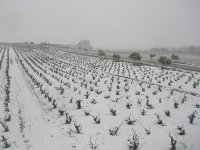
The photo shows the kind of weather we were expecting to get this February but in reality that photo was taken in January 2006.
Naturally, everyone went out and bought snow chains after the snow that you see in the photo. In fact, that is the only day that we have had snow in three years. All that snow landed in a matter of hours one day in January last year, was completely gone the next day and a few days afterwards we were back into the t-shirts.
This year we’ve not had any snow yet and have been in the t-shirts almost every day since February last year. Even the usual wind that comes mainly in the Winter in this area has kept away so we’ve been eating lunch outside nearly all of the time. Even more peculiar is the sight of the locals sunning themselves in the cafés around the town when ordinarily they wear really serious Winter clothing from mid-September through to the following May but with temperatures regularly over 20c for ages, even they are starting to adjust their habits.
Since we’re now equipped with snow chains, we were hoping to head out to one of the local ski resorts a few times over the Winter but even they have only been opened relatively recently compared to the more normal November to March. Net effect is that instead of ski-ers staying with us we’ve had normal tourists looking for somewhere a little warmer than more northerly parts of Europe.
Copyright © 2004-2014 by Foreign Perspectives. All rights reserved.How safe is it to quote your bank account details to strangers?
Many of the B&B and particularly gite owners accept payments by bank transfer to their account. What amazes me is that they never consider that it’s something of a risk to give your bank account details to a complete stranger and even more so when it’s a series of complete strangers.
If you think about this for a while you’ll realise that your bank account details are printed on your cheques but that’s not quite the same as you give cheques to people or organisations that you know. There is a safe way to do this though. Just quote a savings account number and, if you’re really paranoid about it, open a savings account in a bank that you don’t normally deal with.
Every time that I raise this issue, someone quotes their bank manager as having said that it’s perfectly safe to hand out your details in this way and that it’s impossible to take money out using only those details. Haven’t these people even heard of direct debits? After all, a direct debit uses exactly the same information as you quote to receive money. Now, I’m not suggesting that a fraudster is going to set up a direct debit and then withdraw money from your account using it but there are a number of very similar ways to do that. For example, if you care to give me YOUR bank details, I could set up a one-off transfer by simply looking up the address of your bank and faxing them the instructions to do that. You might think that wouldn’t work as they check the signatures, but actually they only check a small percentage of the signatures so it almost certainly would work. Then people say that it must be safe because the electicity company quotes their details for payments so how come someone hasn’t cleaned them out by now? They haven’t because they quote the number of their collection account and collection accounts reject electronic withdrawals.
Since a small business doesn’t have the option of a collection account the safest thing to do is to quote a savings account number as you can’t withdraw money electronically from a savings account.
Copyright © 2004-2014 by Foreign Perspectives. All rights reserved.Language and culture: are they inextricably interlinked?
I participated in quite an extended debate on an excellent English language website written by a French expat living in America recently.
Along the way a number of issues were raised which I never really thought a great deal about before and it was interesting to see a French view expressed on many of them. One in particular was their view that you just couldn’t separate language from culture. From a French perspective the two are indivisible: you can’t have French culture without it being in the French language.
In the English speaking world the two are quite separate. India clearly isn’t an Anglo-saxon culture yet they speak English and even Hong-Kong remained very much a Chinese culture even when it was a British colony. Yet, the French would seemingly argue that both India and Hong-Kong are Anglo-Saxon.
Even the French world has examples of the separation these days. France24 put out a full English-language news service yet it is still quite clearly a French channel. Perhaps the most interesting example though is of the TV series Nikita which although based on the French film of the same name was made entirely in English yet still came across as a French series.
The other thing that I found odd was that they seemingly considered all English speakers to be Anglo-Saxon which I suppose is reasonable if you start with the premise that language and culture aren’t separable.
It was also a little strange to come across a group of people from a fairly major language grouping who were so defensive about their language. You’dt from a group speaking very much a minority language, not from speakers of one of the top 15 world languages. For instance, they have a law that says all government services must of be offered in French. OK, it’s France so you would expect them to be in French but why should that require a law?
Copyright © 2004-2014 by Foreign Perspectives. All rights reserved.Buying a house in France: part 8: visas & immigration: European citizens in established European countries intending to work
We introduced the various terms involved in the area of visas, residence permits and immigration in our last entry. Now it’s time to take you through the simplest of these.The simplest case of immigration to France is where you are a citizen of one of the established European countries and are coming to France to work as either an employee or for yourself. Established European countries are those that have been in the European Union for more than four years; if it’s been in the union for less than four years then transitional arrangements may apply.
This section also applies to you if you are French and if you have dual/multiple nationalities so long as one of those nationalities is European.
If this applies to you and all your family, then you just need to come to France and there are no documentation requirements at all beyond those which a French citizen would need to meet. In practical terms, the French must treat you as though you were French and had always been French. This doesn’t mean that there is no paperwork to be done though! For example, if you up a business then you will need to register that business just as a French person would have to (see our section on employment for more information on this).
Although the heading says “intending to work”, you can also move on the same basis if you are receiving a pension or other income sufficient to support yourself and your family. In practical terms, this means an income of something like 1000‚€ or more per month but that’s largely irrelevant as the French don’t seem to apply this criteria.
If you’re in one of the new European countries for which transitional arrangements apply. In practical terms, so long as you have a job lined up there doesn’t seem to be any distinction between the new and the old European countries.
Fortunately, this section covers 90% or more of the immigrants to France from other European countries. In our next edition, we’ll look at another simple case which covers those who aren’t European but have a European spouse.
Copyright © 2004-2014 by Foreign Perspectives. All rights reserved.

