Archive for the ‘Travel’ Category
 Posted in
Airport security in practice
 September 9th, 2006 |
  Author:
 When the panic button was pressed in the UK in August, the effects were seen here the next day, but did it have any lasting effect?
The small shop in our local airport doesn’t sell much wine or honey these days as it mainly sold those whilst people were wandering around after they’d checked their luggage. The wineries are none too pleased as there was a considerable amount of wine taken home as hand-luggage before the scare. A pilot who was staying with us recently thought that he’d be able to get his little case of wine onboard by showing his pilots license ’til I reminded him that the guys that flew the planes into the twin towers also had a pilots license.
I was expecting at least some increased level of security on my flight from Barcelona to Santiago but if anything the security was much lower than I’d been expecting. Thanks to the wonders of online check-in I was never even asked if I’d any sharp objects in my luggage, if I’d packed it myself, etc. In fact, the only contact that I had with anyone prior to boarding the plane was when someone had a fairly cursory glance at my passport just before I walked out onto the tarmac.
What about the increased security in the UK airports though? Delays in flight arrivals are much more common as the increased security level means that minor discrepancies result in flights being held until the source is identified. Earlier in the week one of the flights was an hour late because someone had dropped their boarding card for instance. Is that crazy? No, because the effect of the error was that it looked like someone who should have been on board the flight actually wasn’t.
What doesn’t seem so sensible is the very arbitrary reduction in the maximum size of carryon luggage. Is it really a co-incidence that the size corresponds to that of a laptop bag? I doubt that very much. The other aspect is that it now takes much longer to collect luggage from flights as almost everyone has checked baggage these days (quite a nice little earner for the likes of Ryanair with their charge for checked luggage).
I also can’t see that the security staff will maintain their vigilance in picking out potential terrorists. In todays world what they will more than likely do is to stop and question anyone who looks Muslim. OK, I will grant that this tactic will presumably pick out a higher proportion of potential terrorists than just picking out people at random in that the threat is, in practical terms, originating from the Muslim world. However, it’s also going to alienate Muslims in general and it may well sway the views of some middle of the road Muslims towards the anti-west mind-set which isn’t in anyone’s interest.
To indicate how ridiculous this kind of method of picking out potential terrorists can be, consider the flights from Belfast to London 10 years ago. They were all met by a couple of officers from the Metropolitan police. The ONLY people that they stopped to question were men walking by themselves. I used to travel back and forth from Belfast to London quite frequently so was able to experiment with this. If I was travelling on my own, all that I needed to do to avoid being stopped was to walk alongside a woman. Any woman: I didn’t need to speak to her, or do anything other than walk alongside her. I wonder how long it will be before the security people start picking out their subjects for questioning on the basis of some equally silly thinking to “single guy alone = terrorists”?
Arnold
Copyright © 2004-2014 by Foreign Perspectives. All rights reserved.Using credit cards in French petrol stations: one step forward, two back
 Whilst most countries in the world tend to move forward in terms of the use and usability of technology, it’s often the case in France that it’s one step forward, two backward.
Case in point: just a few weeks ago we noticed that Carrefour had, at last, started to accept foreign cards in their petrol stations and we thought that this was the first sign of the “promised land” of being able to use foreign cards in all petrol stations. Sadly, no. A matter of days later, the only petrol station that we know of within about 100 miles of us that did accept foreign cards on Sunday installed brand new petrol pumps and no longer accepts foreign cards!
This seems particularly short-sighted in light of the experience of the petrol station closest to the airport. Last year, it was “upgraded” from a manned station to being fully automated. Previous to that, there were always queues of cars getting petrol. Now, there are never any queues because the bulk of their potential customers can’t use the pumps anymore. Funnily enough, the pumps offer the choice of four languages but just don’t accept any foreign cards.
Why is that though? After all, even in France the old style cards will be phased out by the end of this year and just about all the other countries in Europe seem to be issuing new chip & PIN cards.
Petrol stations aren’t the only example of this craziness. The ultimate expression of that is the village of Tautavel which lives on tourism. Last year, due to the complications that the combined introduction of foreign chip & PIN cards plus the various banks upgrading their machines to accept them, all the tourist shops decided to stop accepting cards altogether. So, what happens now if you arrive at the till will EUR 100 or so of souvenir pots etc. is that they’ll point you towards the cash machine across the road. Now, for French people, that’s fine as they have debit cards and therefore don’t pay any more to withdraw cash from the ATM than they would to use their card in the shop BUT almost all foreigners use credit cards and therefore would have to pay cash advance fees plus interest.
Overall effect? Well, it’s fine for the French or for those who are buying small quantities of souvenirs but the customers wanting to make larger purchases just walk away. The shops can’t understand why: after all, in their eyes, there’s no difference in cost for the customer as they’re pretty much entirely unaware of the extra costs they’re asking their customers to pay.
The other consequence is that several of the shops are looking rather shaky and seem sure to close. I suspect that the same could easily happen to the airport petrol station too.
Arnold
Copyright © 2004-2014 by Foreign Perspectives. All rights reserved.Learning Spanish in Galicia with the Open University
I spent the third week of August in Santiago de Compostela on an intensive residential as part of the Open University’s Spanish programme.
When you get all the documentation about the residential school a few months in advance the immediate reaction of most people is “Ahhhhh!!!! I can’t do this!” but in reality the relaxed atmosphere makes it seem relatively easy once you get going on it. As it’s part of a second year university course, right from registration on Saturday through to checking out on Friday, everyone is quite insistent that Spanish is spoken all the time. It might seem hard at the time but the idea is to force you to think in Spanish and to do that the best approach is to “live” in Spanish as far as possible.
As it was going to be quite a packed week, I went on the Friday which made for quite a relaxing Saturday (or would have done if I’d not walked right round Santiago in the morning) as the enrollment doesn’t start ’til after 2pm and the course doesn’t formally start until 7pm with the introductory lecture and first introductory class. Usually the first class seems to be amongst the hardest as if you’re not that fluent it’s often difficult to keep the Spanish operational late into the evening.
Sunday was quite short and not really as good as it could have been. In the French residential you have to write up a questionnaire in the morning and then go around the town interviewing people but in the Spanish one, we were given the questionnaire which I didn’t find to be nearly as useful in terms of learning and using Spanish. One unexpected problem we found that the very high proportion of tourists on the Sunday meant that we were often asking tourists the questions rather than the locals.
For the rest of the week, classes generally run all morning with the afternoons being effectively free though included in that “free” time is a visit to the cathedral and La Coruna. Surprisingly, Friday was actually quite a full day as it usually winds down with people leaving for their flights but the departure times in Santiago are quite convenient for the course so just about everyone was there until lunchtime.
Was it a good course though? I think so. Yes, it didn’t seem intensive but with around 20 hours Spanish classes in a week that’s what it was. The relaxed atmosphere makes it feel easier than it is but you do work hard and are tired at the end of each day. One thing that did surprise me was that all of the lecture rooms that were available to us were very much lecture rooms. The fixed rows of seats don’t really fit in that well with modern language teaching as it tends to involve a lot of group work and therefore moveable tables are much better. I assume that this seating arrangement is typical for Spanish universities but don’t really know for sure.
Strangely for a language course, the OU doesn’t have a residential for the final year of the Spanish course when most people feel that they’d need it most. Net effect is that a group of the tutors got together and set up what is effectively the OU residential in Alicante. Unfortunately, it isn’t part of the OU and therefore they can’t really advertise it as such so it’s a much smaller affair and only runs one week. It’s also quite expensive at around £500 for the week. However, there are alternatives to that and indeed the University of Santiago runs two week courses for around £400 so, at the moment, I’m thinking that I’ll do that next year: almost twice as much Spanish for £100 less seems like a good deal to me.
Copyright © 2004-2014 by Foreign Perspectives. All rights reserved.Santiago de Compostella – what is it really like?
Santiago is world famous for its magificent cathedral and the thousands of pilgrims that it attracts throughout the year, but what is the town really like?
In fact the section of the town that is most famous is actually quite small. It’s very easy to walk right around the famous section in under an hour if you don’t dawdle and in fact almost all of the tourists and pilgrims (it’s often difficult to distinguish between them) see a very small portion of the town which is consequently incredibly crowded. Even in the evening you can find it difficult to get a table in a restaurant, despite the large number of them in this area.
However, it doesn’t take much of a walk to get outside the touristy parts of the town. Almost everyone appears to cross the road from the park and walk along the Rua Franco to the cathedral which makes this, of course, one of the most crowded streets in the town. But, if instead of going straight towards the cathedral, you turn right within a few hundred yards you’ll find yourself in the modern section of the town which is full of “normal” shops and almost completely devoid of tourists. You almost get the impression that the inhabitants of the town like it that way as you’re immediately into a very Gallician area with signs in the local language rather than Spanish.
Whereas the tourist sections are lively at night with street theatre, in the modern town you don’t get any of that and the streets are almost deserted when it gets dark. If you’re looking for nightlife it seems to be best to stick to the areas around the cathedral as we found that most things seemed to close down around 10pm in the new town with just a few things such as some restaurants and cinemas staying open a little later than that. If you want to watch a film, bear in mind that in the new town all the films are in Spanish and there are no subtitles.
If you’re looking for a quiet stroll in the evening, try some of the numerous parks in the new town. In many cases, you’ll find that you have the places pretty much to yourself which makes a welcome change from pushing through the crowded streets in the cathedral area. There aren’t nearly as many restaurants in this area but it’s very easy to get a table and, of course, you get much more authentic Gallician food than you’ll find in the restaurants in the tourist area.
Copyright © 2004-2014 by Foreign Perspectives. All rights reserved.Protests in Gallicia against the fires
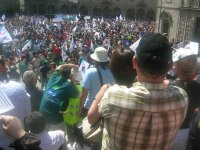 You may have seen news of the extensive fires in the Gallician countryside over the last couple of weeks.
Naturally, in the summer fire breaks out in numerous areas of Spain but a considerable number of these were set deliberately. I was staying at the University of Santiago and the fires came within about 1km of the university campus which is rather too close for comfort. Think of the heat and smoke coming from a log fire in your home and magnify that 1000 fold and you’ll get some idea of the problems that this causes. Surprisingly though, some homes on the hill opposite the university seemed to be virtually intact despite having been surrounded by the intense forest fires. I wonder though if they were quite so unscathed as they appeared to be when seen from a distance?
The fires were largely spent by the time I arrived but by that time the population had begun to hold a series of protest rallies. Interestingly for me was that they felt very much like the protest rallies that you see now and again in Northern Ireland so I guess this is another sign of the celtic heritage of the region. Even the slogans were quite similar with “Ulster says No” translating to “Nunca Mais” (Never Again) and, of course, the use of bagpipes. All that was absent was the police in riot gear!
Arnold
Copyright © 2004-2014 by Foreign Perspectives. All rights reserved.

