Archive for the ‘Relocating’ Category
 Posted in
French websites
 January 16th, 2007 |
  Author:
 French websites are very interesting from several angles.
For a start, they’re almost all entirely in French. You’re probably thinking, why wouldn’t they be, after all French is the language of France, isn’t it? Well, yes, but the French don’t use the Internet that much so most people looking at the site won’t be French. Last year, the local Chambre of Commerce paid serious cash for a brand new website to attract tourists to the area yet it’s entirely in French when the majority of tourists coming here aren’t French and neither speak nor read French particularly well.
In fact in some cases French sites clearly don’t work and have obviously never been tested. For instance, it’s actually impossible to register for a job interview on the ASSEDIC site if you’ve not had a job before. One reason that we’re registered on very few French listings sites is that few of them actually work; when we looked up one of the local hotels a few years back we found that only one out of about 4 or 5 of the websites that they were listed on worked.
The other thing that’s quite typically French is to have a beautiful website which is totally invisible to google et al because it’s all graphics. For instance, the brand new website for the Sense winebar in Perpignan looks lovely but try turning the graphics off and all you get is the empty screen which is seen by the google bots.
Where there are more sensible developments are with the utilities and banks which generally provide at least a minimalist website in English and you can even phone EDF and France Telecom in English.
Copyright © 2004-2014 by Foreign Perspectives. All rights reserved.January in the south of France: house hunting season in France
At the start of the month it’s the French that generally fill the hotels up with their reveillon celebrations. Prices for these can reach as high as EUR 80 for very modest affairs which is mainly down to the French not trusting places with lower prices to do a réveillon meal.The following week, it’s the turn of the Spanish with their Day of the Kings holiday, the equivalent of Christmas for everyone else. In Spain, there are celebrations all over the country and on the day itself (January 6th) Spain is closed so there is quite an influx of Spanish shoppers in France which reverses the normal traffic.
And then usually it’s all quiet until March which makes this period one of the best for house hunters in France.
House hunters in France have been rather thin on the ground over the last year but the numbers seem to be going up with a vengeance as we move into 2007 for a combination of reasons.
Adding to the existing four daily flights from Paris to Perpignan by AirFrance and the Ryanair flight from Stansted, over the last year both FlyBE and BMIBaby have started flying from Birmingham, Manchester and Southampton daily which has obviously increased the number of prospective house hunters considerably and indeed one Cornish couple have just left us after an initial scouting trip and they expect to be back later on in the year for a full scale house hunting visit. Not only that but the Paris to Barcelona highway had the final bottleneck eliminated with the completion of the bridge at Millau just over a year ago and work is progressing quickly on the improvements to the train lines to allow full speed TGV access to Perpignan. So it’s considerably more accessible than it has been but if you’re considering a house hunting trip, do it soon as the prices, whilst still fairly low, are starting to catch up with other more accessible parts of southern France.
Aside from the cheap flights and accommodation at this time of year for house hunters it’s almost perfect because the villages and towns are at their normal level of activity. In many cases, people buy property in coastal resorts or even some cute inland villages having only seen them in the Summer and find that what seemed like a perfect location is almost completely dead even just a little out of season never mind in the Autumn or Winter. Not a problem if you’re only looking for a Summer house in France but many people buy places with a view to retiring here in due course.
So check out the house hunting in January: definitely amongst the best times of the year to see the place as it really is most of the year.
This is part of our guide to the Pyrenees.
Copyright © 2004-2014 by Foreign Perspectives. All rights reserved.Buying a house in France: part 2: becoming fluent in French
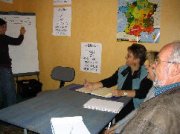 We introduced our series on buying a house in France in the last part of the series. Planning your move is essential, the next most important thing is acquiring fluency in the language.
This aspect will take you the longest period of time so it’s best to start work on it first. You might think that it’s an impossible thing to do or that it will take many years. Fortunately neither is the case and even if you are starting from no knowledge whatsoever of the language you can become fluent in as little as two or three years.
When I started off with the French after a long break, I was expecting it to take many years before I became fluent but in reality it was only two and could have been done in one. So how did I do it?
I was starting off from a very rusty O-Level (GCSE) so thought that a couple of years of night classes would be best to get my French back up to speed again after such a long break. Those night classes (2 hours a week for 20 weeks per year) took me up to roughly A-level conversational French but that’s not really fluency in the sense that I couldn’t chat in French.
The next step was to join a conversation class with the Alliance Francaise in September. I thoroughly recommend them but you need to be aware that the classes can be incredibly intimidating initially and you have to be stubborn enough to just keep going regardless of how dreadful you feel you are doing.
The Alliance Francaise classes operate at a much higher level than A-level French. At A-level you are expected to be able to talk about a range of topics if you know what the topic is in advance (hence you can’t chat at that level), the level above at that is to be able to chat about a range of topics which you don’t know in advance. Alliance Francaise operates at the level about that ie you should be able to talk about anything without being told the topic in advance.
Now you might think that there is absolutely no way you could do that. However, even a GCSE gives you all the vocabulary and grammar that you need. What the Alliance Francaise classes do is to force you to use that knowledge in real time and that’s why the classes are so intimidating at the start.
Anyway, the following September I started the Open University course L120 and did the related residential LXR122 that July. Whilst the Alliance Francaise classes are brilliant for getting your current level of French working much better they aren’t very good for improving your level of French so that’s where the Open University courses come in.
Right in the middle of the residential it was like someone had flicked a switch and all of a sudden I heard the French as though it were English. I’d to meet some French relatives after the course that Summer and was able to chat to them with no effort ie fluently.
So to get to fluency, one route is GCSE, Alliance Francaise and then Open University first year with the residential. I’m sure that’s less time than you expected!
The one thing that is key with learning French is to be stubborn enough to keep going to the classes regardless of how dreadful you feel you are doing. Yes, you will be really bad at the start but the trick with learning languages is to keep going regardless. That’s one reason why I feel it’s essential to be in a class rather than attempting to learn the language on your own. On your own you can easily grind to a halt on some topic which you just can’t understand but in a class environment, the class will force you to simply skip that topic and move on which is OK because you’ll come back to it later.
Our next issue is on staying fluent which, if anything, is more difficult as it feels much more like a chore.
Copyright © 2004-2014 by Foreign Perspectives. All rights reserved.Buying a house in France: part 1: planning
 As the number of house buyers looking at France seems once more to be on the increase, we’re starting a little series today which will take you through all the steps from when you first have the idea of moving to France or just buying a Summer home here to settling in.
Over the course of our little series, we’ll cover all aspects of buying a house in France in enough detail to let you do it with the least amount of hassle. If you’ve already started you can skip a few chapters so to speak by consulting our Moving to France guide and if you’re even further ahead and beginning to settle in our Living in France guide. If you need any services, try our expat services directory; it may be smaller than yahoo but it’s a lot easier to find the services that you’ll require in it.
So, once you’ve decided that you’d like to buy a house in France, where do you start?
Buying a house in France or any country other than your own is a major undertaking and you should never underestimate the amount of work that it will involve. Not only is the language different but the processes that you need to go through are different from those in your own country. Moreover, if you are intending to live full-time in the house then you’ll need to organise moving your furniture from one country to another which is never cheap. That’s before you even consider that chances are you’re moving from somewhere in a town or city to somewhere in a country and even doing that in your own country can be a bit of a culture shock before you start adding in the complications of a new language, culture, social security systems and the like.
With so many things to consider you might be thinking that it’s an impossible task. It’s not, but you do need to put a fair amount of effort into the planning of your move if you want it to be a success and that’s where this series will help you as it will cover all aspects of buying a house in France over the course of the next few months but in bite-size chunks so that you’re not overwhelmed by it.
Planning your move is very much key to a succesful move to France. To do this you will need to sit down and sketch out all the things that you need to do and when they need to be done. The list will be very long, but don’t worry about that, just try to make sure that everything that needs to be done is on the list and it will all work out in the end.
Anyway, that’s probably enough of an introduction for now. Over the coming weeks, we hope to provide you with information on everything that you need to know in order to plan your move to France.
In our next installment we’ll be covering the one thing that will make most difference in easing your transition to France: the language.
Copyright © 2004-2014 by Foreign Perspectives. All rights reserved.French laundry service
 We realised quite quickly in our first Summer here was that we couldn’t cope with doing the laundry once we’d more than 2 or 3 rooms occupied, a problem made worse by the relatively high proportion of overnighters that we had that first year.
The normal landries couldn’t cope with the volume that we needed and were quite expensive so we started looking for an industrial laundry or rather an Laverie Industriel which seemed likely to be the proper phrase for such a thing in that the little laundries were called laveries. We looked, and looked and looked without success. That didn’t really surprise us as the organisation of the French phone book is unbelieveably bad and the yellow pages can only be used to look up the phone numbers of places when you know which town or village they’re in. So we struggled on for a bit and the backlog of ironing built up.
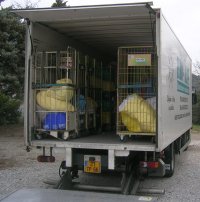
Eventually, one of the local hotel owners called round to say “hi” and we found out where the laundry was. It’s not called a laverie industriel though, it’s called a blanchisserie as you can see from their truck.
One of the things that the laundry deliveries makes quite obvious is that France basically shuts down over the Winter. That changes the running order for laundry volume considerably as we don’t close therefore our little trolley is filled to the top unlike those of the larger hotels which, as you can see, are only about half full.
Anyway, be aware that even if you know the French word for a small version of something, it doesn’t always follow that you can work out the name for the larger version of the same thing.
Copyright © 2004-2014 by Foreign Perspectives. All rights reserved.

